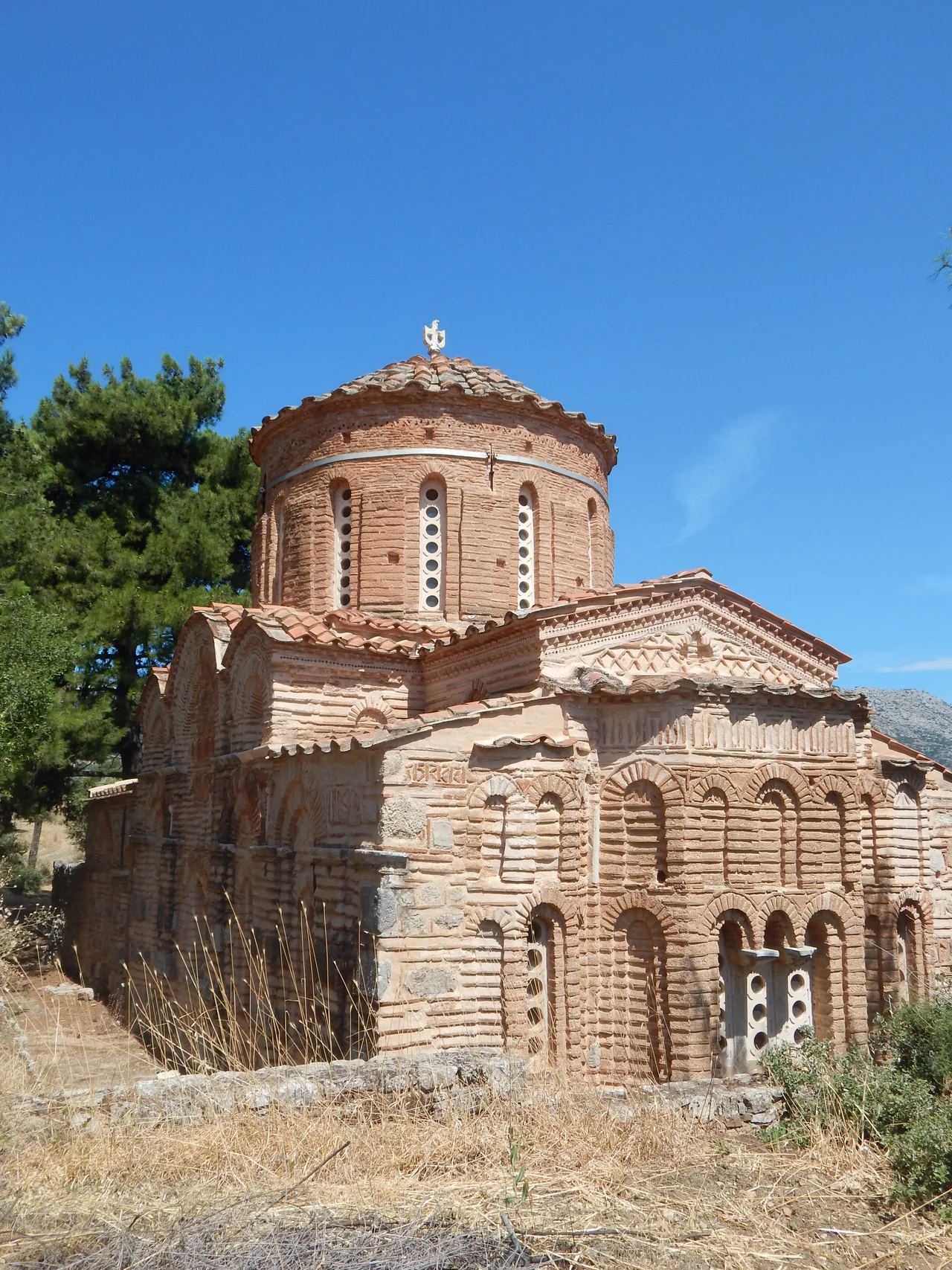

Panagia Krina, Chios
Walk out from the village of Vavyloi, through groves of mastic trees and citrus, and the church appears almost without warning: a compact, high-domed building of dressed stone standing alone among the fields. Panagia Krina has kept its position here for more than eight centuries. It is small enough to take in at a glance, yet it belongs to the same lineage as the most important Byzantine monument on the island, and that kinship is the whole reason it exists.
A Copy of Something Grander
Chios has one architectural masterpiece above all others: Nea Moni, the eleventh-century monastery whose church was raised, by tradition, with imperial patronage from Constantinople. Its design is of a rare and demanding type, the so-called island-octagon, in which the dome rests not on the usual four piers but is lifted on squinches across an open, columnless interior. Panagia Krina is one of the few buildings anywhere to repeat that ambitious plan in miniature. The great dome, broad in proportion to the body beneath it, is the church's defining feature. To stand inside is to understand the original at a more intimate scale, as if a cathedral idea had been distilled into something the size of a chapel.
The Founders in the Walls
This was no anonymous village shrine. The church was raised in the late twelfth century by Eustathios Kodratos and his wife Eirene Doukaina Pagomene, members of the Byzantine imperial court whose family names still carry the weight of empire. Founders like these expected to be remembered, and they were: an inscription, the dating of the templon screen, and the painted programme all point to a building completed around the closing decades of the 1100s. Scholars have parsed the surviving letters and numerals for over a century, debating whether the carved date of 1287 marks the church itself or a later burial in the southern arcosolium. The uncertainty is part of the building's character. It does not announce its age so much as invite you to read it.
Painted Across Generations
Inside, the walls carry layers of fresco rather than a single moment of decoration. The oldest paintings reach back to the church's first century; later hands added to them as the building passed through the medieval centuries. Among the images is an unusual Deesis in the narthex that has drawn the attention of art historians, and an allegorical scene of the Life of Time that an earlier scholar singled out as far back as 1967. Some of the finest panels were eventually lifted from the plaster and carried to the Byzantine Museum in Chios Town for safekeeping. What remains on the walls is dimmer, but it is still in place, still in the building it was made for.
A Monastery That Outlived Its Order
Krina was not always a lonely country church. For centuries it functioned as a working monastery, and an inscription in the outer narthex records a monk and abbot named Ioakeim, dated to 1747, when the exonarthex was added. That later porch marks roughly the end of monastic life here. The monks eventually departed; the orchards crept closer. The dome that crowns the church today is partly reconstruction, rebuilt after the earthquake of 1881 brought the original down, one of the seismic shocks that have rattled this stretch of the Aegean again and again. The building has been knocked about and patched, and it is still standing.
From the Air
Panagia Krina lies at 38.316°N, 26.082°E in central Chios, in farmland between the villages of Sklavia and Vavyloi, a few kilometers southwest of Chios Town. The nearest airport is Chios Island National Airport (LGHI), with Izmir Adnan Menderes (LTBJ) across the strait in Turkey. The single high dome is the church's most recognizable feature from above; survey at low altitude in clear morning light, when the stonework stands out against the surrounding orchards.
Nearby Stories
- Psara 10 km away
- Eğlenhoca 33 km away
- Destruction of Psara 38 km away
- Agios Kirykos 41 km away
- St. Helena Church 43 km away
- Temple of Artemis at Ephesus 57 km away
- Ftelia 62 km away
- Akhisar Museum 108 km away