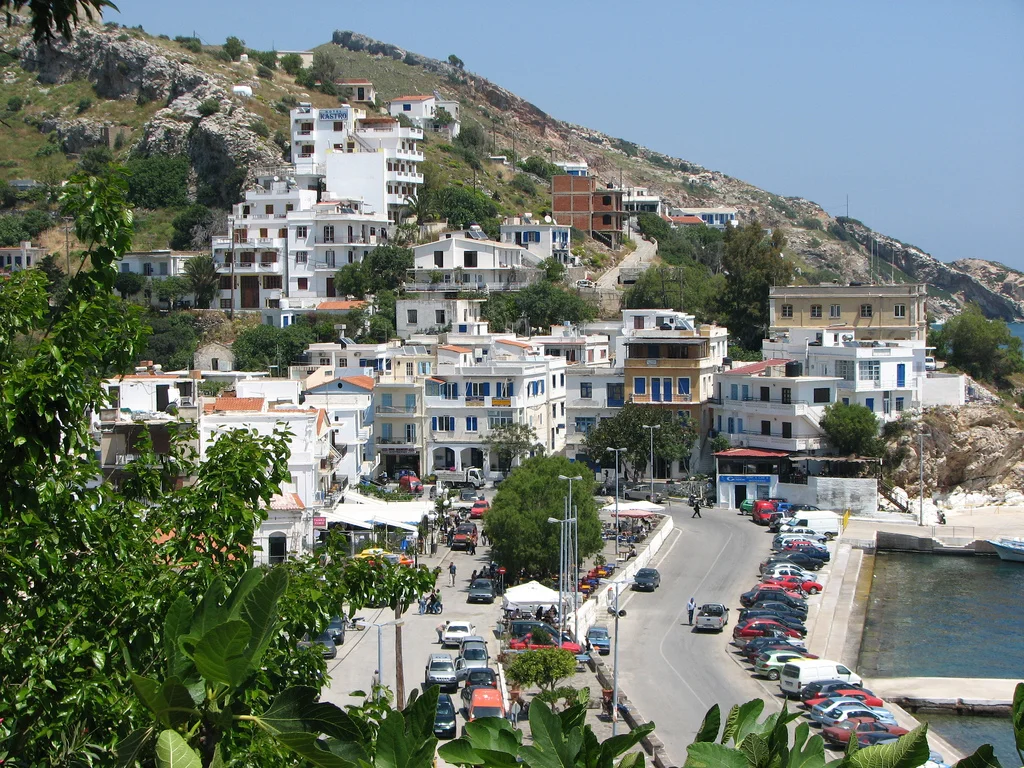

Agios Kirykos
The town is named for a martyr who died at the age of three. Saint Kirykos, or Quiricus, the youngest saint of the Eastern Orthodox Church, was killed in Asia Minor as a small child, and the cathedral of this little harbour town on Ikaria is dedicated to him. It is a strange and tender thing to build a capital around the memory of a toddler, but Agios Kirykos has always been a place of contrasts: a sleepy plateia by day and a town that does not sleep at all by night, calm summer seas and winters so violent they reshape the shore.
Capital of Ikaria
Agios Kirykos is the administrative capital of Ikaria, the island in the North Aegean named in myth for Icarus, who fell from the sky nearby. The town had 2,958 residents at the 2021 census, with 3,565 in the wider municipal unit, which also governs the small Fourni islands offshore. It shares Ikaria with two other municipal units, Evdilos and Raches, and of the three it holds the most people on the least land. Set on the island's southern coast, it is the chief port and the seat of government, the place where ferries dock and official business gets done, a working town rather than a resort.
The Radioactive Waters
Just five minutes east lies Therma, and Therma is the reason people have come to this corner of Ikaria for over two thousand years. Its saline hot springs hold the largest concentration of radon in Greece and rank among the most radioactive springs in the world, their waters surfacing at scalding temperatures. The curative use of these springs was recorded as far back as the 4th century BC. The word radioactive sounds alarming to modern ears, but bathers have soaked in these mineral pools for millennia in search of relief from aches and ailments, and they still do. It is one of the quiet secrets of an island famous for the longevity of its people.
Two Faces of the Sea
The weather here lives a double life. In summer the water is usually calm and it hardly ever rains, with clear skies dominating day after day. Then winter arrives and the town becomes another place entirely. Constant storms pelt the coast, the waves grow too rough to swim in, and locals retreat indoors. The seas are so fierce that no sand can settle on the beaches, leaving only rock, and the town finally built a breakwater of massive concrete tetrapods to throw back the worst of the winter surf. Snow dusts the mountains above but almost never reaches the town itself. Few places in the Aegean swing so completely between serenity and fury.
Late Nights and Long History
Life in Agios Kirykos runs on its own clock. The plateia, the town square ringed by restaurants and public buildings, comes alive from mid-morning to early afternoon, empties for the customary nap, then surges back between eight and eleven at night as families dine and the young gather before heading to the town's club. Bars stay open until five in the morning. The town carries its history lightly: a brass band has played at feast days since 1928, the archaeological museum, once the local high school, guards pottery and arrowheads from an ancient mountain watchtower, and every July the place hosts an international chess tournament fittingly named Ikaros. For a small port at the edge of Greece, it keeps remarkably busy hours.
From the Air
Agios Kirykos sits at approximately 37.61°N, 26.29°E on the southern coast of Ikaria in the North Aegean. From the air it appears as a compact harbour town on a rocky, largely beachless shore, protected on its seaward side by a breakwater of concrete tetrapods. The spa town of Therma lies about 3 km east, and Ikaria National Airport (LGIK) is roughly 25 minutes away by road. Ikaria's mountainous spine rises steeply behind the town. Summer brings calm seas and clear skies and excellent visibility; winter brings violent storms and rough seas along this exposed southern coast.
Nearby Stories
- Kouros of Apollonas 14 km away
- Panagia Tourliani 26 km away
- Emporio, Chios 46 km away
- Temple of Athena Polias (Priene) 53 km away
- Panagia Hozoviotissa Monastery 54 km away
- Temple of Artemis at Ephesus 59 km away
- Greek Islands 63 km away
- Bodrum 68 km away