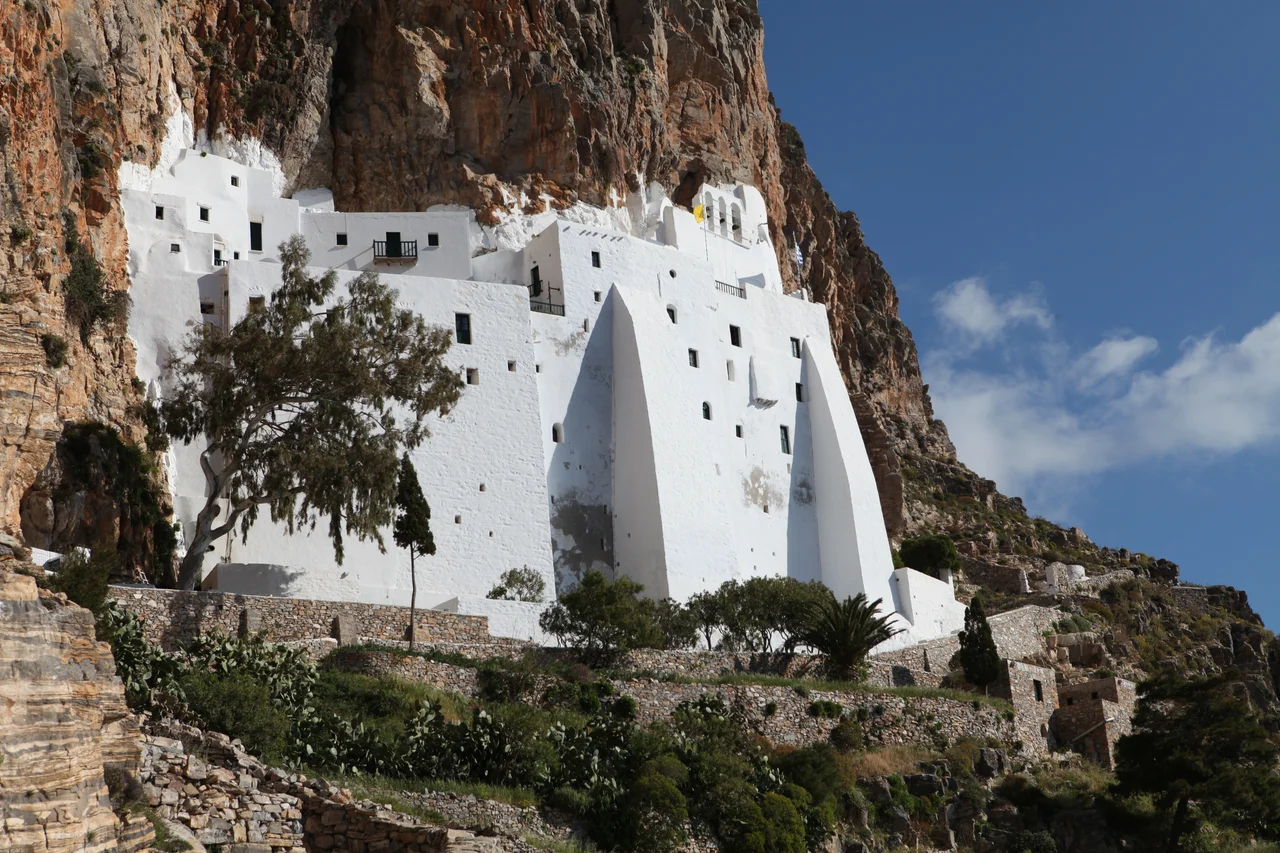

Panagia Hozoviotissa Monastery
From the sea it looks impossible: a thin band of blinding white pressed flat against a gray cliff face, as if a brushstroke of paint had been laid across the rock and somehow turned into a building. This is the Panagia Hozoviotissa Monastery, and the illusion holds even up close. It is forty meters long but barely five meters wide at its widest, eight floors stacked vertically into a crease in the cliff three hundred meters above the water on the steep southern coast of Amorgos. To reach it you climb. There is no other way.
An Icon Carried by the Sea
The monastery's strange name comes, by way of generations of mispronunciation, from Hozeva or Koziva, a place in what is now Wadi Qelt near Jericho, where an Orthodox monastery of Saint George once stood. Local tradition tells that during the Byzantine Iconoclasm, when sacred images were being destroyed across the empire, an icon of the Virgin escaped by sea and washed ashore in the bay of Agia Anna, just below the cliff. The faithful built the first monastery here in the 9th century to house it. Whether the icon truly drifted across the eastern Mediterranean or not, the story has anchored this place for more than a thousand years.
An Emperor's Seal
The monastery steps out of legend and into documented history in 1088. In that year the Byzantine emperor Alexios I Komnenos, who reigned from 1081 to 1118, issued a chrysobull, a decree sealed in gold, granting Hozoviotissa stavropegic status, placing it directly under the patriarch rather than the local bishop. A silver liturgical fan kept inside still records that it was renovated by the great Alexios Komnenos. That imperial seal made a remote island chapel one of the most important monastic foundations in the Aegean, a status it has never lost.
Climbing Into the Rock
Reaching the monastery means climbing 271 steps up the cliff, and the building rewards the effort with engineering that borders on the audacious. Its eight levels are linked by staircases built up or carved straight into the stone. Inside are Byzantine and pointed arches shaped from porolithos quarried on Milos, and a warren of cells, kitchens, storerooms, presses, cisterns and wells, everything a self-sufficient community needed clinging to a vertical world. The original entrance opened ten meters above the ground and was reached only by a hanging ladder that could be pulled up, a defense against pirates who plagued these waters for centuries.
Still Standing
The cliff that protects the monastery also threatens it. On New Year's Day in 1975, in foul weather, a landslide broke loose from the rock above and crashed down. Two boulders punched through several floors, the largest driving all the way down through three levels to the ground floor, while the refectory roof was destroyed and cracks spread through the outer walls. Urgent repairs shored up the foundations and rebuilt what was lost. Today Panagia Hozoviotissa is the patron of Amorgos, honored each November 20 and 21, and the same white monastery that drew Luc Besson's cameras in The Big Blue still glows on its cliff, improbable and unbroken.
From the Air
The monastery sits at about 36.83 degrees N, 25.91 degrees E, on the steep south coast of Amorgos, at an altitude near 300 meters. There is no airport on Amorgos; reach the island by ferry from Naxos (LGNX) or Santorini (Thira, LGSR), the two nearest airports. From the air or sea, the monastery is unmistakable: a thin white horizontal stripe set into an otherwise bare gray cliff, just above the bay of Agia Anna. Clear, dry summer light gives the sharpest contrast between the whitewashed walls and the rock.
Nearby Stories
- Panagia Gremniotissa 12 km away
- Astypalaia 27 km away
- Battle of Amorgos 28 km away
- Kouros of Apollonas 28 km away
- Monastery of Saint John the Theologian 29 km away
- Delos 34 km away
- Battle of Rhodes (1912) 79 km away
- Battle of Heraklion 137 km away