
Monastery of Saint John the Theologian
From the sea it looks less like a house of prayer than a fortress, which is exactly the point. The Monastery of Saint John the Theologian crowns the highest ground on Patmos as a dark, battlemented castle - towers, crenellations, blank defensive walls. It was built to repel pirates and Seljuk raiders, not to welcome them. Yet behind those walls lies one of the great treasure-houses of the Greek Orthodox world, and around them grew an entire town that has not stopped living for nine hundred years.
A Gift From an Emperor
The monastery owes its existence to a single act of imperial generosity. In 1088, the Byzantine emperor Alexios I Komnenos granted the deserted island of Patmos to a monk named Christodoulos, along with permission to build. Christodoulos had come to the emperor's court in Constantinople with a plan to repopulate the abandoned island through a monastic community. Around 1091 he began construction, raising his church over the ruins of a 4th-century basilica that had itself honored Saint John. The oldest surviving parts - the Katholikon, the main church, and the refectory where the monks shared meals - date to that founding century. Their marble floors are inlaid in the intricate opus sectile style, and medieval frescoes still glow on the walls.
The Town the Monastery Built
Most monasteries stand apart from the world. This one absorbed it. From the very beginning, the fortified complex drew people to settle in its shadow, and the white-walled town of Chora grew up directly around its defenses, sheltered by the same walls. The arrangement is unusual: the sacred and the secular share a single fortress, the monastery's bulk anchoring the maze of narrow streets and merchant houses that climb the slope below. As trade flourished under later centuries, fine houses rose, and Chora became one of the very few Greek settlements inhabited without interruption since the medieval era. To walk its lanes is to move through a town that has organized itself around a single building for the better part of a millennium.
Relics and Manuscripts
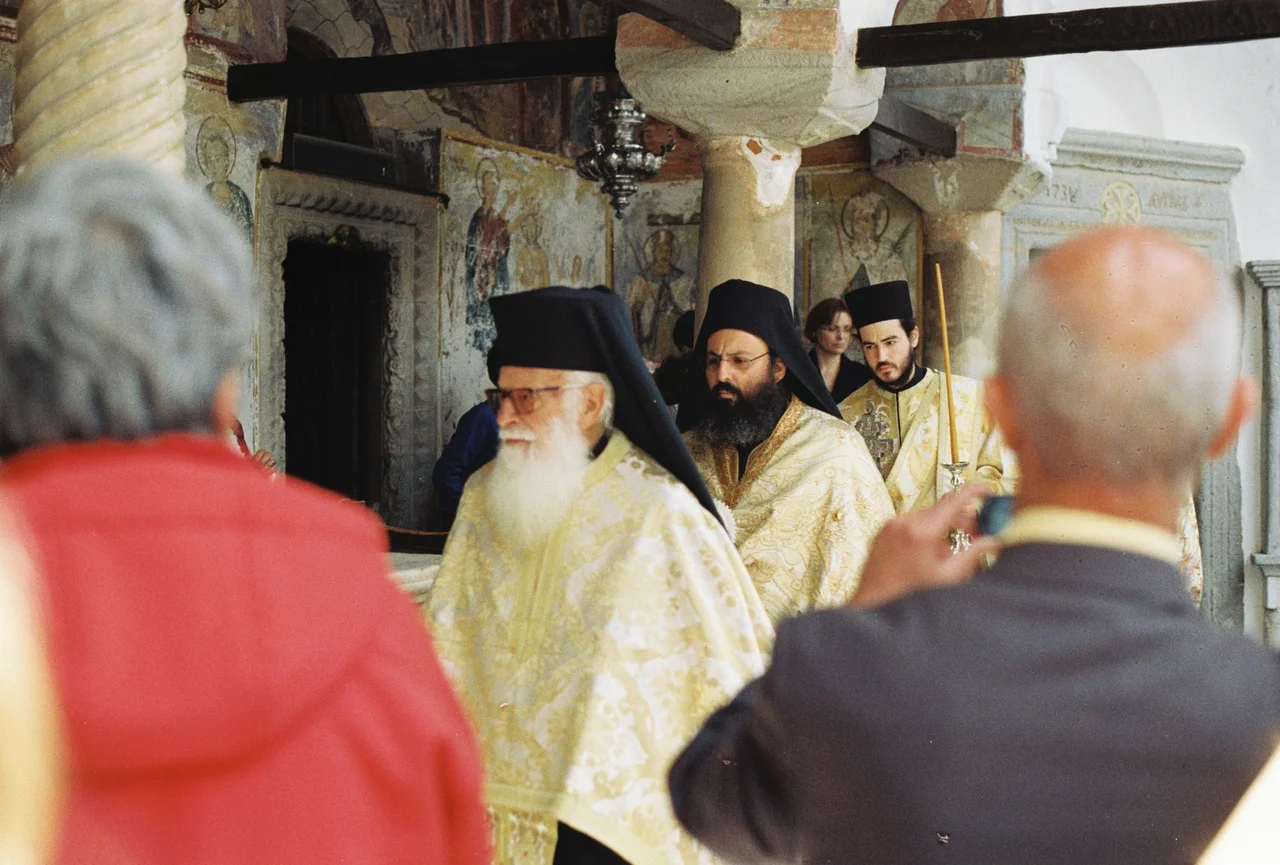
Inside, the monastery guards a remarkable collection. Its library holds rare manuscripts, including ancient biblical codices and minuscules studied by scholars worldwide, alongside liturgical art, icons, and church treasures accumulated over centuries. Among its relics, the monastery counts the skull of Saint Thomas the Apostle. About forty monks still live and worship here, keeping a rhythm of devotion that has barely changed since Christodoulos's day. The collection survived in part because of the monastery's privileges: under Ottoman rule it was permitted tax-free trade, certified by imperial documents still held in its library - a rare pocket of autonomy that let learning and worship continue undisturbed.
Crown of a Sacred Island
The monastery does not stand alone. Halfway down the slope toward the port lies the Cave of the Apocalypse, where, by tradition, John of Patmos received the visions of the Book of Revelation; the monastery at the summit and the cave below are two ends of a single pilgrimage. In 1999, UNESCO recognized the whole ensemble - the monastery, the cave, and the historic town of Chora - as a World Heritage Site, honoring its significance to Christianity and the living continuity of its ancient ceremonies. Seen from the water, the monastery's silhouette still dominates the island exactly as it was meant to: a stronghold of faith built to outlast empires, and so far, it has.
From the Air
The monastery stands at 37.31°N, 26.55°E on the summit above Chora, on Patmos in the eastern Aegean's Dodecanese. Patmos has no airport; nearest fields are Samos (LGSM) to the north and Leros (LGLE) to the south, with ferry access only. From altitude, the monastery is the most prominent landmark on the island - a dark, angular fortified mass at the high point, surrounded by the white cluster of Chora. The Cave of the Apocalypse lies on the slope below it. Skies are usually clear in summer.
Nearby Stories
- Temple of Athena Polias (Priene) 21 km away
- Panagia Hozoviotissa Monastery 30 km away
- Bodrum Castle 33 km away
- Kouros of Apollonas 46 km away
- Bodrum 48 km away
- Battle of Corycus 54 km away
- Astypalaia 59 km away
- Mastichochoria 70 km away