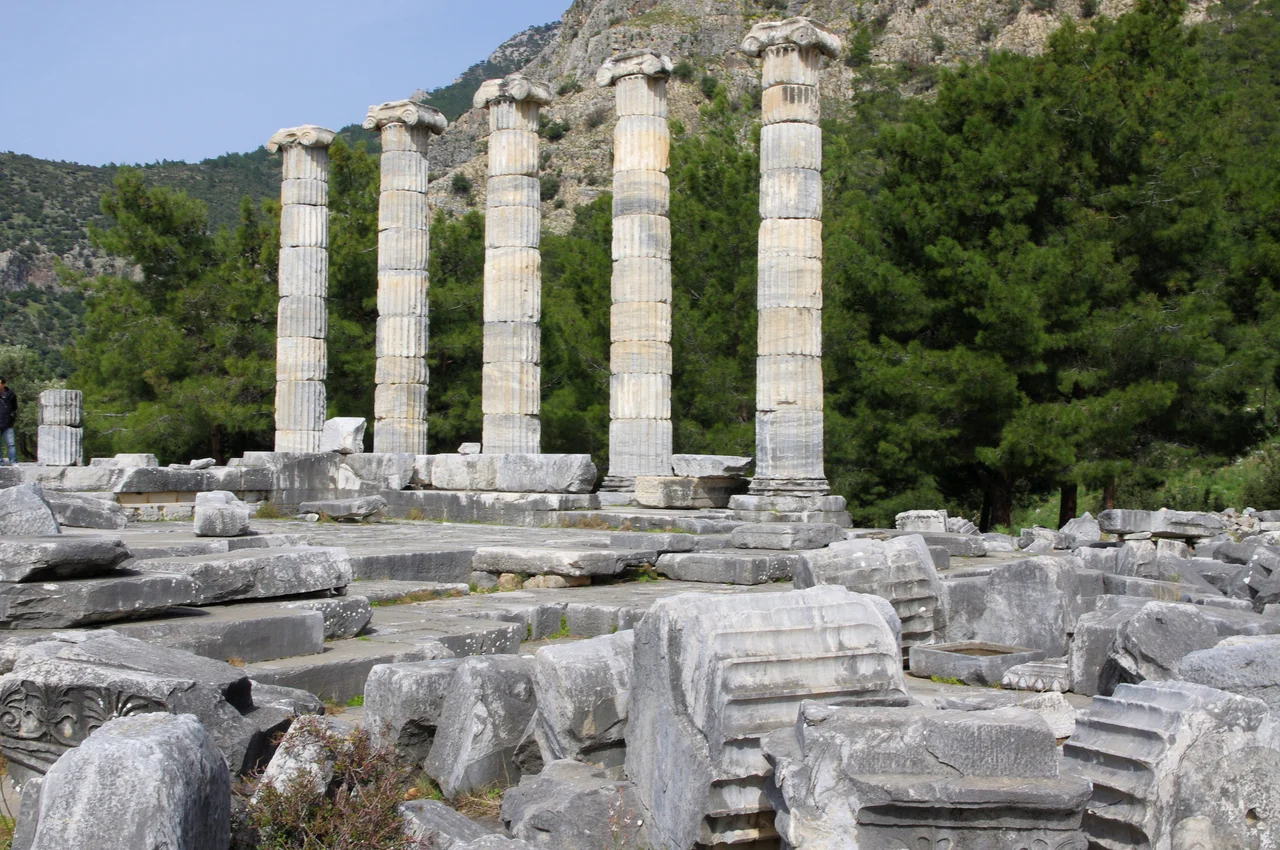

Temple of Athena Polias (Priene)
Alexander the Great paid for it. The marble inscription on the wall says so explicitly, in letters carved while the king was still alive: "King Alexander dedicated the temple to Athena Polias." He was twenty-two years old, fresh from his first victory against the Persians at the Granicus River, and he wanted his name on a building that would outlast him. The Temple of Athena Polias at Priene, on a terrace high above the Maeander valley in what is now western Turkey, became that building. It was designed by Pytheos, the same architect who built the Mausoleum at Halicarnassus, one of the Seven Wonders of the Ancient World. The same hands that shaped a wonder shaped this.
The Architect's Pure Geometry
Pytheos was a theorist as much as a builder, and at Priene he treated the temple as a problem in proportion. Every dimension was an integral multiple of the Attic foot, the standard unit of 29.46 centimeters used in Athenian construction. The peristyle ran eleven columns long by six wide. The shafts rose 11.5 meters, the same height as those of his Mausoleum. He left the walls almost entirely undecorated, as if any sculpted ornament would muddy the math. The exception was the southern wall, which carried inscriptions, including Alexander's edict to the Prienians granting them autonomy and tax relief. The Britannia Encyclopaedia later called it a textbook example of pure Ionic style. The German archaeologist Gottfried Gruben pushed back, arguing that academic late-Classical elements had been mixed in. Either way, Pytheos was working out a theory in stone, and the building was meant to be read as much as seen.
Two Centuries of Building
Construction began around 350 BC, before Alexander was born. The eastern half went up first, including the pediment, and Alexander's dedication followed in 334 BC. Then the project stalled. The western half remained unfinished for almost two centuries. The Prienians kept building, on and off, through the entire Hellenistic period and into the early Roman Republic. By the second century BC the city itself was draining away. The Maeander River, which once gave Priene access to the sea, was silting up. Mud blocked the river mouth. A lake formed. Mosquitoes bred in vast swarms. People moved to Miletus to escape the gnats. The temple was finally completed under Augustus, whose name was carved into the eastern architrave as a deified emperor. He died before the inscription was even weathered. Construction had taken roughly three hundred years.
Color Beneath the White
What looks like white marble today was once a riot of color. Excavators found traces of cinnabar red and a copper blue-green pigment on the moldings. The Ionic egg-and-dart was painted red. The bead-and-reel sat against red. The figures of giants and Amazons on the coffered ceiling were left in marble white, set against painted blue backgrounds, so that the human and mythological forms read as light against shadow. Polychromy on Greek temples was the rule, not the exception, but the rule has been forgotten because almost all of it has weathered away. At Priene the traces survived in protected corners of the cella, the inner chamber where a six-and-a-half meter statue of Athena once stood. The statue was three times smaller than the original Athena Parthenos in Athens, and its exact form is unknown.
Rediscovery and Ruin
Two French travelers, Jacob Spon and George Wheler, recorded the site in the 17th century, the first modern witnesses. In 1764, Richard Chandler arrived on an Asia Minor expedition funded by London's Society of Dilettanti, a club of British aristocrats interested in classical antiquity. He shipped fragments to the British Museum, where they remain. German archaeologists have worked the site since. The lowest layer of the cella stayed undisturbed across two thousand years. Pillaging was minor. Earthquakes did most of the damage. Today the temple's columns lie scattered across the terrace like fallen trees, drums tumbled off their bases, capitals upended. Five columns have been re-erected. The rest is a field of carved stone.
The Standing City
Priene itself is the rarest kind of ancient site, a Hellenistic city preserved almost intact because no one rebuilt over it after the population left. The grid of streets, the agora, the theater carved into the hillside, the bouleuterion where the council met, all sit on terraces stepped up the slope of Mycale mountain. From the temple terrace the view runs across the broad green plain that was once the Aegean Sea. The Maeander has filled the gulf entirely. The coast is now thirteen kilometers west. Ships that once called at Priene's harbor now would have to anchor in farmland.
From the Air
Located at 37.66 N, 27.30 E in western Turkey, on a terrace at roughly 130 meters elevation overlooking the silted Maeander plain. The temple sits on Mount Mycale's southern slopes, about 35 km south of Kusadasi and 100 km south of Izmir. Nearest airports: Izmir Adnan Menderes (LTBJ) 100 km north, Bodrum-Milas (LTFE) 150 km south. Best viewed from a southwest approach below 1,500 meters AGL. Priene's grid plan and theater are visible alongside the temple terrace.
Nearby Stories
- Battle of Corycus 19 km away
- Patmos 20 km away
- Fourni 25 km away
- Bodrum 48 km away
- Izmir 51 km away
- Akhisar Museum 106 km away
- Palace of the Grand Master of the Knights of Rhodes 118 km away
- Church of St John of the Collachium 146 km away