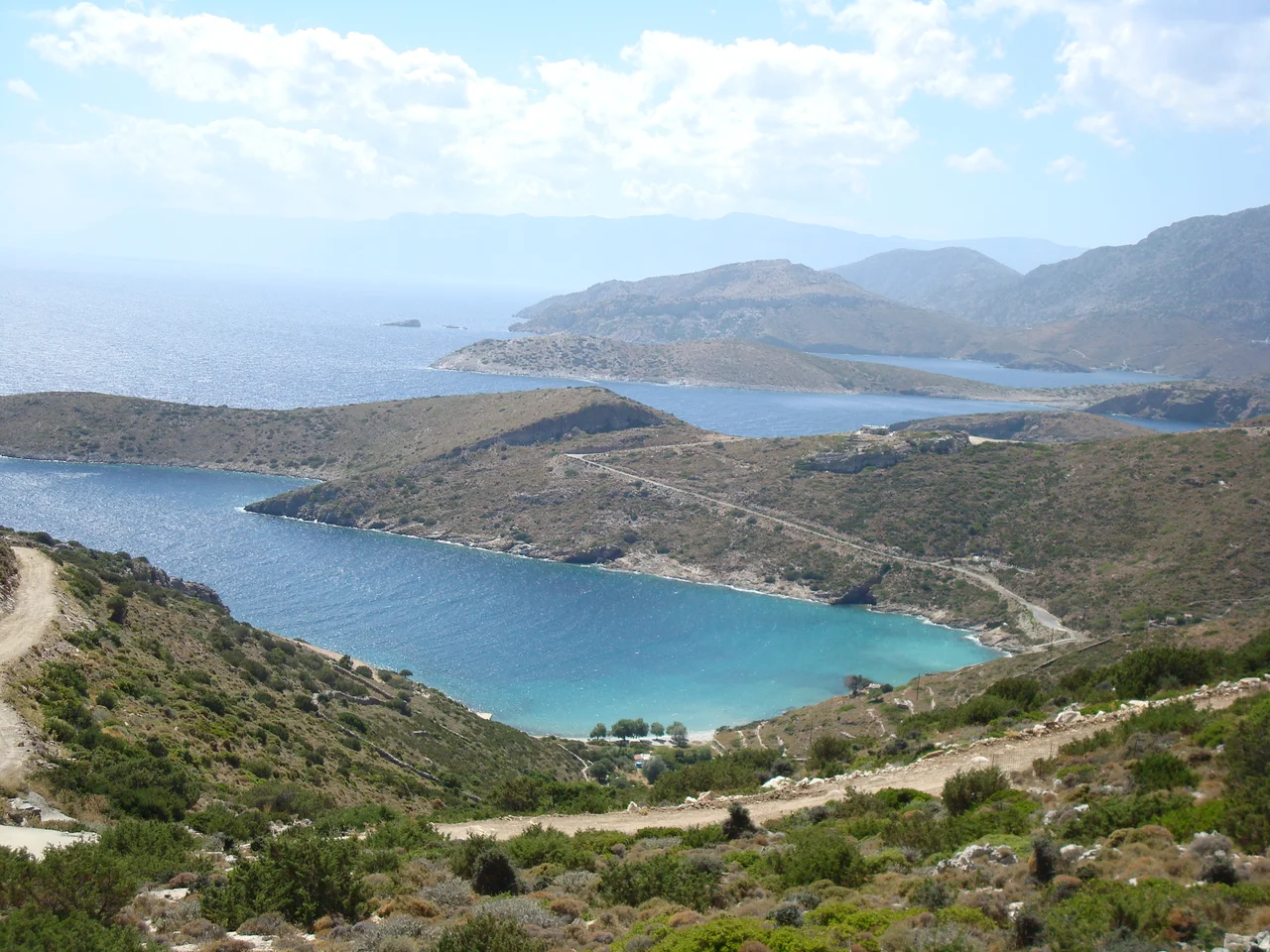

Fourni
The islands take their name from the men who once hid among them. Fournoi Korseon - the corsairs' islands - is a maze of more than twenty barren rocks scattered in the eastern Aegean, its coastline so torn with hidden coves and miniature fjords that a pirate fleet could vanish into it without a trace. For centuries that was exactly the point. Today the same hidden bays that sheltered raiders shelter fishing boats and a handful of sailors who have learned that remoteness can be a kind of luxury.
A Corsairs' Coastline
Geography made Fourni a pirate's dream. The main island, only about 30 square kilometers, is split into two long arms nearly nine kilometers each, pinched in places to less than 300 meters wide. Its coast is a chaos of cliffs and caves, rocky shores and deep bays of sand and pebble - hundreds of inlets where a ship could slip out of sight. Through the Middle Ages this made the archipelago an ideal base for the corsairs who preyed on Aegean shipping, and it is from those raiders that the islands draw their name. Of the score of islets, only two are inhabited today: Fournoi itself and the even lonelier Thymaina. The rest remain barren, hilly, and empty, exactly as the pirates would have known them.
The Graveyard Beneath the Waves
What the corsairs hunted, the sea kept. The waters around Fourni hold one of the densest concentrations of ancient shipwrecks anywhere on Earth - around sixty have been found, most dating from Greek, Roman, or Byzantine times. The archipelago sat astride busy trade routes, and its treacherous, wind-raked passages claimed ship after ship over the centuries. For divers and snorkelers, the clear bays now offer an underwater museum of antiquity, where cargo amphorae and the bones of old hulls lie scattered across the seabed. The same indented coastline that hid pirates and wrecked traders is what makes the swimming here so extraordinarily clear and calm.
Scattered Antiquity
On land, the past lies half-forgotten among the rocks. There are no grand monuments here, no single famous ruin - instead, fragments of many ages are strewn across the islands. Finds from the Ionian, Classical, and Hellenistic periods turn up throughout. On the hill of Agios Georgios, a cyclopean wall traces the line of an ancient acropolis. There are the ruins of the temple of Kamari, a shrine to Poseidon at Agia Triada in Chrysomilia, an old quarry at Petrokopi, and even the remains of houses now resting on the seabed. The archipelago shares its name with Phourni, one of the most important Minoan burial sites yet discovered - though that cemetery lies on a hill near Archanes in Crete, a coincidence of names that speaks to how widely the ancient world spread its traces. The attraction of Fourni is not any one sight but the accumulation - a landscape quietly layered with thousands of years.
Island Time
Modern Fourni keeps the slow rhythm its isolation demands. As tourism grew on neighboring Ikaria, day-trippers began crossing over, but few stay long; the island is too remote and too quiet for most, which is precisely its appeal to those who do come. There is a single main town with the basics - a baker, a butcher, a pharmacy - and a scattering of rooms and apartments, but no hotel. The best beaches reach only by dirt track or by small fishing boat, and the nightlife is a quiet drink in a harborside cafe. Travelers are warned to carry water into the empty interior. For sailors threading the secluded anchorages, though, this forgotten corner of the Aegean is something close to paradise.
From the Air
The Fourni archipelago lies at 37.58°N, 26.48°E in the eastern Aegean, tucked between Samos to the north and Ikaria to the west. There is no airport; nearest fields are Ikaria (LGIK) and Samos (LGSM), with ferry and seasonal Flying Dolphin connections. From altitude, look for a tight cluster of small, elongated, deeply indented islands - the main island split into two long arms - with the larger masses of Samos and Ikaria flanking it. The surrounding sea is known for strong, gusty winds; skies are usually clear in summer.
Nearby Stories
- Temple of Athena Polias (Priene) 25 km away
- Temple of Artemis at Ephesus 31 km away
- Battle of Corycus 35 km away
- Bodrum 41 km away
- Kouros of Apollonas 43 km away
- Mastichochoria 51 km away
- Panagia Tourliani 56 km away
- Panagia Hozoviotissa Monastery 74 km away