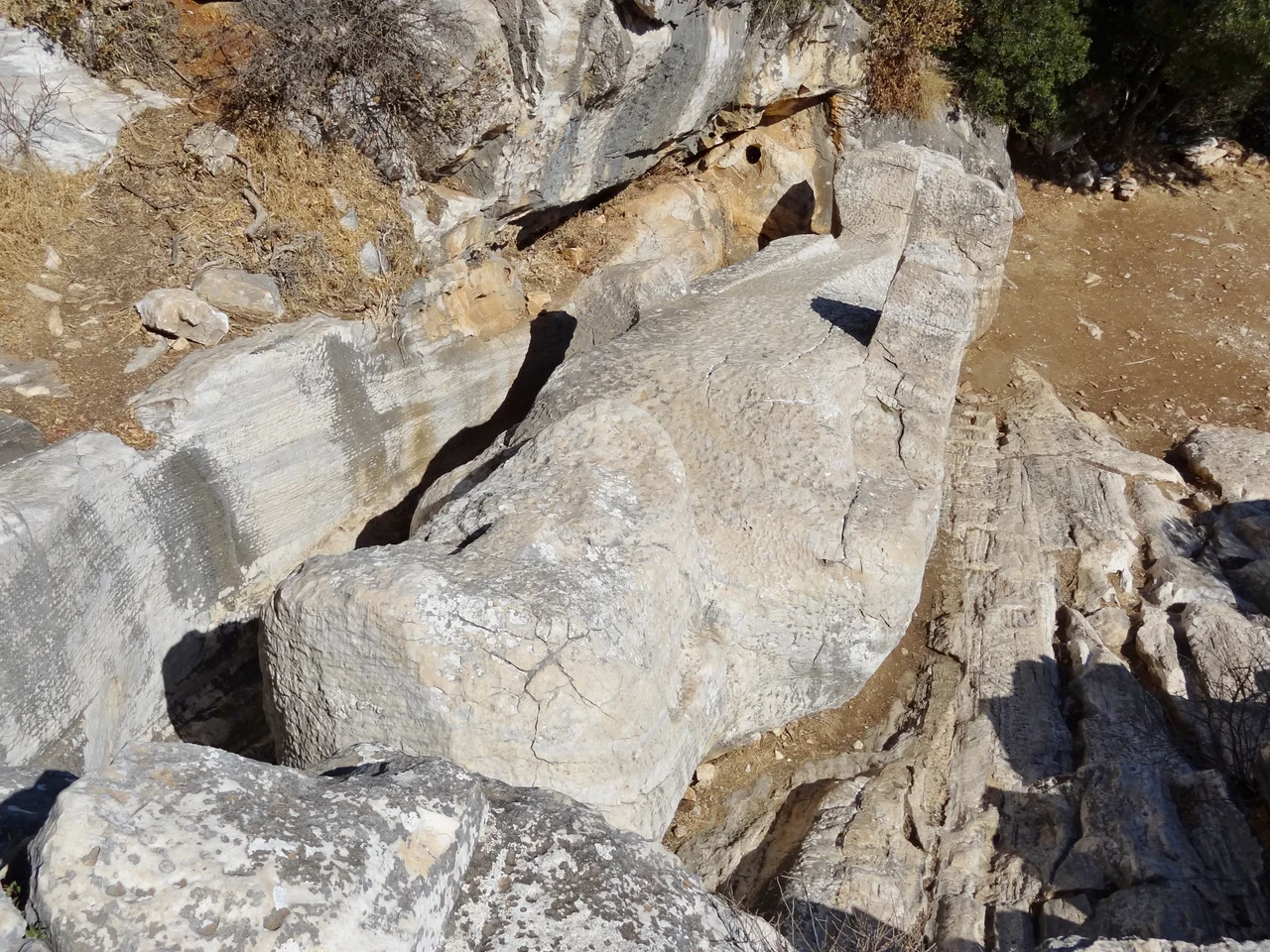

Kouros of Apollonas
He is enormous, and he is unfinished, and he has been lying on his back in the same hillside quarry for roughly 2,500 years. The Kouros of Apollonas stretches 10.7 metres of light grey Naxian marble across a 30-degree slope above the village of Apollonas, in the north of the island. The sculptors cut him free on three sides, roughed out a bearded head, blocked the arms into rectangles, began the feet on a low plinth - and then walked away. An estimated 80 tonnes of stone, half-emerged from the ground, was simply left where it lay.
The Giant in the Ground
Walk up the unpaved road above Apollonas and you come upon him suddenly: a colossal figure lying on a north-south axis, his front roughly carved, his back still fused to the bedrock. The body, the head with its beard and ears, the first suggestion of hair - all are recognizable in the rough. The arms remain blunt rectangles the stonemasons never refined. The feet were only begun. This is a kouros, the standing male figure that Archaic Greek sculptors carved by the hundreds, but no other survives at anything like this scale. He dates from around the turn of the seventh and sixth centuries BC, when Naxos was one of the richest and most powerful islands in the Aegean, and its marble was prized across the Greek world.
How a Statue Was Born
The quarry around him is one of the oldest in Greece, a surface quarry where stone was cut straight from the hillside rather than mined from shafts. The marks of the work are everywhere. Sculptors struck the marble with bronze chisels, pickaxes and hammers, leaving a field of small holes across the figure's surface. The plan was to smash the crystal grains of the stone with coarse blows, then return with finer chisels and gentler strikes to grind the surface smooth. Only after the rough contour emerged would the figure be rounded into a man. The Kouros of Apollonas freezes that process in the middle: a body half-released from the rock, the coarse stage complete, the smoothing never begun.
Why He Never Rose
On his back are clues to an ambition that outran the means to fulfill it. Keyholes five to eight centimetres wide run in pairs across the stone, and a rectangular slot forty centimetres across waited for a wooden lifting beam - the standard rigging points for moving a Greek monolith. Someone meant to stand this giant upright and carry him away. They never could. The archaeologist Gottfried Gruben's verdict, undisputed in scholarship, is the simplest one: at 80 tonnes, the monolith was too heavy to transport. Guidebooks add other stories - that cracks were discovered too late, that the carvers feared he would shatter as he was freed, that no one ever paid for him. Those tales cannot be proven. What is certain is that the weight that made him magnificent is the same weight that pinned him to the earth.
Apollo, Dionysos, or Neither
His name is a long argument. Because he lies near the town of Apollonas and its old sanctuary of Apollo, a fifteenth-century visitor called him a 'statue of Apollo,' and the scholar Ludwig Ross repeated it in 1840. The name stuck for a century. Then in 1932 Wilhelm von Massow looked at the beard - Apollo was traditionally shown beardless and youthful - and argued the figure was Dionysos, the bearded god of wine, which is why he is also called the Colossus of Dionysus. Today scholars simply call him a kouros, the neutral term for the form, and admit they do not know whom he was meant to be. He has outlasted the certainty of his own identity, which suits a statue that was never finished becoming anything at all.
From the Air
The Kouros of Apollonas lies at 37.178509 N, 25.544457 E, on a hillside above the village of Apollonas on the rugged northern tip of Naxos, the largest of the Cyclades. From the air, look for the deep indented bay of Apollonas on the island's north coast; the quarry sits on the slope just inland and above the village - too small to resolve from altitude, but a precise waypoint over dramatic terrain. The nearest airport is Naxos Island National (LGNX), about 25 km south near Chora. Recommended viewing altitude 2,000-4,000 ft for the coastline; clear Aegean summer skies give exceptional visibility, though afternoon meltemi winds can make the northern approach turbulent.
Nearby Stories
- Apollon Theater, Syros 1.6 km away
- Panagia Tourliani 8.5 km away
- Keros 15 km away
- Ikaria 21 km away
- Archaeological Museum of Sifnos 30 km away
- Kimolos 39 km away
- Astypalaia 49 km away
- Cave of the Apocalypse 49 km away