
Apollon Theater, Syros
On the evening of 20 April 1864, the curtain rose in Ermoupoli's new Municipal Theatre on a production of Verdi's Rigoletto — the opera that had premiered at La Fenice in Venice thirteen years earlier. The audience that filled the Apollon's velvet seats that night had waited a long time for this moment. Theatrical performances in Ermoupoli had been held since 1828, in warehouses and wooden cafes pressed into service as makeshift stages. Now the city had something permanent: a proper opera house, built in marble and limestone, its ceiling decorated with portraits of poets and composers, its design drawn from the great Italian theatres of the age. It was the first purpose-built opera house in Greece, on an island in the middle of the Aegean.
A City That Wanted a Theatre
Ermoupoli, the capital of the Cyclades, was the busiest port in Greece through much of the nineteenth century — a commercial city of shipowners, merchants, and craftspeople who had built substantial wealth and, with it, cultural ambition. The theatrical life of the city had been vigorous since the 1820s, sustained by improvised venues that were never quite adequate to the demand. On 30 October 1861, the City Council voted unanimously to build a proper theatre near Miaouli Square, the civic heart of Ermoupoli. The construction budget was set at 60,000 drachmas. Despite controversy over costs and design, work began at the end of 1862 under the supervision of Pietro Sampò — an Italian architect then employed at the Ermoupoli town hall. He completed the building in under two years.
A Miniature of La Scala
Sampò designed the Apollon in conscious dialogue with the great Italian opera houses. His sources included La Scala in Milan (whose original 1776 design he studied), the restored Teatro di San Carlo in Naples, the Academic Theatre in Castelfranco, and the Teatro della Pergola in Florence. The result is widely described as a miniature of La Scala — smaller in scale but faithful in spirit to the Italian tradition of the intimate lyric theatre.
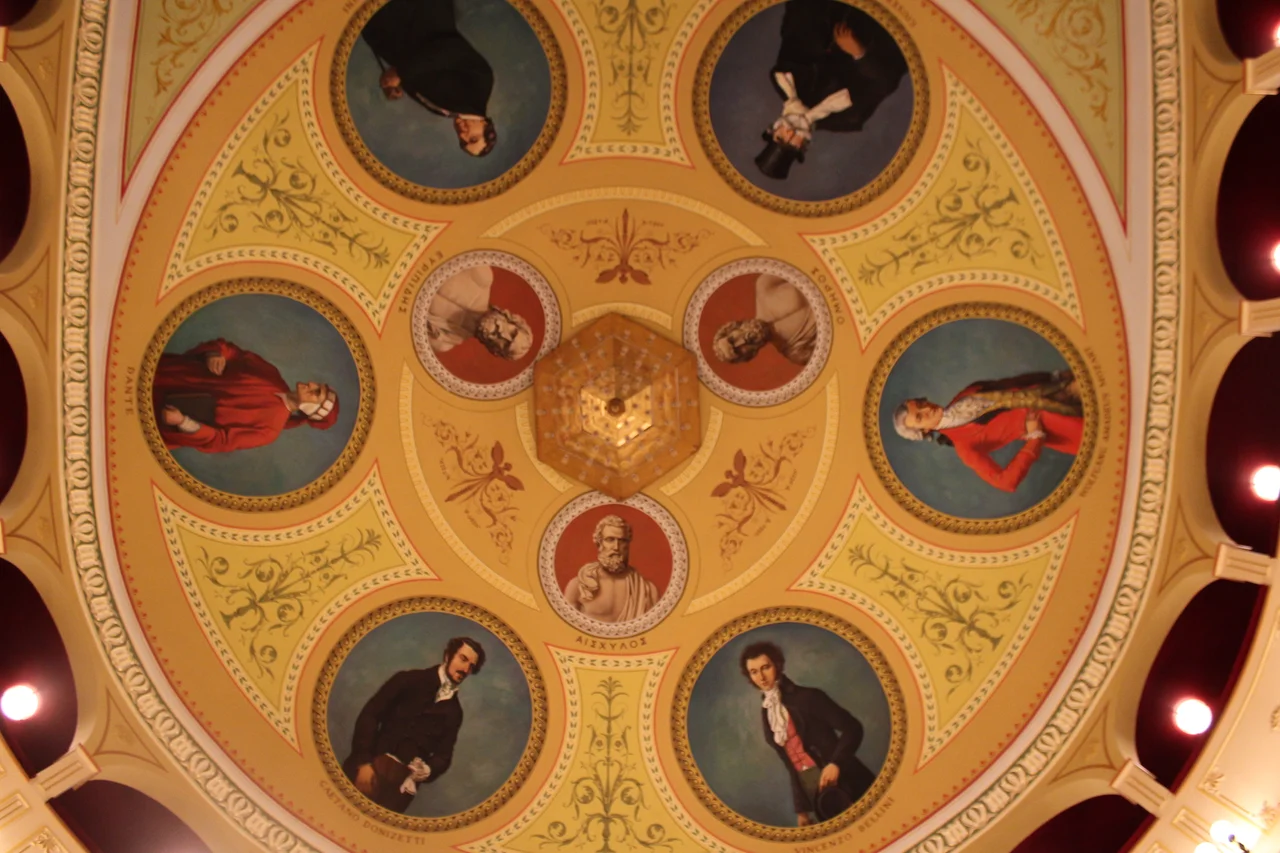
The exterior is restrained. Two storeys of plastered façade with a marble centrepiece, four pillars rising the full height and bearing a shield, arched openings on the ground floor, rectangular windows above. There is no extravagant ornamental display. Inside, the impression changes. The stage is 9 metres wide and 10 metres deep, proportioned for European lyric theatre. Velvet covers the seats, the rails, and the curtains between the wings. The vault decorations use light colours with embossed rosettes at the centres of the frames and gilded details at the corners. On the ceiling, medallion paintings depict the poets and composers who wrote the works that would be performed on the stage below. The vault support follows the French engineering system of the period — a structural choice that quietly distinguishes it from its purely Italian models.
Rigoletto to Kotopouli
The opening night's Rigoletto was followed immediately by four more productions: La favorita, La traviata, and two comedies performed by the same Italian company. Within two years the theatre had passed to the Hellenic Drama Society, and the Apollon began to host Greek theatre alongside Italian opera. The interwar decades were the theatre's richest period. The great names of the Greek stage appeared here; Ermoupoli, though it had lost its mid-nineteenth century commercial dominance by then, had not lost its appetite for theatre.
The last performance of the actress Marika Kotopouli's career took place on the Apollon's stage on 24 March 1953 — a valediction from one of the defining figures of modern Greek theatre, in a theatre that had outlasted the commercial empire that built it. After that, the Apollon fell silent. It was deemed unsuitable for operation. Years of wartime use as a cinema, followed by post-war neglect, had damaged the fabric of the building and left it without the investment it needed.
Restoration and Return
The road back was long. The municipality began thinking about renovation in 1959, but general repairs only started in 1970 — and caused further internal damage, the wooden vaults replaced with concrete balconies that altered the acoustic character of the space. Theatrical and film clubs kept the building's memory alive through the 1970s, showing films in the damaged theatre to hold the public's attention.
The first phase of proper restoration, funded jointly by the Greek state and the European Economic Community, was completed in 1991. On 29 October 1991 — about forty years after it had last functioned as a theatre — the Apollon reopened for the 4th Meeting of Amateur Theatres of the Aegean. New wallpapers were installed in 1998, designed by Dimitris Fortsas. Full reconstruction, overseen by architect Petros Pikionis and approved by the Greek Ministry of Culture, was completed in 2000. The Apollon now seats 350 people and operates continuously, hosting the Aegean Festival, the Animasyros International Film Festival, and the International Cycladic Classical Music Festival. Velvet, marble, and gilded rosettes: what the founders wanted in 1864 is still, in its essentials, what you see today.
From the Air
The Apollon Theatre sits at approximately 37.446°N, 24.944°E in the centre of Ermoupoli, the capital of the island of Syros. The nearest airport is Syros National Airport (LGSO), approximately 4 km to the south of the town. Ermoupoli is recognisable from the air by its densely packed neoclassical townscape climbing the hills above the harbour — the blue-domed church of Anastasis on Ano Syros, the Catholic hilltop to one side, the Orthodox to the other. The theatre itself is not visible as a distinct feature from altitude but sits adjacent to Miaouli Square, which anchors the commercial centre of the city. Syros lies approximately 140 km southeast of Athens; from LGAV on a direct track, the island appears after roughly 35 minutes at cruise.
Nearby Stories
- Battle of Mykonos 8.8 km away
- Andros 14 km away
- Temple of Apollo (Naxos) 18 km away
- Massacre of the First Sapper Battalion 22 km away
- Brauron 28 km away
- Serifos 28 km away
- SS Heraklion 46 km away
- Emporio, Chios 77 km away