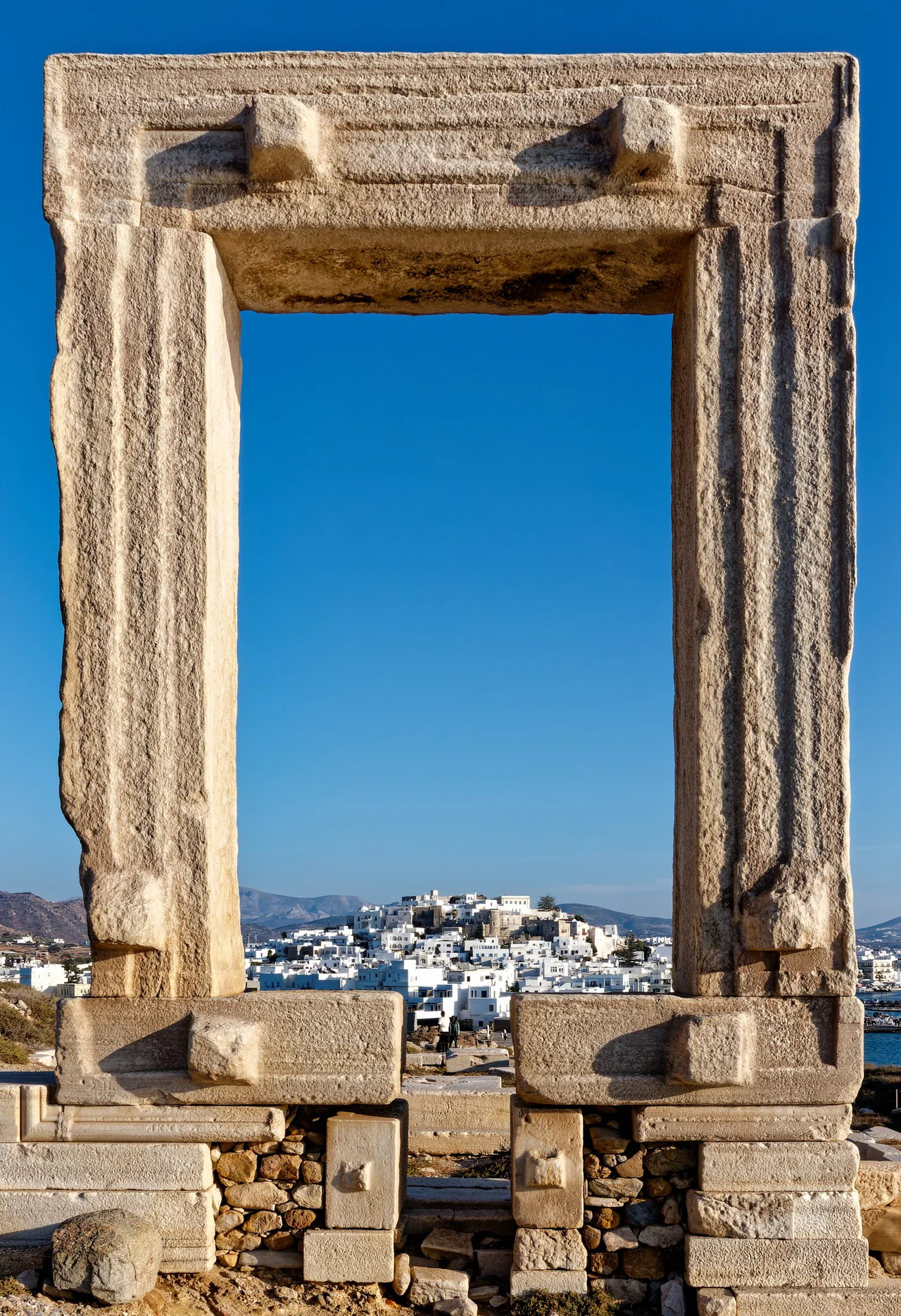

Temple of Apollo (Naxos)
It is just a door. That is the strange and wonderful thing. On the small islet of Palatia at the entrance to Naxos town harbor, four enormous slabs of marble form a freestanding rectangular doorway, eight meters tall, that leads from nothing to nothing. The Greeks call it the Portara - the Great Door - and it has stood here for roughly 2,500 years, alone, surviving every other piece of the temple it was meant to belong to. The temple itself was never built. The tyrant who started it lost power, the workers walked off, and only this single perfect threshold remained, too heavy to dismantle. Stand on the islet at sunset and the sun drops directly through the open frame.
Lygdamis the Tyrant and His Unfinished Project
Around 530 BC the tyrant Lygdamis of Naxos launched an ambitious building program: harbors, public works, and this enormous temple to Apollo. Naxos was then one of the wealthiest islands in the Cyclades, and Lygdamis intended his temple to announce that wealth across the Aegean. The plan was Ionic, 38 meters long by 16 meters wide, oriented deliberately northwest so that a worshipper standing in the doorway would look directly toward Delos, Apollo's birthplace, 75 kilometers across the sea. Construction had even started a decade earlier under a different orientation; Lygdamis rotated the whole temple 180 degrees in 530 BC and began again. He never finished. In 524 BC the Spartan-led Peloponnesian League removed him from power, and the workmen abandoned the site mid-stride.
Twenty-Ton Stones and the Logic of Bosses
Each of the four slabs of the Portara doorway weighs up to twenty tons. They were quarried at Flerio, ten kilometers inland, and dragged across the island - across uneven terrain, then across the narrow isthmus that once connected the islet to the mainland. To lift each slab into position, masons carved bosses, small protruding bumps, on the marble surfaces. Ropes wrapped around the bosses. Wooden treadwheel cranes turned by men did the lifting. Once the slab was placed, the bosses would normally be chiseled smooth - they were temporary scaffolding, not architecture. On the Portara, the bosses are still there. Visible. Untrimmed. Two and a half millennia of workers walking past and never taking five minutes to grind off the bumps, because there was no point: the temple would not be finished, and refining the door alone would have been an absurdity. The unfinished bosses are perhaps the truest evidence that the abandonment was sudden.
The Mythological Setting
Greek myth placed Naxos at the edge of one of its strangest stories. Theseus brought Ariadne here after she helped him kill the Minotaur in the labyrinth on Crete. He abandoned her on this islet while she slept - the act varies in the telling between cowardice, divine command, and forgetfulness. When she woke, the wine god Dionysus arrived with his entourage, fell in love with her, and made her his queen. The islet of Palatia is traditionally identified as the spot. Whatever the historical foundation of the story, the islet has always carried that double resonance: a place of departure and a place of arrival, abandonment followed by transformation. To this day Naxos celebrates Dionysus and Ariadne in local festivals, and visitors who walk the causeway at dusk are walking, at least metaphorically, the same shore where the myth occurred.
Christians, Venetians, Builders
After the temple was abandoned, the islet did not stay quiet. In the 5th century AD a Christian church was built directly on top of the unfinished foundations and dedicated to Saint Mary - Panagia Palatiani. To fit the church door, masons cut a notch into the threshold of the Portara, a notch still visible today. A second church appeared in the 9th century, dedicated to Saints Nicholas and Constantine. During the Venetian period, beginning in 1207 with the Duchy of Naxos, the temple's smaller stones were carted away to build the Castle of Naxos in the upper town. Only the four marble slabs of the doorway proved too heavy to bother with. Whatever the Venetians thought of the gate, they left it alone. The medieval churches eventually fell into ruin too, and at last only the Portara stood - the oldest piece of architecture on the islet, surrounded by the ghosts of everything built around it.
The Sunset Pilgrimage
A causeway built in 1919 connects the islet to Naxos town. Walking it now, with cafe noise from the harbor behind you and the marble doorway ahead, you join an evening ritual that draws hundreds in summer: tourists, locals, lovers, photographers, all gathering on the rocks before dusk to watch the sun set through the Portara. The orientation that Lygdamis chose to align with Delos turns out to align with the western horizon as well. Apollo was the sun god. There is a small irony in his unfinished temple becoming, twenty-five centuries later, a place of gathering at exactly the moment of his daily disappearance. The temple Lygdamis dreamed of, complete with cella and columns and roof, would have hidden this view. The fact that he failed gave the world the better thing.
From the Air
Temple of Apollo (Portara) sits at 37.1103 N, 25.3723 E on the small islet of Palatia at the entrance to Naxos town harbor in the central Cyclades. The Portara doorway, roughly 8 meters tall, is visible from the air against the white-built town. Best viewed at 2,000-4,000 feet on inter-island routes through the Cyclades; Delos lies 75 km to the northwest, Santorini 110 km south. Nearest airfield: Naxos Airport (LGNX) on the southwest coast of the island. Mykonos (LGMK) is 50 km north. Aegean meltemi winds from the north can produce strong turbulence and challenging crosswinds in summer afternoons.
Nearby Stories
- Apollon Theater, Syros 1.6 km away
- Panagia Tourliani 8.5 km away
- Keros 15 km away
- Ikaria 21 km away
- Archaeological Museum of Sifnos 30 km away
- Kimolos 39 km away
- Astypalaia 49 km away
- Cave of the Apocalypse 49 km away