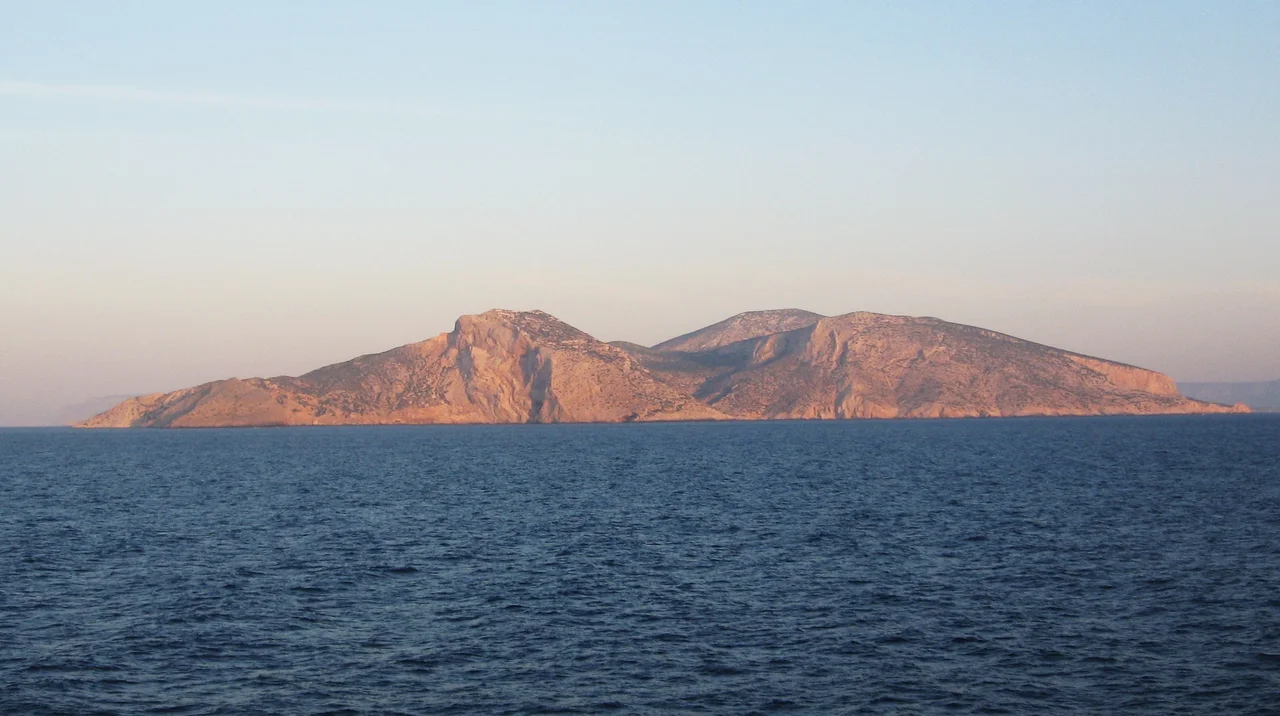

Keros
Nobody lives on Keros, and nobody is allowed to land. The small, dry island southeast of Naxos is forbidden ground - guarded not for what it is, but for what was found there. Beneath its slopes lay one of the strangest deposits in the ancient world: hundreds of marble figurines, the serene folded-arm idols of the Cycladic culture, all deliberately broken. Not weathered, not casually damaged. Shattered on purpose, then carried across open water from islands all around, and buried here in pieces around 2500 BC. Why anyone would do this is one of the genuine unsolved mysteries of Aegean archaeology.
The Hoard of Broken Idols
When the so-called 'Keros Hoard' surfaced, the volume alone was staggering: the number of figurine fragments from Keros exceeds the total of whole figurines found across all the other Cycladic islands combined. Greek archaeologist Christos Doumas first documented marble fragments here in 1963, and decades of excavation that followed at Kavos, on the island's west coast, revealed the crucial clue. British archaeologist Colin Renfrew led formal excavations beginning in 1987. The breakage was ancient and deliberate - and the pieces did not fit together. There were almost no joining fragments, and no marble chips from carving. The figures had been broken somewhere else, and only selected pieces brought to Keros. Someone was importing fragments of smashed sacred objects to a single island, from many places at once, and depositing them with care.
A Sanctuary Before the Gods
Renfrew's conclusion was that Keros was a sanctuary - perhaps the oldest maritime sanctuary in the world. He pictured it as a 'symbolic attractor,' a place that drew islanders on periodic pilgrimages across the sea to deposit the broken remains of their figurines in a shared ritual. The dating makes this remarkable. The activity here ran from about 2750 to 2300 BC, which predates any identified worship of named gods anywhere in the Aegean. Whatever drove people to break their idols and ferry the fragments to this one barren island, it was a communal act of belief older than the Greek gods themselves - religion, or something like it, before there were any gods we can name.
The Gleaming Headland of Daskalio
Just off Keros sits the tiny islet of Daskalio, once joined to the larger island before the sea rose to cut it off. It turned out to be no mere outcrop. Excavations revealed that nearly its entire surface - some 7,000 square meters - was built up in the Early Bronze Age, making it the largest known site in the Cyclades. The headland, barely 500 feet across, was sheathed in roughly 1,000 tons of stone into a single great stepped structure that researchers compared to a step pyramid, complete with terraced walls, drainage tunnels and traces of advanced metalworking. To raise it, ancient seafarers made an estimated 3,500 voyages, hauling between 7,000 and 10,000 tonnes of white marble between islands. They were careful to note the island is naturally pyramid-shaped - but the monument that crowned it was anything but natural.
The Keros-Syros World
Keros gave its name, alongside the island of Syros, to an entire phase of prehistory: the Keros-Syros culture, which flourished during the Early Cycladic II period from roughly 2700 to 2300 BC. This was a high point of Cycladic life, when the use of metal spread and craftsmanship flourished. Among its signature objects are the curious 'frying pans' - shallow circular clay vessels with elaborately decorated bases, their true purpose, like so much here, still debated. Some of the best-preserved sites of this culture lie not far away, on the islands of Kea and Ios. Keros sat at the center of this network, a hub in a busy, sophisticated Bronze Age sea-world.
An Island Left to Silence
Today Keros keeps its secrets. Its 15 square kilometers rise to just 432 meters, uninhabited and closed to visitors, a protected blank on the map of the busy Cyclades. The figurines that survived have scattered to museums; the headland of Daskalio has been mapped, sampled and studied down to its phytoliths and pollen. And yet the central question remains open. We know what was done here - the breaking, the carrying, the depositing, the building - but not, finally, why. Four and a half thousand years on, Keros still stares back as blankly as one of its own marble idols, beautiful and unreadable, withholding the answer.
From the Air
Keros lies at roughly 36.89°N, 25.65°E in the Lesser Cyclades, about 10 km southeast of Naxos and near the inhabited islands of Koufonisia. It is uninhabited and landing is forbidden. From the air, look for a small (15 km², highest point 432 m), bare, pyramid-shaped island just east of the Koufonisia, with the tiny islet of Daskalio off its west coast at Kavos. Recommended viewing altitude 4,000-6,000 ft. Nearest airports: Naxos (LGNX) to the northwest, with Santorini (LGSR) and Paros (LGPA) within range. Clear summer visibility and the northerly meltemi wind are typical; the surrounding shallows show vivid turquoise from altitude.
Nearby Stories
- Battle of Amorgos 8.3 km away
- Panagia Chrysopigi 23 km away
- Miaouli Square 40 km away
- Astypalaia 42 km away
- Cave of the Apocalypse 53 km away
- Battle of Rhodes (1912) 110 km away
- Battle of Rethymno 138 km away