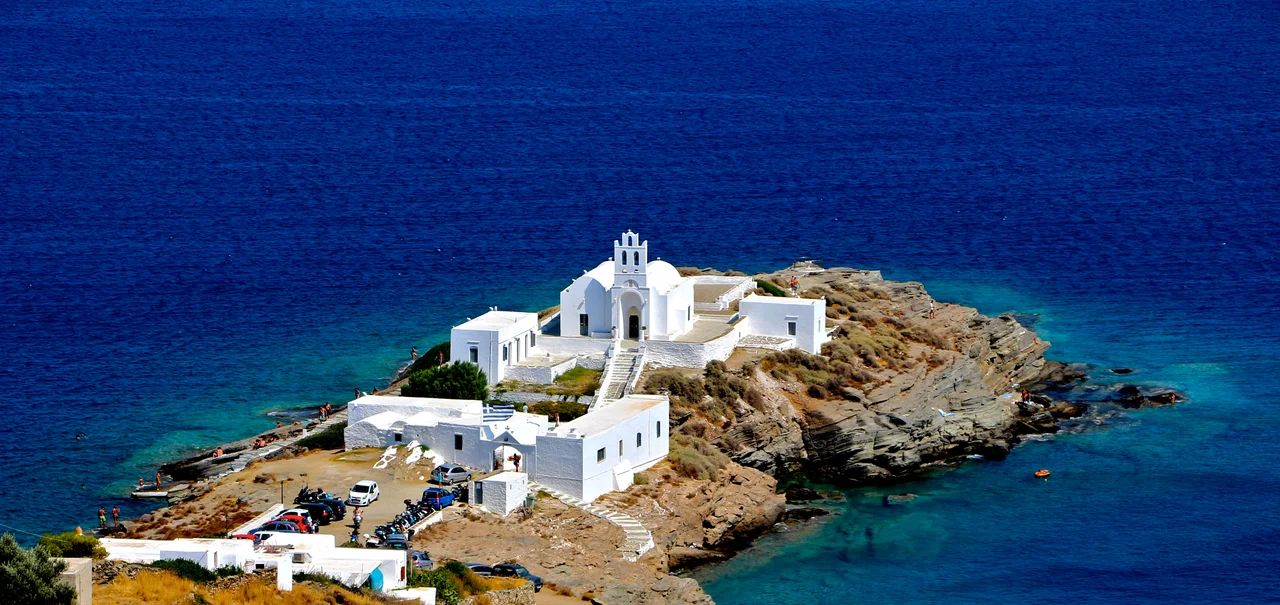

Panagia Chrysopigi
The cape is 400 metres long and 100 metres wide, separated from the rest of Sifnos by a narrow gap of seawater and joined back to it by a bridge. On this slender finger of rock jutting into the Aegean stands the Panagia Chrysopigi — the Virgin of the Golden Spring — a former monastery whose white walls have marked the southeast coast of Sifnos since at least the 17th century. In 1964, she was appointed the island's patron saint. The building sits at the edge of two worlds: the land it was built on, and the sea that nearly surrounds it.
Rock Split by Legend
The earliest written record of the Panagia Chrysopigi appears in a manuscript by the monk Parthenios Hairetis, dated by scholars to 1676 or 1677. The manuscript describes the miracles attributed to the site — and the most arresting of them is the splitting of the rock. According to tradition, the promontory itself was divided from the island by divine intervention, creating the narrow gap now bridged over. Whether the gap is the cause of the legend or the legend grew from the gap is one of those questions that places like this resist answering. The monastery complex on the islet includes the church, a refectory, cells, and two additional vaulted rooms of uncertain purpose — possibly altars for Catholic worshippers, given Venetian influence in the Cyclades.
The Church and Its Inscription
The single-aisled church carries a wall inscription dating its current form to 1757, when it was probably rebuilt. Vaulted and solid, the interior is reinforced by half-metre-wide stone slings supported on piers. The floor is marble, and carved into it in front of the iconostasis is a double-headed eagle — a Byzantine symbol — that dates from the period 1801 to 1816. The entrance is framed in marble decorated with waves, rosettes, and a carved motif probably reflecting Venetian influence: the Cyclades passed through Venetian control for centuries before the Ottoman period, and its architecture carries both memories. Above the entrance, the bilobed spire rises on two pilasters, and two plaques are built into the facade — one marked 1757, the other carrying an inscription in Russian.
Golden Spring, Dazzling White
The name Chrysopigi — Golden Spring, or sometimes translated as Golden Source — may refer to a freshwater spring on or near the promontory, though the precise etymology has not been definitively established. What is beyond dispute is the visual effect of the monastery complex in Aegean light. White walls, blue dome, the sea on three sides, the long bridge connecting island to islet: it is one of the most photographed spots in the Cyclades, and with reason. Near the Panagia Chrysopigi lies the small fishing settlement of Faros — probably the island's main port in earlier centuries — and the beaches nearby at Apokofto bay have developed a reputation for good, traditional tavernas.
Patron of the Island
The formal appointment of the Panagia Chrysopigi as patron saint of Sifnos in 1964 was the official recognition of a devotion that had been building for three centuries. On the Feast of the Holy Spirit — the Monday after Pentecost — the icon is carried in procession from the monastery, and the celebration draws people from across the island and from the Greek diaspora. The older monastic function has faded; the complex no longer operates as an active monastery. But the church itself remains a living place of worship, the most visited religious site on Sifnos, and the image its buildings make against the Aegean sky has become inseparable from how Sifnos sees itself.
From the Air
The Panagia Chrysopigi sits at approximately 36.936°N, 24.746°E on a narrow promontory on Sifnos's southeast coast, near the village of Faros. From the air the rock spur is clearly distinct from the main island body — the narrow gap and bridge are visible at low altitude. The nearest major airport is LGAV (Athens International Eleftherios Venizelos). Sifnos has no airport; access is by ferry from Piraeus to Kamares port, roughly 10 km northwest of Chrysopigi. At around 3,000 feet, the white monastery complex on its rock spur stands out against the blue-green water. The eastern coast of Sifnos is greener and more terraced than the rugged western side visible from the ferry approach at Kamares. Summer visibility in the southern Cyclades is typically excellent.
Nearby Stories
- Ios 2.4 km away
- Italian submarine Jantina (1932) 9.6 km away
- Temple of Sangri 11 km away
- SS Heraklion 19 km away
- Syros 23 km away
- Milos 33 km away
- Agios Georgios (island) 38 km away
- Monemvasia 107 km away