
Monemvasia
The name is an instruction. Monemvasia comes from the Greek words for single — moni — and approach — emvasis. One way in, one way out. An earthquake in 375 AD had already done the essential work, separating the great rock from the mainland and leaving only a narrow tombolo of land connecting the two. The people who eventually settled here understood what that geography meant: a place that could be defended from almost any direction except the single causeway that joined it to the Peloponnesian shore. In 1890, a portion of even that tombolo was cut to allow ships through. The town became, as completely as geography can make anything, an island.
The Rock and the Town
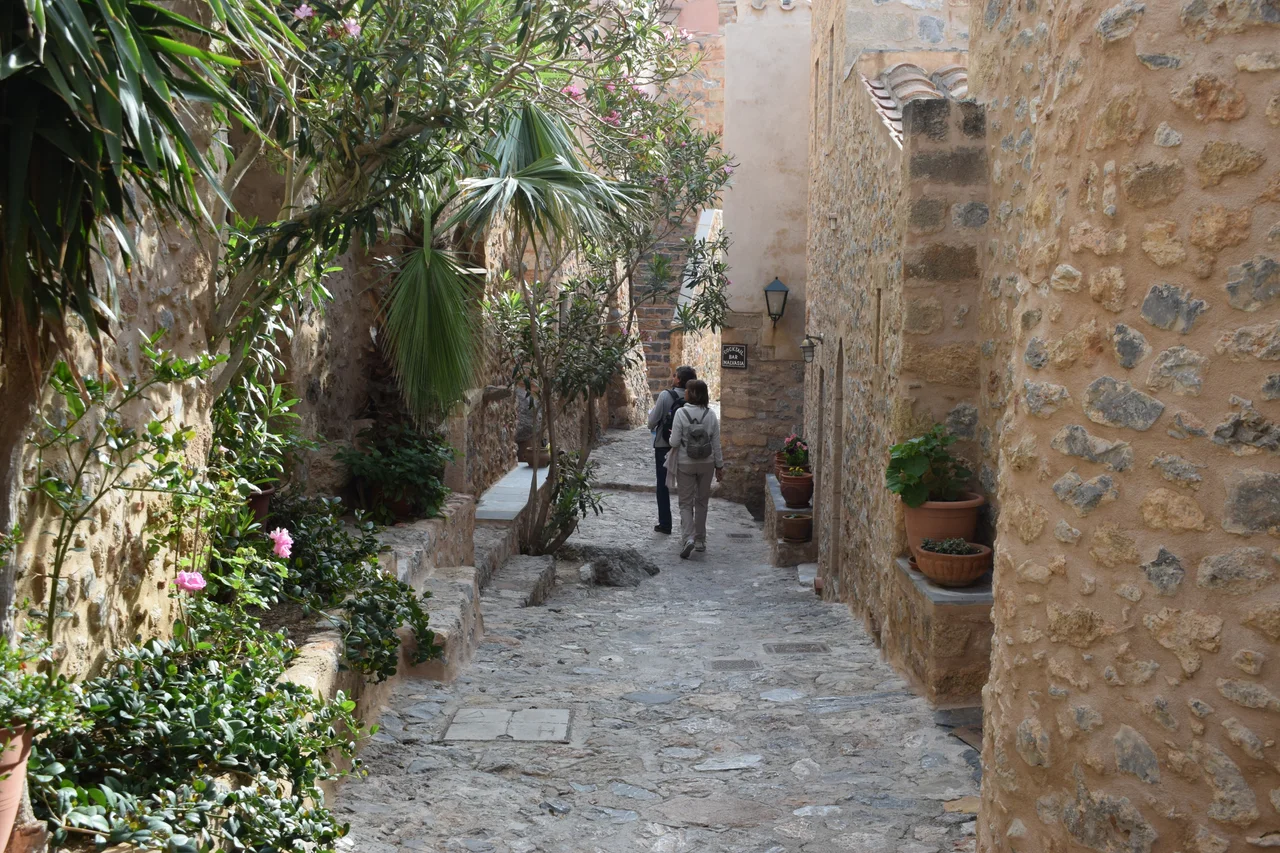
The rock of Monemvasia is not a gentle hill. Its plateau rises roughly a hundred metres above sea level and extends about a kilometre in length, with sheer cliffs on the northern and western faces. The town is built on the slope to the southeast, pressed between the cliff above and the Myrtoan Sea below. Many of the streets are too narrow for anything but pedestrians and donkeys. The upper town, on the plateau itself, was abandoned after the second Venetian occupation and is now a ruin — accessible through a fortified gate at the top of a winding path from the lower town. The lower town remains inhabited, its Byzantine and Venetian stone buildings carefully restored, its lanes leading to the western gate and the road across the causeway to the mainland.
The church of Hagia Sophia, built in the twelfth century, stands in the upper town on the edge of the plateau. It is perhaps the most striking single building on the rock — a domed Byzantine church at the lip of a cliff, overlooking the sea. The lower town has its own Metropolitan Church of Christos Elkomenos, and across the square from it, the former Ottoman mosque that has served in turn as a prayer hall, a hospice, a prison, a café, and since 1999 as an archaeological museum.
Founded from the Ruins of Sparta
Monemvasia was founded in the sixth century, and its origins are unusually specific: the inhabitants came from the ancient settlement of Epidaurus Limera to the north, who in turn were connected to the longer history of Laconian settlement going back to Sparta itself. The sources describe the town's establishment in the context of refugees from Lacedaemon — ancient Sparta — relocating to more defensible ground as the late Roman world fell apart around them.
The site may have been occupied earlier. Pausanias, writing centuries before the town's founding, called it Akra Minoa — the Minoan Promontory — and Strabo described it as a Minoan fortress. Whether this reflects a genuine Minoan presence or simply the ancient tendency to attribute mysterious old stones to Minoan builders is uncertain. Underwater traces of an ancient port have been discovered near the rock. By the time Monemvasia was formally founded in the sixth century, it inherited at least a mythology of antiquity, which served its self-image well.
Byzantines, Venetians, and Ottomans
For most of the medieval period Monemvasia was a Byzantine stronghold, and it became one of the most important commercial centers in the eastern Mediterranean. The town's strategic position on the sea routes between Constantinople and the western Mediterranean gave it economic weight far beyond its modest size. Byzantine emperors valued it; crusaders coveted it.
The Franks who briefly controlled parts of the Peloponnese after the Fourth Crusade gave Monemvasia its most lasting legacy without intending to. They corrupted its name to Malvasia. That corrupted form became the name by which a style of sweet wine — traded extensively through Monemvasia's harbor, though not grown locally, coming mostly from the Peloponnese and the Cyclades — was known across Europe. The English called it Malmsey. In Shakespeare's Richard III, the Duke of Clarence is drowned in a barrel of it. The grape itself, most ampelographers believe, originated in Crete. But the wine's name, and its reputation, attached permanently to this rock on the Laconian coast.
The Venetians held the town for much of the fifteenth and sixteenth centuries. The Ottomans took it in 1540. The Venetians reclaimed it from 1690 to 1715. The Ottomans returned. Greek forces took it in 1821 during the War of Independence. The town weathered each transfer of power and retained its character — compact, Greek-speaking, stubbornly particular.
Yannis Ritsos and the Town's Literary Life
Monemvasia's most famous native son is the poet Yannis Ritsos, born here in 1909 and died in Athens in 1990. Ritsos is one of the major Greek poets of the twentieth century — deeply political, associated with the left, imprisoned multiple times during periods of right-wing and military government in Greece. He wrote prolifically and across forms, and his work is marked by a quality of compressed, almost mineral hardness that seems fitting for a man who grew up on a rock.
The town also produced George Sphrantzes (1401–c. 1478), a Byzantine historian and personal secretary to the last Byzantine emperor, Constantine XI, who died defending Constantinople in 1453. Sphrantzes survived the fall of the city and eventually retired to a monastery, where he wrote his chronicle. Isidore of Kiev (c. 1385–1463), an Eastern Catholic cardinal who had attended the Council of Florence and advocated for union between the Eastern and Western churches, was also connected to Monemvasia. For a small fortress-town, its record of notable people reflects an outsized engagement with the larger currents of Mediterranean history.
The Town Today
After Greek independence, Monemvasia was home to just 659 inhabitants according to the 1828 census, most of the houses destroyed in the war. The rebuilding was slow. Today the town is a carefully preserved medieval settlement and a significant tourist destination, its restored stone houses serving as hotels and restaurants, its lanes open only to foot traffic. The climate is extreme by Greek mainland standards — Monemvasia holds the distinction of being the only area in mainland Greece that falls within the 11a plant hardiness zone, recording 133 tropical nights per year and temperatures that have reached 45.2 °C. Snow accumulation has not been recorded in eighty years.
The mainland town of Molaoi now serves as the administrative seat of the Monemvasia municipality. The rock itself remains what it always was: a place that can be entered only one way, that looks outward to the sea on three sides, and that carries its history not as a burden but as the material from which it is built.
From the Air
Monemvasia is one of the most visually dramatic sites on the Greek coast. The great rock — roughly a kilometre long, rising sheer from the sea — is connected to the eastern Peloponnese by the narrow tombolo causeway, unmistakable from the air. The lower town's roofscape crowds the southeastern slope below the plateau cliffs. At the edge of the plateau, the dome of Hagia Sophia is visible in good conditions. The Myrtoan Sea spreads to the east; the Laconian coast extends north and south.
From the Air
Monemvasia is located at 36.688°N, 23.056°E on the eastern Peloponnese coast, Laconia, Greece. The rock and its causeway are unmistakable from altitude. Nearest major airport: LGKL (Kalamata International), approximately 90 km northwest. Recommend 3,000–5,000 ft for full appreciation of the rock's geography, the tombolo causeway, and the lower town's layout on the southeastern slope.
Nearby Stories
- Agios Vasileios — Mycenaean Palace of Laconia 7.5 km away
- Alepotrypa Cave 11 km away
- The Slamat Disaster 17 km away
- SS Heraklion 57 km away
- Agios Georgios (island) 71 km away
- Battle of Cape Spada 79 km away
- Siege of Chania (1645) 132 km away
- Temple of Zeus, Cyrene 401 km away