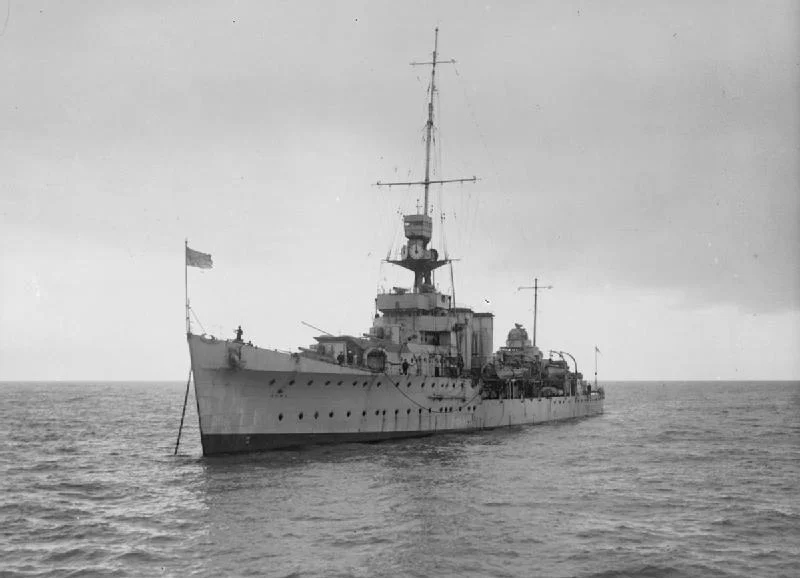

The Slamat Disaster
On the morning of 27 April 1941, three Allied vessels — the Dutch troopship SS Slamat and the British destroyers HMS Diamond and HMS Wryneck — were sunk within hours of each other in the waters east of the Peloponnese. The Luftwaffe's Junkers Ju 87 dive bombers, operating under Wolfram Freiherr von Richthofen's VIII Fliegerkorps, found them during Operation Demon, the desperate evacuation of British, Australian, and New Zealand troops from Greece. Of the roughly 1,049 men across all three ships, 66 survived.
The Day Greece Was Given Up
Germany and Italy had invaded Yugoslavia and Greece on 6 April 1941. The Allied expeditionary force — British, Australian, and New Zealand troops — lost ground quickly. By 17 April, planners were organizing the evacuation of 60,000 men under Operation Demon. SS Slamat, a Dutch ocean liner converted to a troopship by Koninklijke Rotterdamsche Lloyd, had been operating in the Indian Ocean since October 1940. Orders sent her through the Suez Canal and into the Mediterranean. On 24 April she departed Alexandria as part of Convoy AG 14, one of six merchant ships bound for Greece. Two days later, off the Greek coast, the convoy split. Slamat and a smaller troopship were directed to Nauplia and Tolon on the Argolic Gulf, escorted by a cruiser and destroyers. The port at Nauplia was already in chaos. A Belfast Steamship Company troopship had run aground in the bay on 24 April, blocking it; an air attack the following day reduced it to a total loss. Ships had to anchor in open water while tenders ferried soldiers from shore. On the approach to Nauplia, Slamat's convoy was attacked. Bombs struck B and C decks, destroyed two lifeboats, and wounded one crewman. The ship reached the anchorage. She would not survive the morning.
Four Bombs
Von Richthofen had planned to catch the evacuation ships as they departed their embarkation points on the morning of 27 April. The Stukas found Slamat. HMS Hotspur's crew watched four bombs hit her. The troopship went down fast enough that the lifeboat launches descended into disaster of their own. Lifeboat No. 10 capsized under the weight of too many men. Lifeboat No. 4 was still being lowered when HMS Diamond had to accelerate away to evade another air attack, and it overturned. Men entered the water in large numbers. One of the Stuka pilots, Bertold Jung — a former German navy man — saw one or two of his fellow pilots machine-gunning survivors in the lifeboats. Jung flew back to Almyros airfield and complained forcefully: the people in those boats had suffered enough and should be spared in future. His protest was noted. It did not undo what had already been done.
Diamond and Wryneck
HMS Diamond and HMS Wryneck turned back to search for survivors. It was the right thing to do and it cost both ships. The Stukas found the destroyers at work among the floats and wreckage. Both were sunk around 1330 hours. Vice-Admiral Pridham-Wippell sent HMS Griffin to the position. Griffin arrived after dark and, at 0240 hours, reported what she had found: 14 survivors in two Carley floats, and the news that both destroyers had already been gone for hours. In the morning Griffin searched again, found a few more floats, and pulled four additional men from the water. She took them all to Crete. Of Diamond's complement of 166, only 20 survived. Of Wryneck's crew of 106, only 27. From Slamat herself, 11 men lived.
The Whaler's Passage
Some of the survivors' journeys home were long and improbable. Wryneck's whaler — a small open boat — was still afloat on 28 April, roughly 30 nautical miles off the island of Milos in the Aegean. The men in it set a course for Milos. At noon they sighted Ananes Rock, about 13 nautical miles southeast of the island, and landed there, exhausted. At the rock they found a caïque carrying Greek refugees and British soldiers, bound from Piraeus for Crete and sailing only at night. That evening the caïque left Ananes heading south, towing the whaler with five men aboard. The following day, 29 April, they sighted a small British landing craft, A6, operating out of Porto Rafti near Athens. The landing craft took everyone on board. The next day they reached Souda Bay, Crete. Other survivors from all three ships were eventually brought to Port Said, Egypt, by HMS Hotspur. George Dexter, a Royal Army Service Corps veteran, was rescued from the water after Wryneck sank by HMS Orion.
Remembrance
The war in Greece ended quickly. The losses in the Argolic Gulf on 27 April 1941 were absorbed into a larger collapse. The 983 dead were not forgotten by those who knew them. When the Netherlands was liberated in May 1945 and the Dutch government returned from exile, the reckoning with what the war had taken began in earnest. In August 1946, Queen Wilhelmina wrote to the widow of Captain Luidinga of the Slamat. She called him "een groot zoon van ons zeevarend volk" — a great son of our seafaring people. The Royal Navy personnel lost on Diamond and Wryneck are commemorated on naval monuments at Chatham, Plymouth, and Portsmouth. George Dexter, who had survived the sinking of Wryneck, later commissioned a monument to all those lost across the three ships. It stands in the Royal British Legion Club in Shard End, Birmingham. There is nothing to mark the water where they went down. The Argolic Gulf is open sea.
From the Air
The Slamat disaster occurred at approximately 37.02°N, 23.17°E, in the waters off the east coast of the Peloponnese near the Argolic Gulf. From the air at 5,000–8,000 feet, you see the blue expanse of the gulf, the craggy peninsula reaching south, and the bay near Nafplio (ancient Nauplia) where the evacuation ships anchored. There is no wreck visible, no marker on the water — only open sea where three ships went down within hours of each other. The nearest major airport is LGAV, Athens International "Eleftherios Venizelos," approximately 100 km to the northeast. The coast of the Argolic Gulf is roughly 40 km southwest of the disaster coordinates.
Nearby Stories
- Epidaurus Limera 0.8 km away
- Agios Vasileios — Mycenaean Palace of Laconia 3.2 km away
- Vervena 12 km away
- Kalamakia Cave Site 14 km away
- Franchthi Cave 20 km away
- Agios Georgios (island) 40 km away
- SS Heraklion 54 km away
- Milos 77 km away