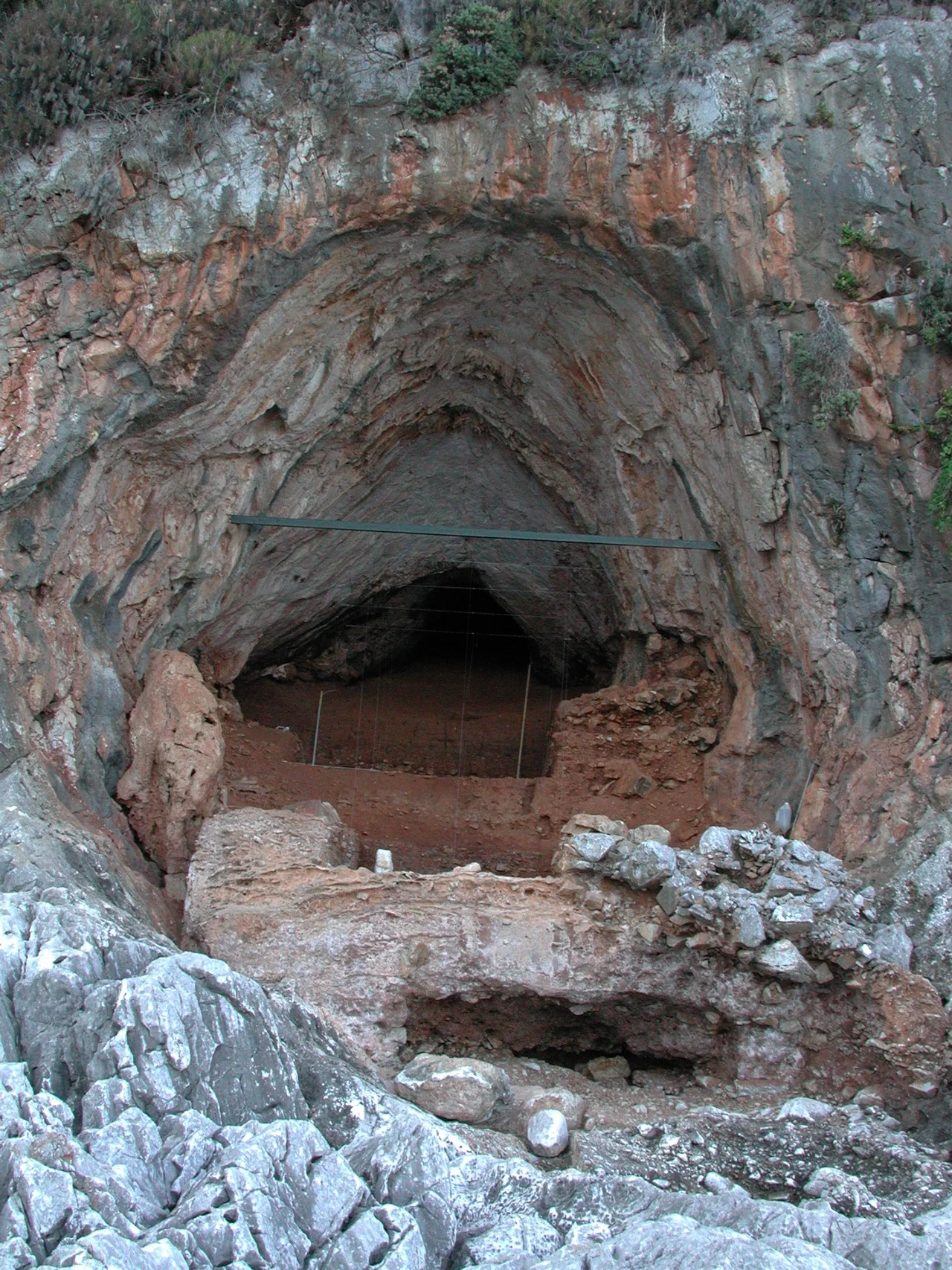

Kalamakia Cave Site
Fourteen people left their bones in this cave. They were not buried here by chance or swept in by water — the evidence shows they lived here, repeatedly, in a place chosen with care: two meters above the sea, close enough to hear waves, sheltered enough to stay through seasons. They were Neanderthals, and the cave at Kalamakia on the western Mani peninsula preserves, in layered sediment, the record of what their lives on this coast looked like.
A Cave by the Sea
Kalamakia sits near Areopolis on the western coast of the Mani peninsula, occupying one of the lowest natural platforms on the shoreline — within ten meters of the water, roughly two meters above present sea level. The position mattered. Tectonic activity has shifted platforms and coastlines across the Mani over geological time, and the cave's low elevation reflects a period when sea levels and landforms were arranged differently than they are today. During the Pleistocene, when the cave was occupied, what is now the Messenian Gulf looked different; the shore was a resource, and proximity to it was a reason to return. Systematic excavations began in 1993, led by archaeologists Andreas Darlas and Henry de Lumley, who identified seven distinct stratigraphic units in the sediment — a layered archive running from a lower stalagmitic floor up through beach deposits, wind-blown sands, angular gravels, clay-bound scree, and silt layers to an upper stalagmitic crust. Each layer is a chapter.
What the Sediment Holds
The seven stratigraphic layers at Kalamakia are not just geological bookkeeping. Each records a different environmental moment: the Tyrrhenian beach layer documents a period of higher sea levels; the wind-blown dune sands speak to drier, more exposed conditions; the red clay matrix embedded with large blocks suggests episodes of erosion and slope collapse. Running through these layers are the things the cave's inhabitants left behind — stone tools worked from raw material gathered in the area, the bones of large and small vertebrates, and fossils of marine fauna brought in from the nearby shore. Researchers from the University of Crete, analyzing faunal remains and the wear patterns on ruminant teeth, concluded that the cave's climate during occupation was temperate. That relative warmth, combined with coastal access and shelter, made Kalamakia attractive for habitation across multiple periods rather than just one.
The People of the Cave
Fourteen human remains were recovered from the Kalamakia excavation. They are Neanderthal. These were not isolated individuals but evidence of a community — or several communities across time — that returned to this specific place. Studies of the skeletal material indicate that some occupation periods were brief, seasonal stays, while others were more extended. The Neanderthals who lived here were not simply passing through. They worked stone, selecting and shaping raw material, adapting tools to the tasks at hand. They hunted the large vertebrates whose bones accumulated in the same deposits. They fished or collected from the sea nearby. Taken together, the remains at Kalamakia describe people who knew this coast and used it deliberately — not the wandering, improvising figures of an older imagination, but inhabitants with a relationship to a particular place on a particular stretch of shoreline.
A Place Still Being Read
Excavations begun in 1993 have generated a body of scholarly literature on Kalamakia's palaeoenvironment, its faunal assemblages, and its stone tool traditions. The site sits within a broader Palaeolithic landscape of the Balkans — a region that preserves evidence of Neanderthal populations in cave and open-air sites across what is now Greece, the former Yugoslavia, and Bulgaria. Kalamakia is notable among them for its coastal setting, its stratigraphic completeness, and the number of human remains recovered. The Mani peninsula today is known for its medieval tower houses, its stark limestone terrain, and its fierce local identity. But beneath all of that — beneath the centuries of walls and battles and Byzantine chapels — the cave above the sea at Areopolis holds evidence of a different deep history, one that stretches back through the Pleistocene to people who had no name for this peninsula but who chose it, again and again, as home.
From the Air
Kalamakia Cave sits near 36.676°N, 22.365°E on the western shore of the Mani peninsula, close to Areopolis. The nearest major airport is Kalamata International (LGKL), approximately 45 km to the north. Approaching from the north at 3,000 to 5,000 feet, the western Mani coastline is visible as a narrow strip between the Taygetus foothills and the Messenian Gulf; the cave site itself is not visible from altitude, tucked into a low platform above the water. The contrast between the rugged limestone upland and the calm blue of the gulf below is a defining visual feature of this approach.
Nearby Stories
- Battle of Pylos 8.6 km away
- Battle of Sapienza 14 km away
- Agios Vasileios — Mycenaean Palace of Laconia 16 km away
- Epidaurus Limera 18 km away
- Leonidio 28 km away
- Battle of Cape Spada 110 km away
- Siege of Chania (1645) 181 km away
- El-Kouf National Park 409 km away