._Ancient_Agora_Museum_of_Athens.jpg)
Battle of Pylos
Demosthenes hadn't been given official command of anything. He was aboard as an adviser, a strategos-elect whose formal authority wouldn't begin until midsummer. But he had a plan he'd been keeping to himself — a plan to fortify Pylos, a rocky promontory commanding the Bay of Navarino, deep in Spartan-controlled Messenia. The generals in charge rejected it. Then a storm blew the fleet onto the very shore Demosthenes had wanted, and boredom finished what the storm had started: Athenian sailors, waiting out the weather with nothing to do, began piling up walls with their bare hands. Within days, a small garrison held a defensible position in the heart of Spartan territory. Within weeks, that position had thrown the Spartan government into a crisis that Thucydides would record as one of the war's decisive turning points.
An Accidental Foothold
Pylos was not, in 425 BC, a significant place. It was a peninsula jutting into the Bay of Navarino, far from Sparta's main lines of communication, commanding an excellent natural harbour. Demosthenes had identified it as ideal for a forward outpost — close enough to Sparta's territory to cause trouble, defensible, and supplied by sea. When the Athenian fleet en route to Sicily was forced ashore there by a storm, Demosthenes seized the moment. The two generals, Sophocles and Eurymedon, were unconvinced even then; it took the assembled soldiers' restlessness to get construction underway. They worked hard. Within a few days the promontory had rough walls. When the main fleet sailed on toward its original destination, Demosthenes was left with five triremes, perhaps six hundred men — only ninety of them hoplites — and a newly built fort in enemy country.
Sparta's Alarm
The Spartan reaction was faster and sharper than anyone had expected. Agis, the Eurypontid king, was at that moment leading an army through Attica, burning crops and farms in the annual invasion the Peloponnesian War had made routine. He turned for home after just fifteen days — the briefest such expedition on record. The fleet that Sparta had been operating at Corcyra was recalled. Allies across the Peloponnese were summoned. Within days of Demosthenes raising his walls, Sparta had assembled forty-three triremes and a substantial land army. The Spartan plan was straightforward: assault the promontory from land and sea simultaneously, then blockade the harbour with hoplites stationed on Sphacteria island, which sat in the middle of the bay's main entrance. It did not go as planned.
A Day and a Half of Assault
Demosthenes had anticipated exactly where the Spartans would hit hardest — the southwest corner of the peninsula, where his wall was weakest and the beach most suitable for landing. He stationed himself there with sixty hoplites and a few archers. Spartan triremes drove themselves onto the rocky shore to disembark soldiers, an approach that damaged the ships but gave the crews a chance to fight. Captain Brasidas led by personal example, driving his ship onto the beach, until he was badly wounded and fell. Wave after wave came and retreated. The tactic of storming a fortified beach against determined defenders was, as Thucydides dryly observed, notoriously difficult in this era. After a day and part of a second, the Spartans gave up the direct assault and settled in for a siege. They sent ships to fetch timber for siege engines. That pause was fatal.
The Tables Turn
The Athenian fleet, fifty triremes strong, arrived from Zacynthus the day after the Spartans stopped their assaults. The Spartans had planned to blockade the harbour entrances with ships in the gaps around Sphacteria — but they had been unable to do so, whether from miscalculation or incapacity. The Athenians sailed in through both entrances and routed the Spartan fleet in quick order. The consequences were immediate and staggering: 440 Spartan soldiers, including 120 men of the elite Spartiate class — probably one tenth of all Spartiates then alive — were now trapped on Sphacteria, unable to escape or be resupplied. Members of the Spartan government rushed to the scene in person. An armistice was arranged on the spot. Sparta surrendered its entire fleet as a guarantee of good faith and sent ambassadors to Athens to negotiate peace. That negotiation would fail, but the men on Sphacteria were not going anywhere.
A Shield Hung in Athens
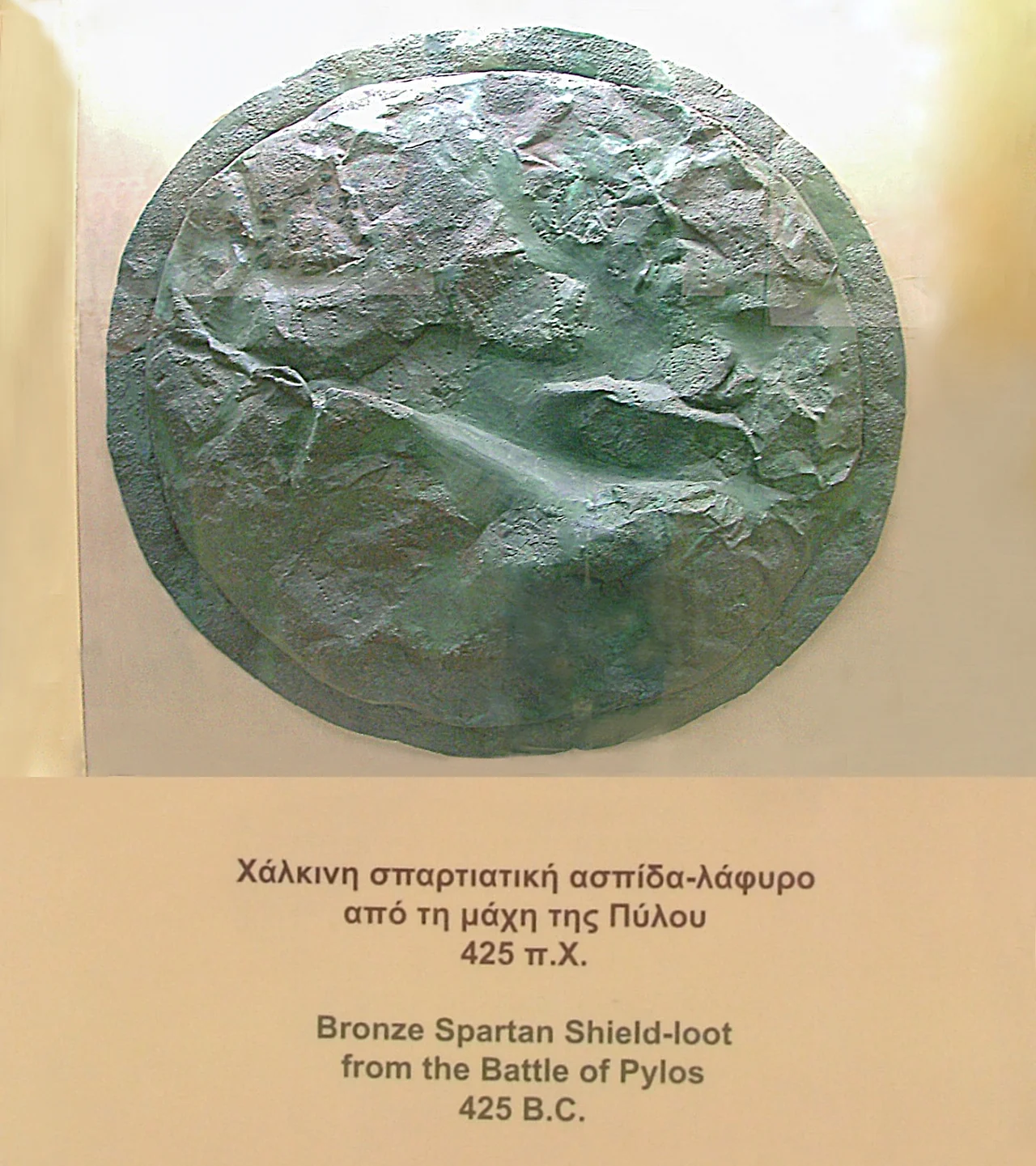
The peace talks collapsed, undone partly by the Athenian politician Cleon's maximalist demands and partly by the impossibility of Sparta publicly conceding what amounted to betrayal of its allies. The armistice at Pylos ended. The men on Sphacteria remained. Demosthenes and his garrison settled in to wait them out, guarding the island day and night. A bronze Spartan shield captured in the battle was eventually hung in the Painted Stoa in Athens — it survives today in the Ancient Agora Museum, still bearing its inscription: "taken from the Spartans at Pylos." The crisis set in motion by that accidental storm and those restless sailors would resolve the following summer at the Battle of Sphacteria — a resolution that, as Thucydides wrote, shook the Greek world.
From the Air
The Pylos peninsula lies at approximately 36.92°N, 21.70°E at the southern end of Navarino Bay (modern Pylos / Pylos town). From altitude, the bay's geography is striking: the narrow, elongated island of Sphacteria running along the western side clearly illustrates how it could block or control access to the harbour. The fortified promontory Demosthenes occupied is the headland above the present town. Nearest airport: LGKL (Kalamata International), approximately 50 km to the northeast. A low pass over the bay at 2,000–3,000 feet reveals both the Pylos headland and Sphacteria in a single view, making the ancient tactical situation immediately legible.
Nearby Stories
- 1986 Kalamata Earthquake 2.8 km away
- Peloponnese 20 km away
- Kalamakia Cave Site 21 km away
- Lepreum 22 km away
- Strofades 29 km away
- 2018 Ionian Sea Earthquake 55 km away
- Apidima Cave 67 km away
- Valletta 597 km away