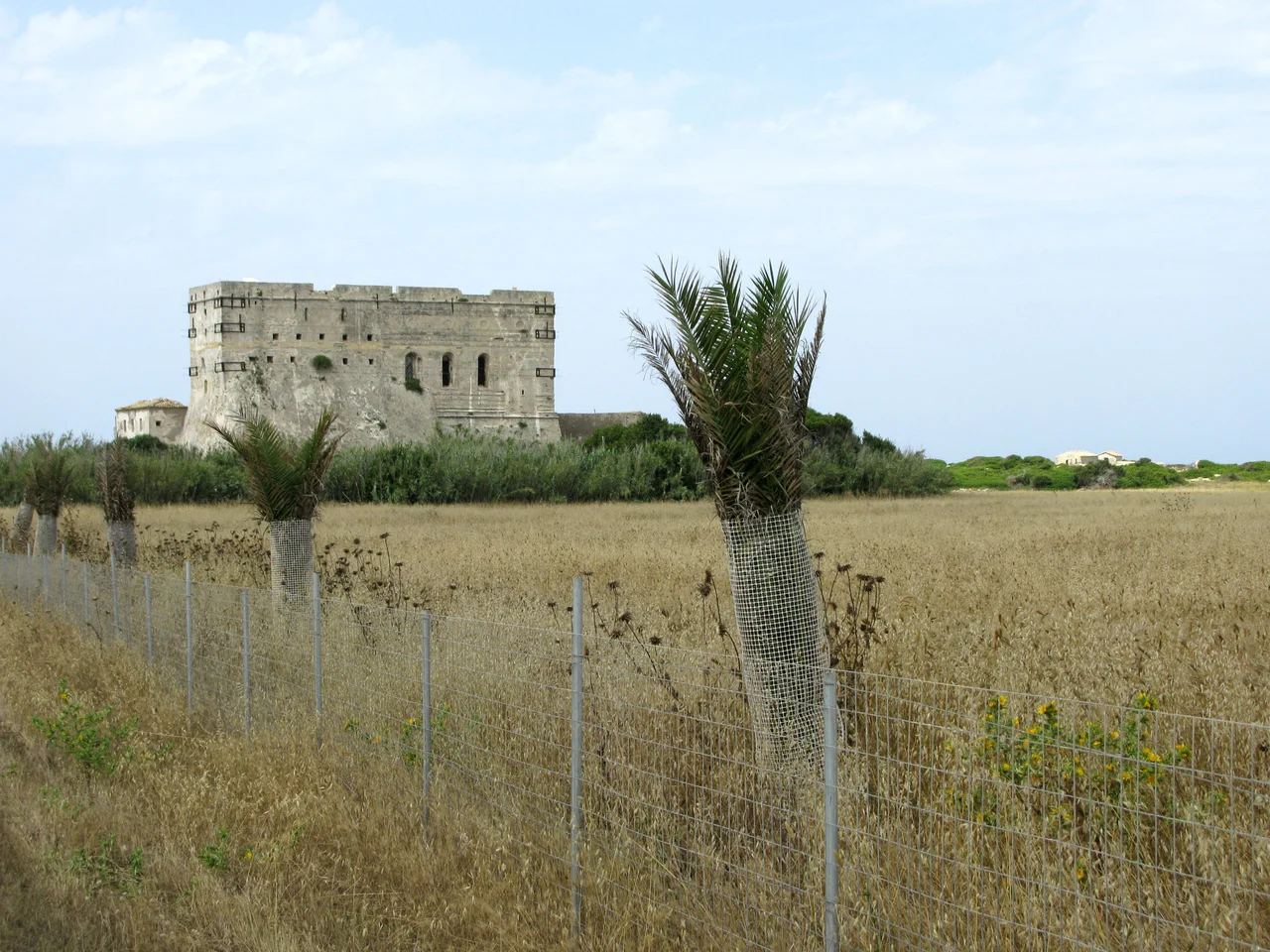

Strofades
For most of history, the Strofades were easiest to explain through myth. Virgil wrote that the Harpies — those shrieking, clawed creatures that tormented the blind prophet Phineus — made these two flat, windswept islands their home. Aeneas and his Trojans landed here and were driven off. Even the name stuck: the Strofades, 'Islands of Turning,' marks the place where the Argonauts Zetes and Calaïs turned back in their pursuit of the monsters, persuaded by the rainbow goddess Iris to let them go. For islands that barely clear the waterline 44 kilometers south of Zakynthos, the Strofades carry an outsized mythological burden. And then, underneath the myth, there is the history — stranger and more stubborn than anything Virgil invented.
A Fortress Built from a Shipwreck
In 1241, a princess named Irene Laskarina — daughter of the Nicaean Emperor Theodore I — survived a shipwreck on Stamfani, the larger of the two islands. Her gratitude took the form of stone. At her request, a monastery dedicated to the Transfiguration of Christ was built on the island, and it was built like a fortress: thick walls, defensive parapets, cannon emplacements. The design was not decorative. Pirates and Ottoman raiders made the Ionian Sea dangerous for centuries, and the monks who came to live here needed walls they could fight behind.
In 1717, that threat became reality. On August 19, Ottoman forces attacked the monastery. The monks were captured and killed; only two, hidden in the scrubby undergrowth, survived. They carried the relics of Saint Dionysios back to Zakynthos. Two cannons remain at the gate today. The monastery survived, and monks continued to live there across the centuries, including — for a time — Dionysios of Zakynthos himself, who became the island's patron saint and died in 1622.
The Last Monk
Father Grigorios arrived at Stamfani in 1976. He was not quite alone: there was still a lighthouse keeper on the island. But in 1985 the lighthouse was automated, and the keeper left. Grigorios stayed.
He remained the sole inhabitant of the Strofades for nearly three decades, tending the monastery through Ionian winters and long silences. On November 18, 1997, a magnitude 6.6 earthquake struck the island and caused severe damage to the historic buildings. It was the only time Grigorios left — and only for a few days. He came back and tried to rebuild.
In 2014, ill health finally forced him to retire to his home village of Agalas on Zakynthos. He died there in 2017. The monastery now stands without a permanent guardian. The main tower is in a precarious state, weakened by that earthquake and by the slow attrition of decades without enough hands to keep up with the work.
Where the Birds Stop
The Strofades are sparsely vegetated and low — rocky plateaus barely above the sea. In spring, that makes them invaluable. Migratory birds crossing the Mediterranean funnel through these islands on their way north, using the tiny scraps of land as a waystation when there is nowhere else to rest. Turtle doves arrive in waves during spring migration. Cory's shearwaters nest here. So do Scopoli's shearwaters — between 2,000 and 3,000 breeding pairs, a population large enough for BirdLife International to designate the Strofades as an Important Bird Area.
The smaller island, Arpia — whose name preserves the ancient word for Harpy — is home to the Ionian wall lizard, Podarcis ionicus. Hunting is prohibited across both islands, which fall within the National Marine Park of Zakynthos and are included in the European Natura 2000 network. The Harpies are gone, or at least the winged kind. What remains is quieter and, in its own way, just as vivid.
What Dante and Rabelais Noticed
The Strofades appear in The Divine Comedy — Dante knew his classical geography — and in passing in the fifth book of Rabelais' Pantagruel. These are not cameos. They reflect how thoroughly the islands had entered the European literary imagination by the medieval and Renaissance periods, anchored there by Virgil's Aeneid and by the strange, repeating logic of their name.
The etymology itself is contested. One reading connects 'Strofades' to the Greek verb for turning, *strepho*, reflecting the Argonauts' reversal. Another points to *στροφάδες άελλαι* — 'whirling storms' — because the winds here come in sudden and strong, spinning off the open Ionian in ways the ancients associated with the monsters they had written into the landscape. The winds still come. The north wind is called Ziti; the south, Kalai — names that echo the very Argonauts who once chased the Harpies through this sky.
From the Air
The Strofades lie at approximately 37.26°N, 21.01°E, about 44 km south-southeast of Zakynthos in the open Ionian Sea. Flying south from Zakynthos, they appear as a pair of nearly flat landmasses with the whitewashed walls of the fortress-monastery visible on Stamfani. The nearest airport is LGZA (Zakynthos 'Dionysios Solomos' Airport), approximately 50 km to the north-northwest. Approach from the north at 3,000 to 5,000 feet for the best view of the monastery complex and the lighthouse. The sea around the islands is strikingly clear and shallow in contrast to the deep Hellenic Trench to the southwest.
Nearby Stories
- 1886 Peloponnese Earthquake 9.9 km away
- Samicum 17 km away
- Battle of Zonchio 21 km away
- 2018 Ionian Sea Earthquake 33 km away
- Hellenic Trench 53 km away
- Navarino Massacre 69 km away
- Chavriata 112 km away
- Valletta 538 km away