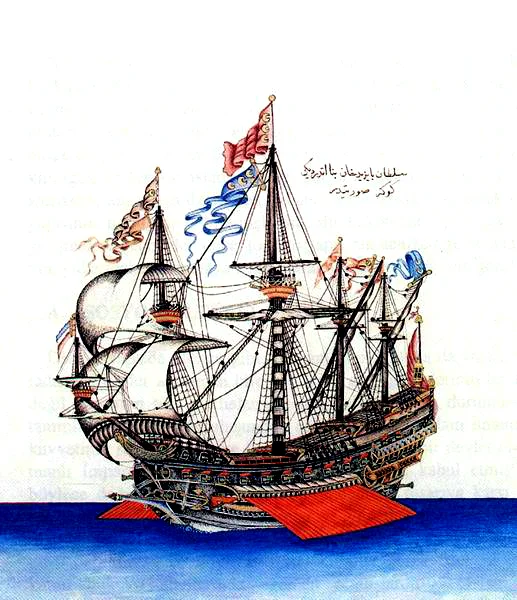
_the_flagship_of_Kemal_Reis.jpg)
Battle of Zonchio
History records a great many "firsts" that were accidents — the first shot fired in a war nobody wanted, the first ship sunk by weather rather than enemy action. The Battle of Zonchio offers a different kind of first: a deliberate, engineered transformation of what naval combat could be. When Ottoman and Venetian fleets clashed off the coast of Navarino across four days in August 1499, the Ottomans brought with them two enormous carracks — vessels displacing 1,800 tons each, mounting heavy artillery, carrying one thousand soldiers apiece — and the world watched guns fire from ships in a naval battle for what is believed to be the first time in recorded history.
The Admiral Who Bought His Commission
Venice chose Antonio Grimani to command its fleet for reasons that had less to do with military genius than with money. He was 65 years old, a proven captain but an inexperienced fleet commander, and he had secured the position partly through a donation of 16,000 ducats to the state treasury and personal funding for 10 galleys. He was sent out without clear instructions about whether to fight offensively or defensively. The Venetian captains who gathered at Methoni in July 1499 advised him to steer the fleet to open sea — yet when the moment to act arrived, Grimani hesitated. Arrayed against him was Kemal Reis, an experienced corsair who had Sultan Bayezid II's full confidence and a mandate to wage large-scale war. The mismatch would define the entire campaign.
Ships That Changed the Sea
The Ottoman fleet that appeared in the Ionian Sea in the summer of 1499 numbered some 260 vessels and carried as many as 35,000 fighting men, including elite Janissaries. Its most formidable elements were two massive carracks called göke — a term derived from the word for cog — built under the direction of a renegade Venetian engineer named Gianni, who had worked at the Venetian Arsenal before defecting to Ottoman service. These ships were enormous even by the standards of a century later: 1,800 tons displacement, guns mounted to fire broadside, maintops large enough to hold forty arquebusiers. Their artillery could reach out and strike enemy ships before oars could close the distance. Venetian galleys, designed to ram and board, had no good answer. The göke were thought to be invulnerable — and on the waters off Navarino, they largely proved it.
Four Days of Hesitation
The battle did not unfold in one decisive clash. It stretched across four separate engagements — 12, 20, 22, and 25 August 1499 — each offering the Venetians a chance they failed to take. On 12 August, eight Venetian galleys disobeyed orders and fled before contact. On the 20th, fireships fashioned to burn the Ottoman fleet were spotted and avoided. On the 22nd, Venetian and French guns drove Ottoman ships toward shore, but Grimani ordered retreat rather than finish the attack. French ships under Guy de Blanchefort and Prégent de Bidoux had come to help and left in disgust. Then, on 25 August, the Ottoman fleet finally slipped into the Gulf of Lepanto. The city would be besieged by land and sea. Grimani's own report on his captains — "the whole fleet with one voice cried 'Hang them! Hang them!'" — was the clearest summary of a campaign defined by mutual recrimination.
The Doge Who Was Once in Chains
The aftermath of Zonchio fell hardest on Grimani. Venice was furious. His palace and shops were vandalized. He was arrested, returned home in chains, and banished to the island of Cres. And then — in one of history's more peculiar reversals — he was elected Doge of Venice in 1521, the highest office in the republic. The Ottoman Sultan Bayezid II rewarded Kemal Reis with ten of the captured Venetian galleys. The war continued for four more years, ending in 1503 with Venetian concessions and Ottoman consolidation of their position as a Mediterranean naval power. The guns of Zonchio had announced a new age. Not every announcement, it turned out, was fully understood by the people who heard it.
The Waters Off Navarino
The battle took place in the Ionian Sea between Pylos and Methoni, in the open water off the western Peloponnese. There are no monuments here, no marked buoys, no commemorations at the site itself. The sea off Navarino is the same brilliant Ionian blue it has always been — deep, open, and indifferent to what happened on its surface. Navarino Bay itself, just to the east, is one of the largest and most sheltered natural harbours in the Mediterranean. It would see another decisive naval battle three centuries later, in 1827, when Allied fleets destroyed the Ottoman-Egyptian armada during the Greek War of Independence. History, at Navarino, has a tendency to repeat.
From the Air
The battle site lies in the open Ionian Sea at approximately 36.90°N, 21.68°E, in the waters between Pylos and Methoni on the southwestern Peloponnese. No single landmark marks the engagement — it was fought across a wide expanse of open water. From altitude, the coastline of Messenia is clearly visible: Methoni's Venetian castle on its cape to the south, and the enclosed waters of Navarino Bay (Bay of Pylos) to the north. The island of Sapienza lies offshore to the southwest. Nearest airport: LGKL (Kalamata International), approximately 50 km northeast. Best viewed at cruise altitude approaching from the west, with the Ionian Sea open ahead and the Peloponnese coast below.
Nearby Stories
- Kardamyli 10 km away
- 1886 Peloponnese Earthquake 11 km away
- Vergadeika 18 km away
- Strofades 20 km away
- 2018 Ionian Sea Earthquake 91 km away
- Battle of Cape Spada 171 km away
- Siege of Chania (1645) 245 km away
- Valletta 595 km away