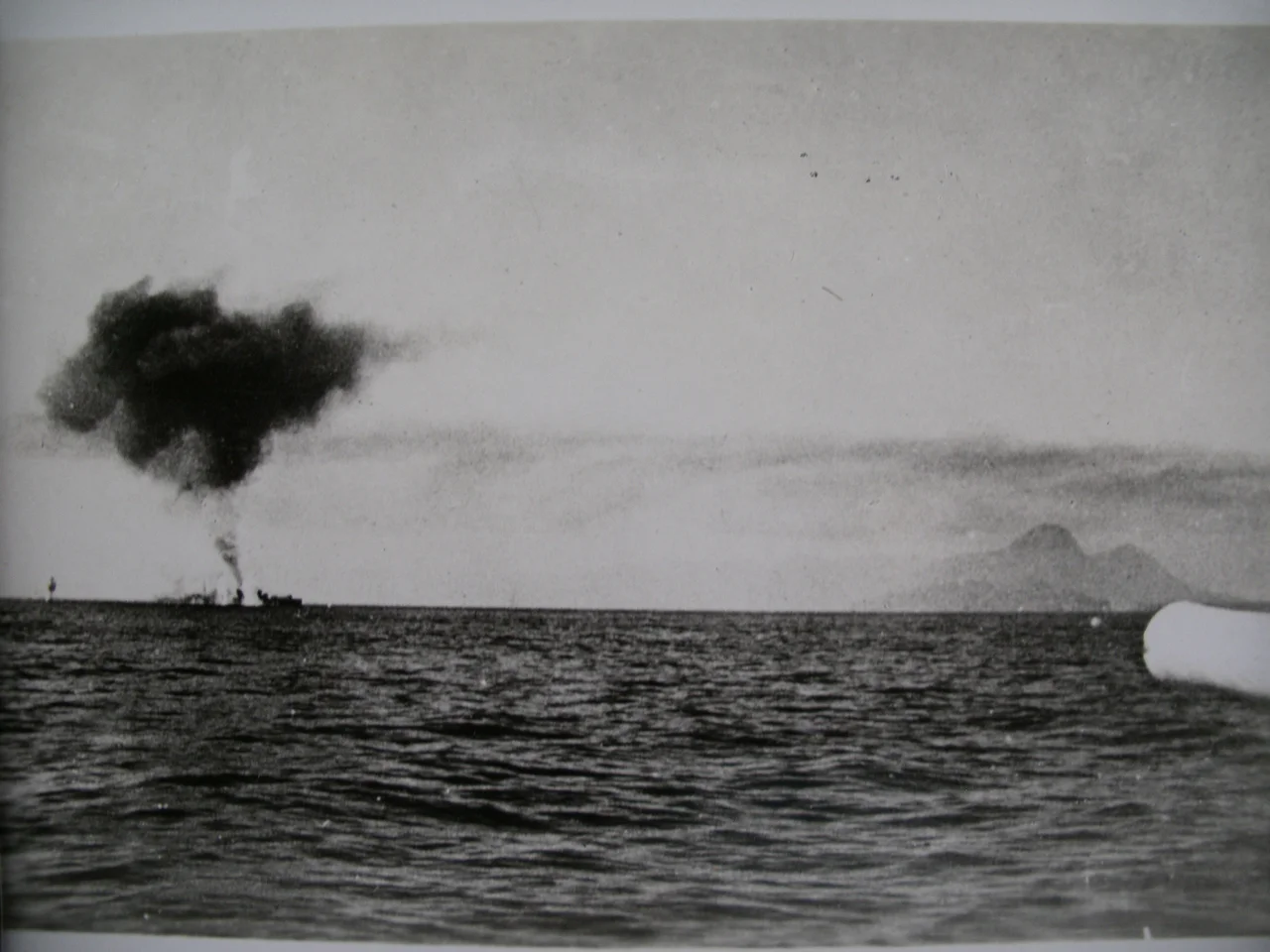

Battle of Cape Spada
Bartolomeo Colleoni was built to outrun anything she could not outshoot. Italian designers stripped her armor to make room for engines that pushed her past 37 knots in trials, the kind of speed a heavyweight boxer fears in a smaller man. On the morning of 19 July 1940, that speed was supposed to carry her safely from Tripoli to the Dodecanese. Instead it carried her into a fight she could not survive, in waters most of her crew had never seen, ten miles north of Cape Spada on the rocky northwestern corner of Crete.
Encounter at 0730
A small Royal Navy squadron was sweeping the Aegean for submarines: the light cruiser HMAS Sydney under Royal Australian Navy Captain John Collins, and five destroyers - Ilex, Hyperion, Hero, Hasty, and Havock. At about 0730 the destroyers spotted two unfamiliar silhouettes in the haze. They were the Italian light cruisers Bartolomeo Colleoni and Giovanni delle Bande Nere, the 2nd Cruiser Division under Vice-Admiral Ferdinando Casardi, en route to garrison the Italian-held islands of Leros. Sydney was twenty miles north, off on her own search. The destroyers turned and ran, drawing the Italians northward. Casardi gave chase, smelling easy prey. He was being herded.
The Chase Closes
Sydney saw the Italians at 0826 and opened fire three minutes later. The Italian cruisers wheeled southwest, hoping to break clear, but the Cretan coast pinned them - they could not turn south without running aground. Their speed advantage shrank with every mile. At 0923 a 6-inch shell from Sydney punched through Bartolomeo Colleoni's unarmored hull and detonated near her boilers. Steam screamed from her funnels. Her engines died, her main guns fell silent, and she lay drifting in the chop. Her secondary 100-millimeter battery kept firing for thirty-six more minutes. Her crew did not stop trying. Captain Umberto Novaro stayed on his bridge as the ship slowly heeled. At 0959 torpedoes from Ilex and Hyperion finished her, and she rolled under. Sydney pursued Bande Nere until she ran low on ammunition - one Italian shell punched a hole through her forward funnel that the ship would carry like a bullet wound for the rest of her career - then turned for home.
The Cost
Of Bartolomeo Colleoni's roughly 670 men, 555 survived. One hundred and twenty-one did not. The British destroyers picked up Italian sailors from oil-streaked water all afternoon, the same destroyers that had hunted them an hour before. Captain Novaro, mortally wounded by a shell splinter, was taken aboard HMS Hyperion and given the dignity of medical care from his enemies. He died on 23 July, four days after his ship. The story of Sydney saluting his coffin as it was transferred ashore has become part of how both navies remember Cape Spada - a moment when the brutal arithmetic of cruisers and torpedoes briefly made room for something else. None of this brought back the men sleeping at the bottom of the Aegean. Their names are inscribed on the Italian naval memorial in Brindisi.
Crete Looks On
Cape Spada is a finger of pale limestone cliff at the western end of the Rodopou peninsula, the northernmost point of western Crete. From the cape today you can see across the Gulf of Kissamos to the smaller Gramvousa peninsula, with the Aegean stretching to a flat blue horizon where the battle unfolded. Less than a year after Cape Spada, German paratroopers would fall on Crete itself, and Sydney's sister ships would be running fugitives back to Alexandria under Stuka attack. The hull of Bartolomeo Colleoni still rests somewhere beneath that horizon, never recovered. HMAS Sydney was lost with all 645 hands off Western Australia in November 1941, sunk by the German raider Kormoran. Cape Spada was her finest hour and her crew would not survive long enough to see the war's end.
From the Air
Cape Spada is the northernmost tip of the Rodopou peninsula in northwestern Crete, at approximately 35.69N, 23.72E. The actual battle took place roughly 10 nm north of the cape in open water. Recommended viewing altitude 5,000-7,000 ft AGL for context with the Cretan coast and Gulf of Kissamos. Nearest airport is Chania International (LGSA), 18 nm southeast. Heraklion International (LGIR) sits 80 nm east. From altitude the cape's pale limestone cliffs stand out against the deep blue Aegean; the smaller Gramvousa peninsula and Balos lagoon are visible to the west, with the Antikythera channel opening to the northwest.
Nearby Stories
- Battle of Rethymno 28 km away
- Battle of 42nd Street 30 km away
- Arkadi Monastery 61 km away
- Siege of Melos 74 km away
- Monemvasia Mosque 74 km away
- Monemvasia 94 km away
- Siege of Monemvasia (1821) 103 km away
- Battle of Derna (1805) 309 km away