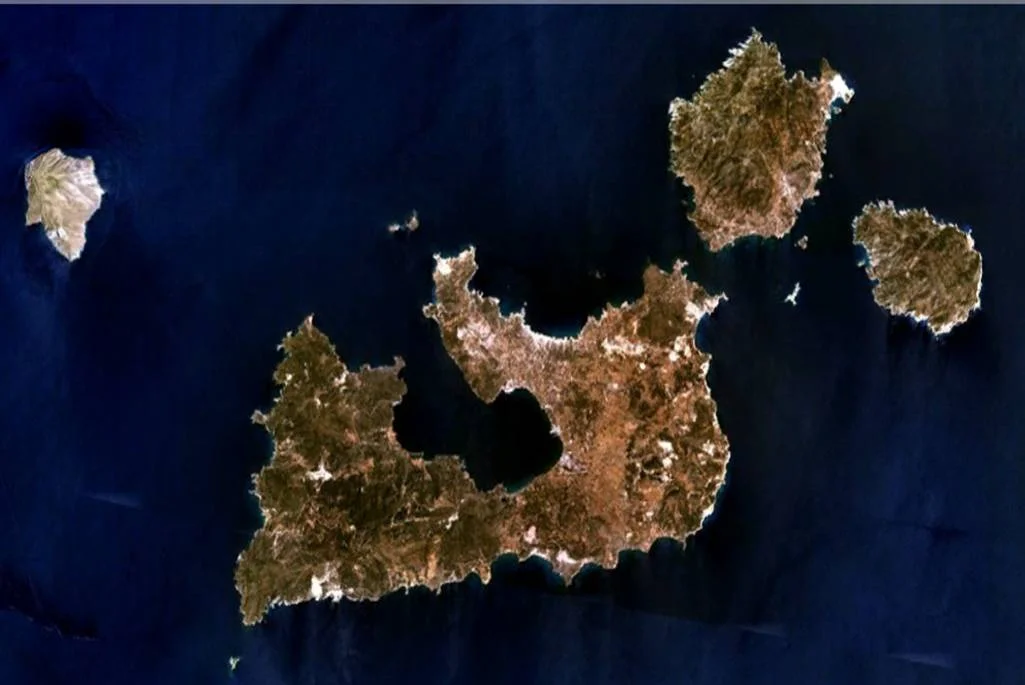

Siege of Melos
The Melians had done nothing to Athens. Their island, in the Cyclades roughly 120 kilometers east of the Peloponnese, was small, agricultural, and committed to neutrality in the war that had pulled most of the Greek world into two camps. Their distant kinship with Sparta amounted to little in practice. They simply wanted to be left alone. In the summer of 416 BC, an Athenian fleet arrived and presented a demand: surrender, pay tribute, accept Athenian rule. The Melians refused. By winter, every man of military age on the island had been killed, the women and children had been sold into slavery, and the island had been resettled with 500 Athenian colonists. Thucydides recorded the negotiations in what became known as the Melian Dialogue, one of the most famous and most brutal documents to survive from the ancient world.
The Melian Dialogue
The Athenian envoys would not waste time on moral arguments. Their position was that the Melian neutrality was, in effect, a refusal to acknowledge Athenian power, and that demonstrating Athenian strength against a small neutral island would discourage rebellions in the empire's larger holdings. The Melians replied that they were not a threat. The Athenians answered that subjects elsewhere would interpret leniency as weakness. The Melians said the gods would help them because their cause was just. The Athenians replied that the strong dominate the weak as a matter of nature, and the gods do not interfere. The Melians said the Spartans would come to their aid. The Athenians said the Spartans would not. The Athenians ended the negotiation expressing surprise at what they called a lack of realism. "The strong do what they can," the dialogue records, "and the weak suffer what they must."
The Siege
There is circumstantial evidence that the siege took longer and cost more than Thucydides directly records. The phrase "Melian famine" entered the Greek language as a metaphor for extreme starvation; Aristophanes used it in *The Birds* in 414 BC, only two years after the events, suggesting his audience would understand. The expression survived into the Byzantine period. The Melians, in other words, did not simply collapse. They held out long enough that watching them starve became an Athenian campaign in itself. When they finally surrendered, what awaited them was not the conditional terms of earlier wars but the maximum penalty the Athenian assembly could impose. Every adult male was executed. The women and children were sold into slavery and dispersed across the empire. The island was given to Athenian settlers.
What This Was, in Plain Language
Modern historians often describe the destruction of Melos as one of antiquity's clearest examples of genocide, in the sense that the political community of Melos was ended deliberately and completely. The men were not casualties of battle; they were prisoners executed after surrender. The women and children were not collateral suffering; they were the property the empire took away. Behind the Melian Dialogue's elegant rhythm of argument and counter-argument is what actually happened to actual people: families separated permanently at the harbor, men marched to a place where they would be killed, children frightened and unable to understand. Even within the Athenian moral universe of the time, this was a step beyond what the city had previously done. After Potidaea in 429 BC, the surviving population had been allowed to leave. Melos got no such mercy.
The Athenian Conscience, Such As It Was
The massacre shocked the Greek world, even Athens. The orator Isocrates, writing later in defense of Athenian conquests, named Melos as a major point of criticism but argued it had been necessary. Xenophon recorded that in 405 BC, when Sparta finally closed in on Athens at the end of the war, Athenians worried out loud that the Spartans would treat them the way the Athenians had treated the Melians. The fear was rational. In March 415 BC, only months after the survivors had been shipped off to slave markets, Euripides premiered *The Trojan Women*, a play set during the fall of Troy that explores in agonizing detail what happens to the women of a conquered city. The play does not name Melos. It did not have to. The historian Mark Ringer notes that Euripides was probably writing the play before the siege ended, but the timing made the resonance unmistakable.
What Followed
The conquest of Melos was supposed to demonstrate Athenian power and discourage rebellion in the empire. Whether it had that effect is uncertain, because what happened next was the Sicilian Expedition. In 415 BC, Athens launched the most ambitious overseas campaign in its history, an attempt to conquer Syracuse. The expedition ended in 413 BC with the entire Athenian fleet destroyed, the army captured, and most of the prisoners worked to death in Sicilian quarries. Whatever advantage the demonstration at Melos had purchased was wiped away. In the wave of rebellions across the empire that followed Sicily, the Athenian deterrent collapsed. The democracy itself fell briefly to oligarchic coup in 411. By 404, Sparta had won the war. The Spartan general Lysander, when he took Athens, did not massacre the Athenians. The Melian dialogue's logic, that mercy makes the strong look weak, turned out to be more brittle than the envoys believed. The dead of Melos got no benefit from the lesson.
From the Air
Melos lies at 36.68°N, 24.42°E in the Cyclades, about 120 km southeast of Athens. The island is roughly 23 km long and shaped like a horseshoe around a deep, almost-enclosed natural harbor, the result of a partially collapsed volcanic caldera. Milos Island National Airport (ICAO: LGML) sits 5 km southeast of Adamas, the main harbor town, with domestic flights only. Best viewed from 4,000-6,000 ft for the harbor's distinctive shape. The ancient city of Melos lay near modern Plaka, on the northern shore of the harbor.
Nearby Stories
- Despotiko 6.2 km away
- Sifnos 26 km away
- Panagia Gremniotissa 30 km away
- Hydra: Fire Ships and Stone Mansions 61 km away
- Monemvasia 76 km away
- Battle of Cape Spada 79 km away
- Archaeological Museum of Chania 103 km away
- Heraklion Archaeological Museum 118 km away