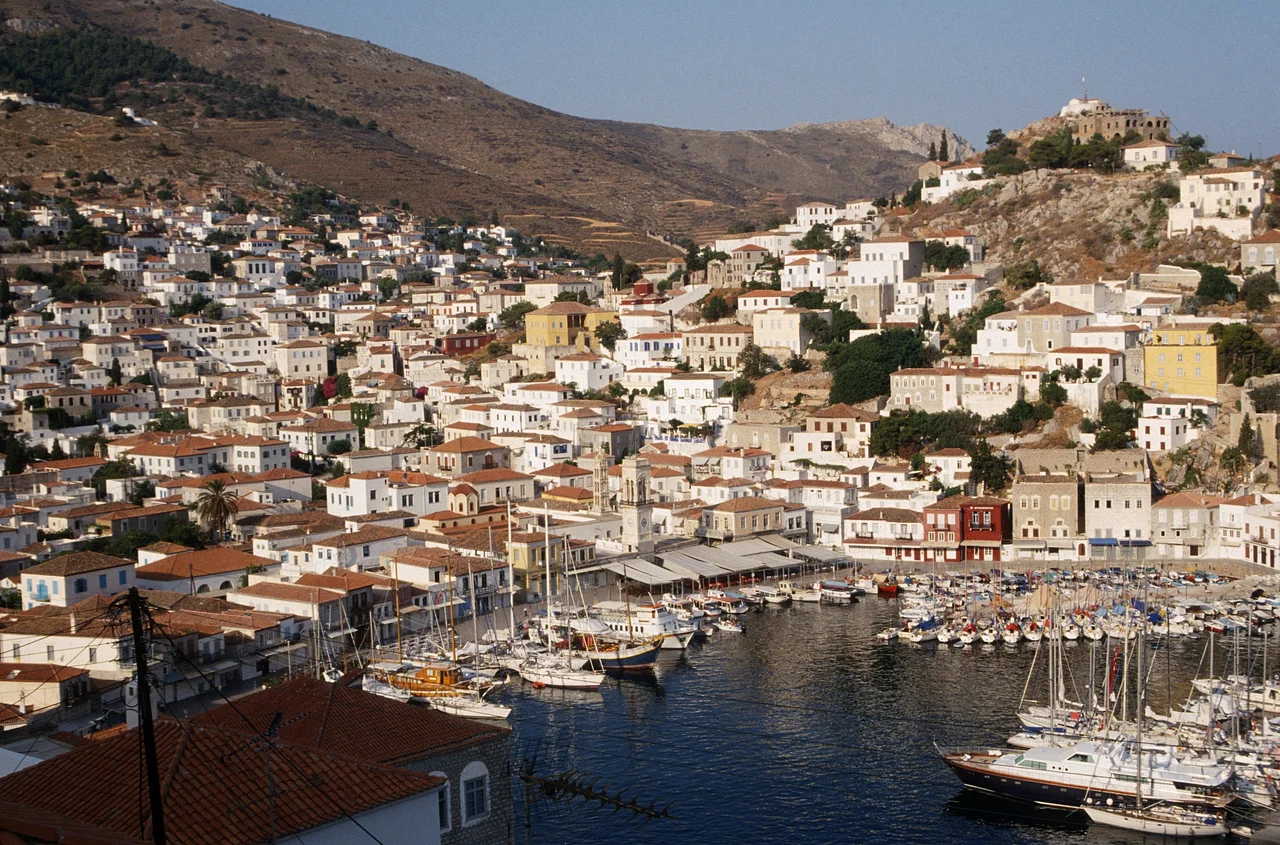

Hydra: Fire Ships and Stone Mansions
Napoleon gave Hydra a silver chandelier. It hangs in the island's cathedral to this day, a gift from the emperor to the merchants who ran the British blockade and kept France fed during the Napoleonic Wars. That detail says almost everything you need to know about what Hydra was: a small, barren, car-free island — it has been car-free since before cars existed — whose people turned an obstacle into an engine. The island has no farmland worth speaking of. Its name derives from the ancient Greek word for water, because the springs that once supplied passing ships are now dry. And yet from this apparently unpromising rock, the Hydriots built one of the most formidable merchant fleets in the eastern Mediterranean and then, in 1821, converted it into a navy that helped win Greek independence.
The Centuries Before the Ships
Hydra's history before the Ottoman period is mostly silence. There is archaeological evidence of Bronze Age habitation — obsidian from Milos, fragments of vases, tools, the head of an idol found on Mount Chorissa — suggesting the island served as a maritime waypoint during the Helladic period. The Dorian migrations around the twelfth century BC appear to have cleared the island. It was resettled in the eighth century BC, possibly by people from the mainland port of Ermioni, and then changed hands between that city, Samos, and Troizina in the way that small strategic islands did in the ancient Aegean. Herodotus and Pausanias mention it, but briefly. For most of antiquity and through the Byzantine era, Hydra stayed at the margins of events — populated, depopulated by pirate raids, repopulated again, a stepping stone rather than a destination.
The Arvanites and the Making of the Hydriot Character
The island's modern population traces its origins primarily to Arvanite communities — Albanian-speaking refugees who settled in the Peloponnese and the islands during the late medieval period. According to local tradition recorded by Antonis Miaoulis in 1830, the Arvanite Hydriots descended from Albanians who fled Ottoman persecution in the 1460s, though historical research suggests the migration came via the Peloponnese rather than directly from Albania. Arvanitika, a form of Albanian, was spoken by all Hydriots for centuries; by the nineteenth century, men had learned Greek but women and children often had not. The language lasted so long on Hydra partly because it was embraced by the merchant class as a mark of identity, and even used by aristocratic Hydriot families like the Koundouriotis clan well into the twentieth century. Church liturgy was sometimes held in Arvanitika — an unusual practice in the Orthodox world.
The Fleet, the Blockade, and the Chandelier
Hydra's maritime transformation began in the seventeenth century. The infertile ground left the islanders no choice but the sea, and they built small vessels first, then larger ones. A ship of 250 tons launched in 1757 marked a turning point. By 1781, the island had fitted out 100 vessels. The critical geopolitical shift came with the Treaty of Küçük Kaynarca in 1774, which gave Russia the right to protect Orthodox Christians in the Ottoman Empire. The Hydriots began sailing under the Russian flag, gaining access to the Black Sea and its grain trade. Their ships ran between the ports of southern Russia and the Italian trading cities of Ancona and Livorno. They ran the British blockade during the Napoleonic Wars, which is how Napoleon came to send the silver chandelier. By the time the Greek Revolution began, the island held 16,000 inhabitants, 125 boats, and 10,000 sailors.
The Fire Ships of 1821
Hydra's entry into the Greek War of Independence was not unanimous. When Antonis Oikonomou expelled the Ottoman governor and proclaimed Hydra's adherence to the independence cause in April 1821, island leaders pushed back — they had a privileged position under Ottoman rule and were reluctant to lose it. Oikonomou was imprisoned, driven from the island, and eventually hunted down and killed by his own people's assassins in December 1821. But Hydra joined the cause nonetheless, and its contribution was decisive. Admiral Andreas Miaoulis deployed fire ships — unmanned vessels packed with combustibles and aimed at the enemy fleet — against the Ottoman navy with devastating effect. Along with the fleets of Spetses and Psara, the Hydriot navy wrested control of the eastern Aegean from the Ottomans. Lazaros Kountouriotis, the island's wealthiest sea captain, gave his entire fortune to fund the war. He is buried in the island's cathedral.
The Artists and Leonard Cohen
After the revolution, Hydra lost its maritime preeminence. The island's shipowners failed to invest in steam power and were outcompeted by the new shipping companies of Piraeus. Sponge fishing provided a partial substitute until Egypt banned foreign vessels from its coastal waters in 1932. Between 1941 and 1943, during the Axis occupation of Greece, famine killed an estimated eight per cent of Hydra's population. Recovery was slow. But the same qualities that had driven the island's decline — its isolation, its ban on wheeled vehicles, its stone streets and captain's mansions — made it attractive to a different kind of migrant in the 1950s and 1960s. Writers and artists from Australia, Norway, and Canada found in Hydra what the commercial world had abandoned: quiet, beauty, and cheap living. Norwegian novelist Axel Jensen came. Australian writers Charmian Clift and George Johnston came. And Leonard Cohen — then a young Canadian poet not yet famous for music — came in 1960, bought a small house for $1,500, and wrote the early songs that would shape his career. The house is still there, still pointed out to visitors, a small white building on a stepped lane above the harbour.
From the Air
Hydra island sits at 37.335°N, 23.473°E in the Saronic Gulf, separated from the Argolic Peninsula of the Peloponnese by a narrow channel of roughly two kilometres. From the air at 5,000–8,000 feet, the island appears as an elongated rocky landmass running roughly east-west, with the main harbour visible as a crescent indent on the north shore. Spetses island lies about 20 km to the southwest; Poros is to the north. Nearest major airport: LGAV (Athens International Eleftherios Venizelos), approximately 65 km north by direct line, with frequent high-speed catamaran service from Piraeus about 37 nautical miles north.
Nearby Stories
- Dendra Panoply 4.7 km away
- Agistri 8.8 km away
- Temple of Poseidon, Sounion 11 km away
- Agios Georgios (island) 14 km away
- Cynuria 16 km away
- Barony of Geraki 18 km away
- SS Slamat 20 km away
- SS Heraklion 32 km away