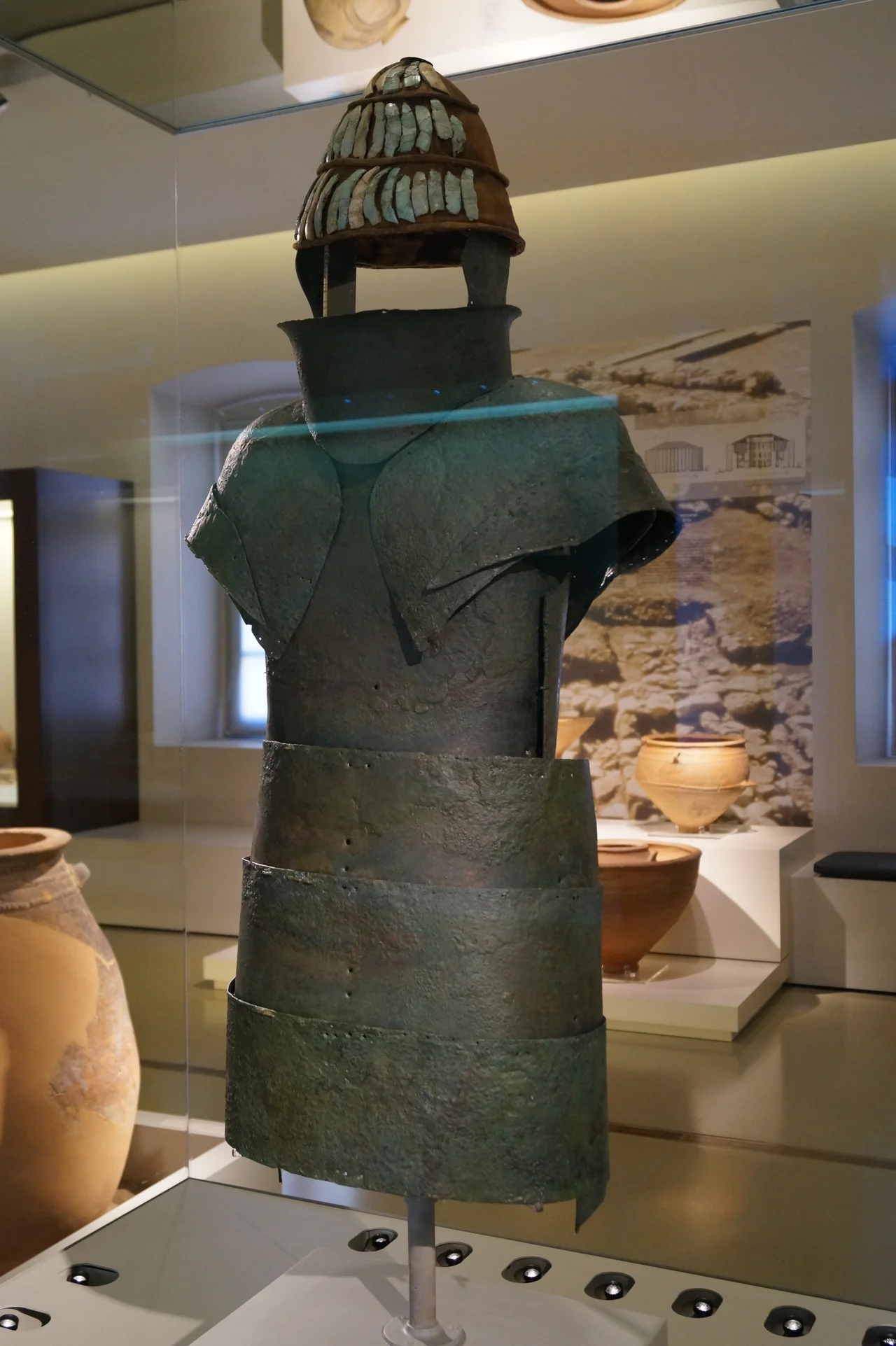

Dendra Panoply
In May 1960, a team of Swedish archaeologists digging in a Mycenaean chamber tomb near the village of Dendra, in the Argolid, found something that rewrote the history of warfare. Buried with a warrior were fifteen separate pieces of beaten bronze sheet, held together with leather thongs, that had once fitted together into a complete suit of armour — chest, back, shoulder guards, neck guard, upper arm plates, and three pairs of curved plates protecting the groin and thighs. Nothing like it had ever been found intact anywhere in the Bronze Age world. The Dendra panoply, as it came to be called, is dated to around 1400 BC, making it the earliest known example of a beaten-bronze full-body cuirass anywhere on Earth. It is now displayed at the Archaeological Museum of Nafplion, about 12 kilometers from where it was buried.
Fifteen Pieces, One Warrior
The panoply is not a single piece of metalwork but a system — fifteen components that overlap, hinge, and hang together to encase a human body from the base of the neck to just below the knees. The cuirass at its core consists of two main plates, for the chest and back, joined on the left side by a hinge and fastened on the right by bronze loops. Large shoulder guards fit over the top of the cuirass, and two triangular plates hang from these to protect the armpits when the wearer raises his arms — a detail that reveals sophisticated ergonomic thinking. A deep neck guard extends upward from the collar; the use of a high bronze neck collar was, at the time, a feature also seen in Near Eastern body armour, suggesting either shared technology or mutual influence across the eastern Mediterranean. Three pairs of curved plates hang from the waist, overlapping downward like a segmented skirt of bronze, protecting the groin and thighs. Fragments of lower arm guards and greaves were also found in the grave, along with slivers of boar's tusk that once made up a boar's-tusk helmet — the standard headgear of Mycenaean warriors, depicted repeatedly in art.
Confirmed in Bronze and Tablets
The panoply did not appear in a vacuum. Linear B tablets from Knossos, Pylos, and Tiryns — the administrative records of Mycenaean palaces written in a syllabic script deciphered only in 1952 — include an ideogram depicting armour of precisely this type, with a clearly discernible high neck guard. The tablets appear in what scholars call the Sc, Sh, and Si series respectively, and they record armour as a managed palace resource: issued, inventoried, and tracked like any other military equipment. Bronze scales and partial bronze armour elements had also been found at Mycenae and at Phaistos on Crete before the Dendra discovery. But those were fragments. Dendra produced the complete system. The vocabulary of the tablets, the ideograms, and the physical armour now agreed, giving archaeologists a rare alignment between text and object from a civilization that left relatively few readable records.
Was It Usable? Decades of Debate
Almost immediately after its discovery, scholars wondered whether the Dendra panoply was practical battle armour or purely ceremonial — made for a great warrior's burial rather than for actual combat. It is, by any measure, cumbersome: a tubular bronze suit that severely restricts the wearer's lateral movement, makes crouching difficult, and generates significant heat. The debate ran for decades. In 1984, staff and students at Birmingham's Bournville College of Art made a replica under the direction of Diana Wardle, who published findings on its practical limitations in 1988. In 2012, professor Barry Molloy used a different replica to study the kinematics — how the joints moved, what positions were possible, what was simply too constrained to attempt. In 2018, archaeologist Spyros Bakas produced a meticulous reconstruction focusing on the anatomy of the individual components. Then, in 2024, researchers from the University of Thessaly led by professor Andreas Flouris ran the most rigorous test yet: trained personnel in a replica of the armour completed an eleven-hour simulated Late Bronze Age combat protocol. Their conclusion was clear — the Dendra panoply was not ceremonial. It was engineered for war.
What It Tells Us About Mycenaean War
The Warrior Vase from Mycenae, painted around 1200 BC and now in the National Archaeological Museum in Athens, shows soldiers in body armour — but different body armour. Their gear appears to be leather or a lighter bronze, more flexible, more like the corslets worn by the Peoples of the Sea depicted on the mortuary temple of Ramesses III at Medinet Habu in Egypt, or like the bell corselets found in central Europe at roughly the same period. The contrast between the Dendra panoply and the Warrior Vase is a reminder that Mycenaean military technology was not static. The full-plate bronze suit found at Dendra represents one approach — perhaps a specialized, elite solution for chariot warfare or shock assault — while the later, lighter armour reflects a different tactical environment. The panoply was buried around 1400 BC. The Warrior Vase was painted around 1200 BC. In those two centuries, warfare in the Aegean world changed profoundly.
From the Air
The village of Dendra, where the armour was excavated, sits at approximately 37.6558°N, 22.8286°E in the Argolid, about 12 km southwest of the archaeological museum at Nafplio where the panoply is now displayed. The site is in low agricultural terrain between Mycenae and the coast; from altitude the surrounding plain is flat and pale, with the citadel mound of Mycenae visible as a rocky ridge to the northwest. The nearest major airport is Athens International (LGAV), approximately 100 km northeast. The Archaeological Museum of Nafplion is the recommended destination for seeing the armour; Nafplio is visible from the air as a small city at the edge of the Argolic Gulf.
Nearby Stories
- Villa of Herodes Atticus 3 km away
- Sicyon 3.5 km away
- Battle of Megalopolis 4.5 km away
- Hermione: The City at the Edge of the World 7.5 km away
- Agia Lavra 7.7 km away
- Megara 13 km away
- Agistri 13 km away
- Teuthis 15 km away