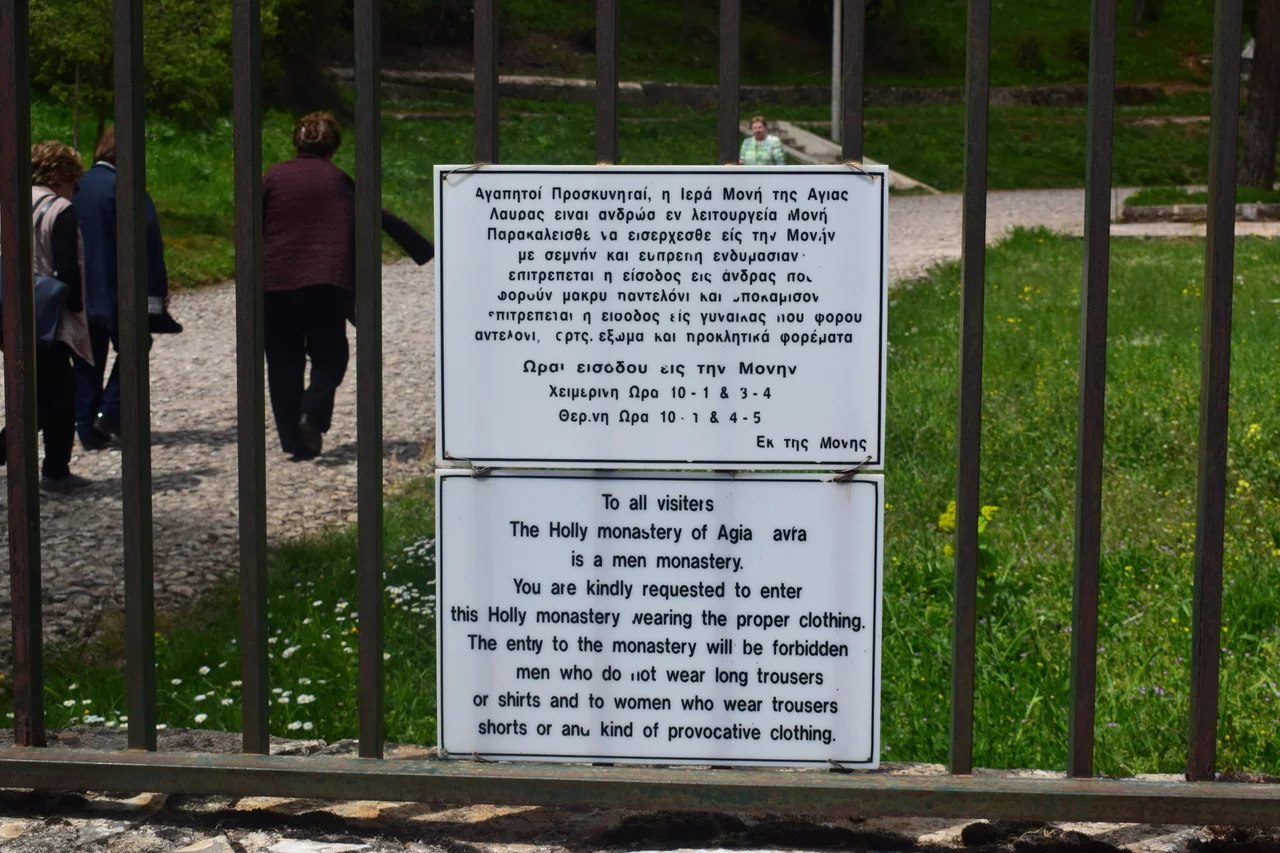

Agia Lavra
On 25 March 1821, Bishop Germanos of Patras stood beneath a plane tree just outside the gate of Agia Lavra monastery and raised the flag of the Greek revolution. The call that went out that morning — Eleftheria i Thanatos, Freedom or Death — launched the War of Independence against the Ottoman Empire. The monastery had already stood for 860 years. It would be burned twice more before the century was out, and burned again in 1943. Each time, it was rebuilt. That is the essential story of Agia Lavra: a place that refuses to stop existing.
A Thousand Years on the Mountain
Agia Lavra — the Holy Lavra — was founded in 961 AD on the forested slopes of Chelmos Mountain, at 961 meters above sea level, in the mountains above the Peloponnesian town of Kalavryta. It stands among the oldest monasteries in the Peloponnese. The name lavra is ancient — it refers to a type of monastic community common to early Eastern Christianity, where monks live in separate cells around a central church. What was built here in the tenth century was humble and remote, a place of prayer cut into the mountain far from the centers of Byzantine power. Over the centuries it accumulated relics, manuscripts and sacred objects, growing into a repository of Greek Orthodox faith and, eventually, of Greek national identity.
Fire, and Fire Again
The monastery has burned four times. Ottoman forces burned it in 1585; it was rebuilt by 1600, with frescoes by the painter Anthimos completed in 1645. Fire came again in 1715. Then in 1826, Ibrahim Pasha of Egypt — fighting on behalf of the Ottomans against the Greek revolutionaries — burned it a third time. After Greek independence was secured, the building was completely rebuilt by 1850. The fourth burning came in December 1943, the day after German forces massacred the male population of nearby Kalavryta: Wehrmacht soldiers torched Agia Lavra as part of Unternehmen Kalavryta. The monastery was rebuilt once more. The pattern — destruction and reconstruction, destruction and reconstruction — has become part of what Agia Lavra represents: something that can be destroyed but not ended.
The Morning of 25 March 1821
The events of that morning in 1821 are remembered as the founding act of modern Greece. Bishop Germanos of Patras performed a doxology — a prayer of praise — and administered an oath to the assembled Peloponnesian fighters, who had gathered here in secret. Then the revolutionary flag was raised under the plane tree beside the monastery gate. Whether every detail of the traditional account is precisely as recorded is a question historians have long debated, but the essential fact is not in dispute: Agia Lavra was the gathering point for the beginning of the uprising. The phrase that rang out that day, Eleftheria i Thanatos, became the motto of the revolution. Greece celebrates its national day on March 25 in part because of what happened on this hillside.
What the Museum Holds
The monastery's museum is a remarkable archive of Greek religious and national history. The vestments of Bishop Germanos are preserved there. So are sacred vessels, crosses, icons, and a Gospel presented by Tsarina Catherine II of Russia. The holy relics of Saint Alexios — given to the monastery by Byzantine Emperor Manuel II Palaeologus in 1398, more than four centuries before the revolution — are also kept here. Pieces of embroidery woven with gold and silver threads in Smyrna and Constantinople, dating from the sixteenth century, survive among the collection. Across the road from the monastery, on a hill opposite, a monument to the heroes of the 1821 Greek Revolution overlooks the grounds. The museum and the monument together make Agia Lavra a place of pilgrimage for Greeks in a way that goes beyond the religious.
From the Air
Agia Lavra sits at approximately 38.01°N, 22.08°E on the forested slopes of Mount Chelmos (Aroania), at around 961 meters above sea level, about 4 km southwest of the town of Kalavryta. The monastery is nestled in dense pine and fir forest; from altitude it appears as a small clearing on the mountainside. The nearest major airport is LGRX (Araxos), approximately 65 km to the northwest. Approaching from the Gulf of Corinth coast, the Vouraikos gorge cutting south from Diakopto provides a clear navigation reference toward Kalavryta and Agia Lavra.
Nearby Stories
- Pellene 3.9 km away
- First Siege of Missolonghi 5.5 km away
- Battle of Manolada 8.4 km away
- Barony of Akova 8.7 km away
- Desfina 11 km away
- Panagia Skafidia Monastery 15 km away
- Battle of Naupactus 15 km away
- Tomb of Clytemnestra 24 km away