.jpg)
Battle of Naupactus
The Peloponnesians were already singing their victory paean. Seventy-seven ships against twenty, nine Athenians already driven ashore, and the survivors fleeing in single file toward the harbor of Naupactus — the outcome seemed certain. Then the last Athenian trireme in the chase swung around an anchored merchant vessel, spun 270 degrees, and drove its bronze ram into the side of the leading Peloponnesian ship, sinking it. What followed turned the autumn of 429 BC into one of antiquity's most studied reversals of fortune.
The Weight of the Odds
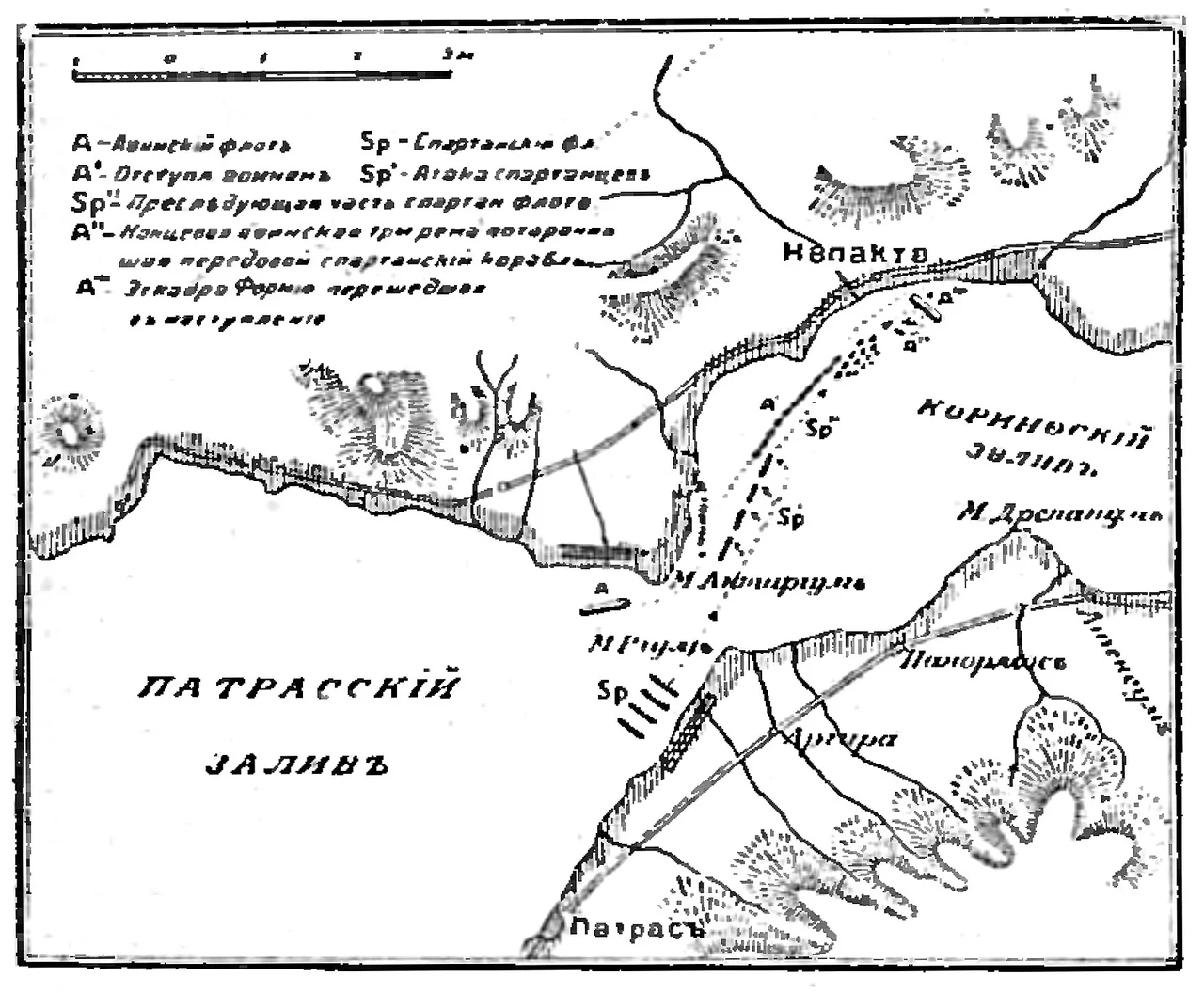
The contest should never have been close. Sparta's navarch Cnemus had assembled a fleet of seventy-seven triremes by combining the survivors from the earlier Battle of Rhium with fresh levies from allies along the gulf. He advanced them to Panormus in Achaea while Athenian admiral Phormio, outnumbered nearly four to one, kept his twenty ships at Antirrhium, across the strait. Phormio had beaten a Peloponnesian fleet of forty-seven ships only days before at Rhium — a humiliation that had prompted Sparta to send advisors, including the formidable Brasidas, to oversee the renewed offensive. Athens, in turn, had dispatched twenty reinforcement ships, but those vessels were diverted first to Crete to attack Cydonia, and they did not arrive in time.
Into the Gulf
The Peloponnesians made their move after six or seven days at anchor. Rather than engage in the open sea — where Athenian crews had already shown they could outmaneuver larger forces — Cnemus led his fleet eastward into the constricted waters of the Corinthian Gulf. The Athenians had no good options. To let the enemy fleet pass unchallenged would mean surrendering dominance of the sea and risking a blockade at Naupactus, which they had left ungarrisoned. So Phormio's twenty ships entered the gulf in single file along the northern shore, Messenian hoplites marching alongside on the land. Across the water, the Peloponnesian fleet advanced in four parallel lines, their twenty best and fastest ships on the right wing, positioned to cut off any Athenian escape.
Collapse, Then Reversal
When Cnemus gave the signal, the Peloponnesian fleet wheeled and drove across the gulf. Only the eleven leading Athenian ships managed to slip around the enemy right wing and race for Naupactus; the remaining nine were cornered, driven onto the beach, and captured. Ten of the eleven survivors reached the harbor mouth and turned to face outward, prows ready. The eleventh, still pursued, swung around the merchant ship — and rammed. The shock of that single sinking rippled through the Peloponnesian fleet. Some oarsmen in the leading ships dropped their oars to wait for the main body, leaving themselves immobile in the face of an enemy now charging toward them. Others ran aground, their captains unfamiliar with the coastline. The ten Athenians in the harbor rushed out, and within minutes the Peloponnesian fleet was in full rout.
What the Victory Cost and Secured
When the fighting ended, the Athenians had recaptured all but one of their nine grounded ships and taken six Peloponnesian vessels. Both sides erected trophies claiming victory, as was the custom. But the actions that followed made the real outcome plain: the Peloponnesians retreated to Corinth under cover of darkness in the days after the battle, fearing the arrival of the Athenian reinforcements. Athens continued to hold Naupactus and dominate the gulf. The human cost of the engagement is not recorded in surviving sources with precision. Thucydides, the principal ancient account, focuses on the ships taken and grounded rather than casualties among the oarsmen and marines — men whose names history did not preserve. In 428 BC, the memory of Phormio's two victories over Peloponnesian fleets was still so vivid that Sparta declined to send naval aid to the rebel Athenian subject state of Mytilene. When they finally did send a fleet west in 427, the commander turned for home rather than risk a confrontation at sea.
Phormio's Waters Today
The Gulf of Corinth remains one of the most visually compelling stretches of water in the Mediterranean world. From the air, its long blue corridor, narrow at the western end where the Strait of Rhium separates it from open sea, looks precisely like the tactical trap Cnemus tried to exploit and Phormio survived. The modern town of Nafpaktos — ancient Naupactus — sits on the northern shore where the Athenian ships ran for harbor. Standing at the waterfront there today, looking east along the gulf toward where two fleets once collided, it is easy to see why this harbor mouth mattered so much to both sides, and why a single captain's decision to turn and fight rather than flee changed the outcome of a war.
From the Air
The battle site lies at approximately 38.39°N, 21.83°E, at the western entrance of the Gulf of Corinth near Nafpaktos (ancient Naupactus) on the northern shore. The narrow Strait of Rhium, where the previous battle of 429 BC also took place, is visible just to the west at the gulf's mouth. The opposing anchorages of Antirrhium (Athenian) and Panormus in Achaea (Peloponnesian) framed the approaches. Nearest major airport: LGRX (Araxos), approximately 45 km to the southwest across the gulf. The Rio-Antirrio suspension bridge, one of the longest cable-stayed bridges in the world, now spans the strait and is an unmistakable visual landmark. Recommended viewing altitude: 3,000–6,000 feet for the full gulf panorama; low passes along the northern shore reveal the harbor contours of Nafpaktos.
Nearby Stories
- Desfina 2.7 km away
- Pleuron (Aetolia) 2.8 km away
- Pellene 12 km away
- Achaea 12 km away
- Mendenitsa 13 km away
- Battle of Manolada 13 km away
- Amphilochian Argos 26 km away
- Prousou Monastery 29 km away