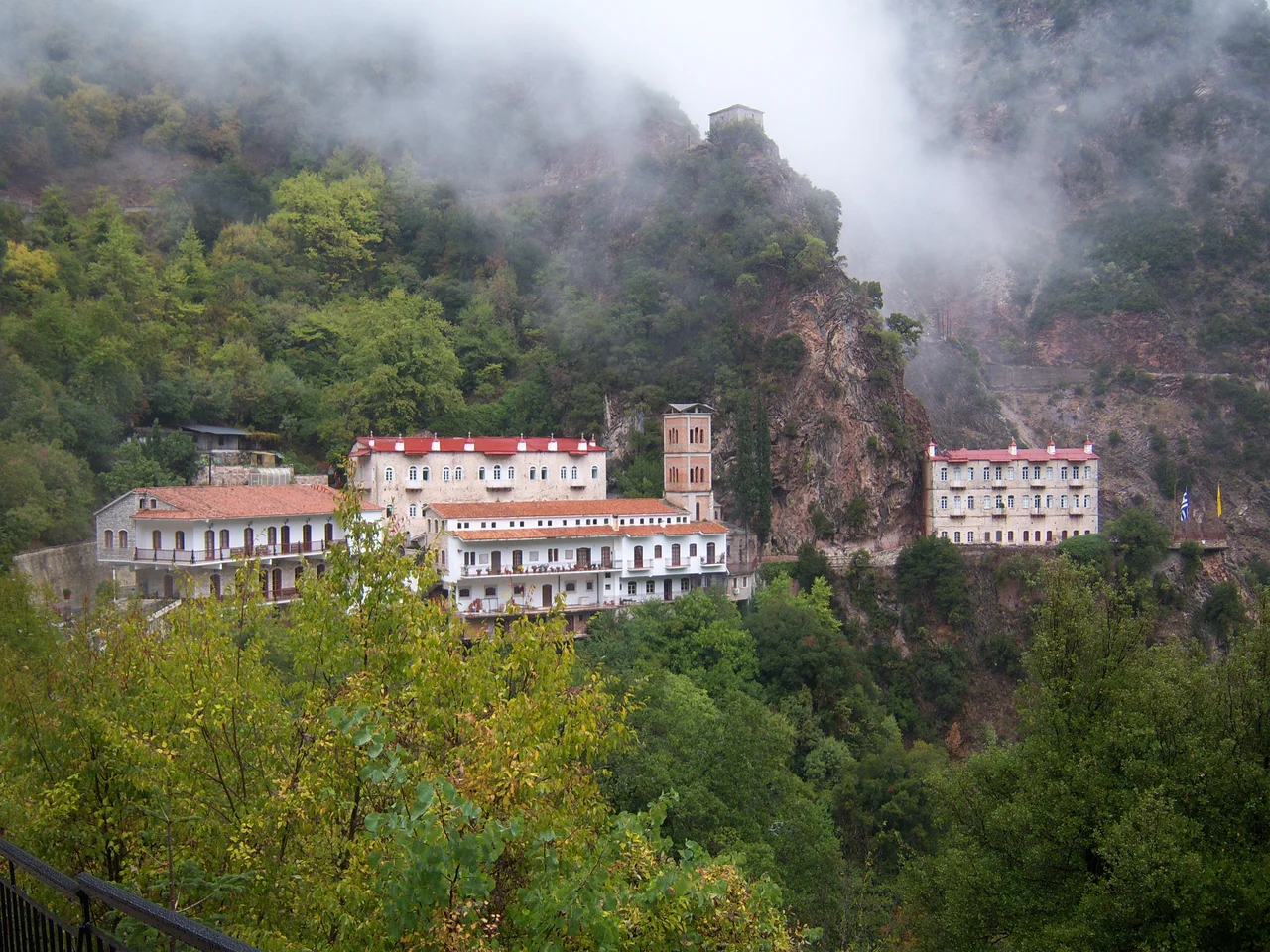

Prousou Monastery
Somewhere in the 9th century, tradition holds, a young man was carrying an ancient icon across the mountains of central Greece when he found he could not move it. He had been trying to spirit the image out of Asia Minor before the iconoclast emperor Theophilos — who reigned from 829 to 842 — could destroy it. The icon, said to have been painted by Luke the Evangelist and venerated in Bursa, had survived the journey. Now, wedged between the mountains of Helidona and Kaliakouda in the deep ravine of the Karpenisiotis River, it refused to go further. The young man, whose name has not survived history, took this as a sign. He and his servant stayed, took monastic vows as Dionysios and Timotheus, and built what would become the Monastery of Prousou. That decision, made in a steep and forested gorge 31 kilometers south of what is now Karpenisi, shaped the spiritual life of central Greece for more than a millennium.
The Icon That Would Not Move
The monastery takes its name from Bursa — Prousa in Byzantine Greek — the city in Asia Minor from which the icon of Panagia Prousiotissa is said to have come. Theophilos's campaign against religious images drove many icons into hiding or across long roads to safer sanctuaries, and the story of this particular journey is bound up with miracles: the image grew too heavy to carry at the very spot where the monastery now stands, on a cliff face above a gorge choked with fir trees. Whether one reads this as divine will or human exhaustion at the end of a hard mountain path, the result was the same. A monastery was built, dedicated to the Theotokos — the Mother of God — and celebrating its feast on August 23 in the Apodosis, the close of the Dormition season. In 1748, the monastery was elevated to the status of Stauropegion, placing it directly under the authority of the Ecumenical Patriarch in Constantinople rather than a local bishop. That designation marked it as a place of more than regional importance.
A School in the Mountains
A few years before the Greek War of Independence, a monk named Kyrillos Kastanofyllis arrived at Prousou as its new abbot. The official reason given was to correct some alleged lapse in his conduct. The real reason was different: Kastanofyllis was a member of the Filiki Eteria, the secret society organizing the coming revolution, and he had been sent to put the monastery on a war footing. He established the School of Greek Letters, which ran from 1818 to 1828, turning the monastery into an educational as well as spiritual center. In a region where the Ottoman Empire had long suppressed Greek cultural institutions, running a school under monastic cover was both practical and symbolic. Letters from Alexandros Mavrokordatos, one of the principal architects of Greek independence, survive in the monastery's records from this period. The gorge, it turned out, made an excellent place to do things the empire would rather not know about.
Headquarters in the Gorge
During the war itself, Prousou served as hospital, arms depot, and command post. The general Georgios Karaiskakis, one of the most celebrated fighters of the Greek Revolution, made his headquarters here. He was suffering from a recurring illness during his stay, and when he recovered, he attributed his return to health to the icon's intercession. In gratitude, he donated the silver cover for the Panagia Prousiotissa. The vault of the monastery still holds his weapons today. Beyond Karaiskakis, the monastery played a role in the prolonged siege of Missolonghi: it helped coordinate communications and, after the catastrophic Exodus of April 1826, sheltered and treated survivors who had fled through the mountains. Through years of fighting, the icon — the reason the monastery existed at all — remained at the center of the building's spiritual life even as its walls became thick with the business of war.
Fire, Survival, and Reconstruction
On August 16, 1944, German forces burned a large part of the monastery. The reason was straightforward: Prousou had been supporting the Greek Resistance, and the occupiers responded the way occupying forces often do. Relics, liturgical objects, manuscripts, and books accumulated over more than a thousand years were destroyed. The Panagia Prousiotissa survived because it had been moved to a hidden crypt. After the war and the subsequent Greek Civil War, reconstruction began under the abbot Germanos and continued through the 1970s under an abbot who later became the head of the Holy Monastery of Dochiario on Mount Athos. The cliff-face monastery visitors see today — a building that appears to grow directly out of the rock above the river gorge — is the result of that long rebuilding, layer upon layer over a site that has held continuous religious life since the early medieval period.
The Gorge Today
The approach to Prousou is part of its meaning. The road from Karpenisi descends into a narrowing valley, fir forests closing in on either side, until the gorge walls become nearly vertical and the monastery appears clinging to them — a cluster of pale buildings with red tile roofs pressed against dark rock. Pilgrims still come throughout the year, and on August 23 the forecourt fills with worshippers marking the feast of the Theotokos. The icon of Panagia Prousiotissa, whatever its true origins, is one of the most revered in the region. It has been in this gorge, by tradition's account, since before the monastery around it existed — a continuity of veneration that connects the Byzantine world to the present day by a thread that proved stronger than emperors, armies, and fire.
From the Air
Prousou Monastery sits at approximately 38.749°N, 21.657°E, in a deep river gorge in the Evrytania highlands of central Greece. The terrain is dramatic — steep forested ridges dropping into narrow valleys — and the monastery is not visible from altitude; approach views require flying through the gorge system. Recommended altitude for area orientation is 5,000–8,000 feet, with the Karpenisiotis River valley providing a clear ground reference. The nearest major airport is LGBL (Nea Anchialos National Airport, near Volos), approximately 90 km northeast; Athens Eleftherios Venizelos International (LGAV) is roughly 200 km to the southeast. Weather in this mountain region can change rapidly, and the surrounding ridgelines exceed 2,000 meters. Clear morning conditions typically offer the best visibility into the gorges.
Nearby Stories
- Acarnania 1.4 km away
- Battle of Karpenisi 5.6 km away
- Massacre of Kommeno 6 km away
- Mount Oeta 13 km away
- Battle of the Echinades (1427) 15 km away
- Calydon 16 km away
- The 1954 Sofades Earthquake 23 km away
- Galaxidi 24 km away