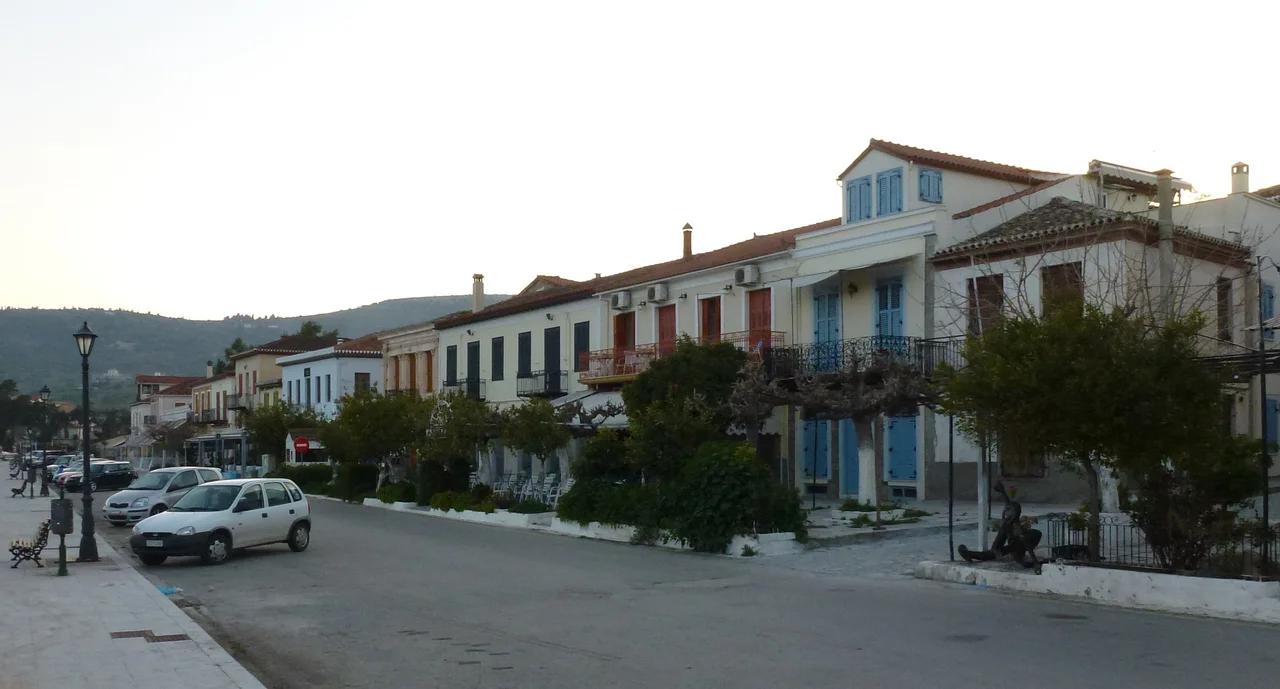

Galaxidi
Every year on Clean Monday — the first day of Greek Orthodox Lent — something remarkable happens in Galaxidi. The town divides itself into a war zone and a neutral zone. Locals and visitors, dressed in old clothes, faces darkened with charcoal, march to the harbour with large quantities of coloured flour. Then they throw it at each other. And at bystanders. Until everyone runs out. The custom is called Alevromoutzouroma — Flour Smudging — and it has been happening, in its current form, since the mid-nineteenth century, origin unclear. By noon the harbour of one of the most architecturally handsome towns on the Gulf of Corinth is submerged in coloured clouds.
A Double Harbour on the Gulf
Galaxidi occupies a peninsula on the west coast of the Gulf of Itea — a northward indentation of the wider Gulf of Corinth — and the town's defining geographic feature is its natural double harbour. Two separate bays face different directions, sheltering boats from almost any wind. It is the kind of site that has attracted settlement since prehistory: traces of habitation survive from the Early Helladic period, a significant Mycenaean settlement has been located at a site called Villa, and a fortified geometric-period settlement from around 700 BCE occupied the hill of St. Athanasios. The ancient city on this ground was called Haleion, a town of western Locris. By around 300 BCE, when the Aetolian League was expanding its power, the present site of the town was settled and walled. Haleion flourished through the Hellenistic and Roman periods. The name Galaxidi appears for the first time in the late tenth century — in 981 or 996 — when the town was destroyed in a raid by Bulgarian forces under Tsar Samuel. Its inhabitants fled to the offshore islands and did not return for fifty years.
Captains and Caiques
The Galaxidi that visitors see today — the neoclassical sea-captains' mansions, the church of the Dormition of Mary, the stone-paved lanes — is largely the product of the nineteenth century, when the town was a significant maritime power. Its shipowners and captains operated a merchant fleet of wooden sailing vessels, trading across the eastern Mediterranean and beyond. The Chronicle of Galaxidi, published by the historian Konstantinos Sathas in 1865, records this proud seafaring tradition, and the Maritime Museum of Galaxidi — housed in a building that once served as the town hall — preserves its physical legacy: ship models, navigational instruments, captains' documents, and the artefacts of a way of life that the steam engine eventually made obsolete. The museum also holds ancient finds recovered from the surrounding area, including geometric pottery, Hellenistic vessels, and items that were identified in 1973 through comparison with pottery in the British Museum and in Edinburgh bearing the indication 'Galaxeidi.' The town is 7 km southwest of Itea and 15 km from Delphi, and its position on the gulf made it the natural maritime gateway to the sanctuary for much of its history.
Raided, Destroyed, Rebuilt
Galaxidi has been destroyed more than once. The Bulgarian raid of 981 or 996 was followed by Norman invasions in 1081 and 1147, each time scattering the inhabitants and leaving the town to rebuild itself. This pattern — disaster, abandonment, return — recurs across Galaxidi's long history. The most important harbour of the Gulf of Itea alongside ancient Krissa, its position made it both valuable and exposed. Between the Norman invasions and the Ottoman period, the town passed through various hands, including periods under the Lordship of Salona, the local Frankish state established after the Fourth Crusade. Through all of it, the double harbour remained the reason people came back. A sheltered anchorage in a coast that offers few of them is an asset no amount of political upheaval makes permanently worthless. By the time the seafaring economy of the nineteenth century reached its peak, Galaxidi had rebuilt itself into something genuinely elegant.
The Town the Gulf Made
Galaxidi today is a popular weekend retreat from Athens, about two and a half to three hours by road. The neoclassical architecture survives in unusually good condition — the captains who built these houses did so with the profits of a successful trade, and the town never underwent the kind of rapid industrial development that tends to erase such things. Walking the lanes behind the harbour, past the mansions with their carved stone lintels and wrought-iron balconies, it is easy to understand why the town has attracted painters and writers for generations. The artist Spyros Vassiliou was born here. The sea is visible from almost everywhere, glinting between buildings or framed at the end of a lane. The museum holds the chronicle; the harbour holds the memory; and on Clean Monday, the whole town covers itself in coloured flour and reminds itself that this place knows how to celebrate.
From the Air
Galaxidi lies at approximately 38.38°N, 22.38°E on the northern shore of the Gulf of Corinth, in the southern part of Phocis. The double harbour is visible from the air as two distinct bays flanking a low peninsula, with the neoclassical town climbing the hillside behind. The nearest major airport is LGRX (Araxos), approximately 60 km to the southwest across the gulf; most visitors arrive via Athens Eleftherios Venizelos (LGAV), roughly 195 km to the east. A viewing altitude of 2,000–4,000 feet gives a clear picture of the harbour formation and the town's relationship to the wider Gulf of Corinth, with the mountains of Phocis rising steeply to the north.
Nearby Stories
- Battle of Leontion 2.8 km away
- Siege of Livadeia 3.1 km away
- Pyre of Heracles 8.2 km away
- Corinth Rail Disaster 8.8 km away
- Rio–Antirrio Bridge 9.9 km away
- Heraion of Perachora 13 km away
- Prousou Monastery 15 km away
- Free and Real 30 km away