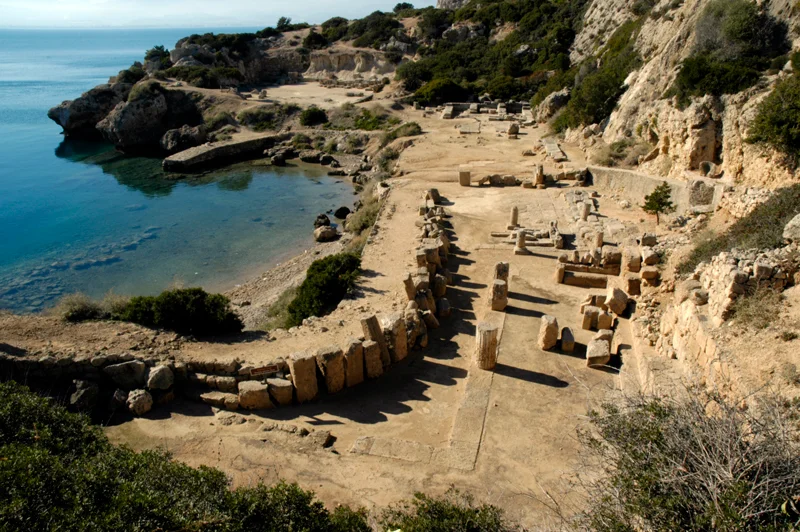

Heraion of Perachora
Medea came here, according to Euripides, to bury her murdered children. Sailors departing from Corinth's harbor at Lechaion stopped here to pray for safe passage. The tyrant Periander, in one of the stranger acts recorded by Herodotus, came here and stripped the clothes from the Corinthian women assembled at Hera's sanctuary. Whatever one makes of those stories, they share a common thread: the Heraion of Perachora, set at the very tip of the peninsula that juts into the Corinthian Gulf, was a place where people came when the stakes were highest.
A Sanctuary at the Edge of the World
The Perachora peninsula reaches northwest from the coast near Corinth like a finger pointing into the Gulf. At its tip, where the land narrows to a rocky point, a small cove provides the only shelter for miles. The ancient Greeks built their sanctuary of Hera in and around this cove — temples, storerooms, dining halls, a water system — occupying a rectangle roughly 45 meters north-to-south and 245 meters east-to-west, wrapping around the water's edge and climbing uphill along the ridge to the east. The epithet Hera Akraia, meaning 'Hera of the headland,' named the goddess for this position: the goddess of the promontory, watching over those who round the peninsula. The site sits 14.2 kilometers northwest of Corinth and 75.9 kilometers west of Athens, close enough to the great city across the water to be under its religious influence, isolated enough to feel genuinely apart from the world.
Nine Centuries of Worship
Cult activity at Perachora began perhaps as early as the 9th century BC, when the earliest structure — a small apsidal building with what may have been a thatched roof — was raised here, resembling the house-temple models known from the Argive Heraion. In the 6th century BC a proper Doric temple replaced it, with an unusual design: the inner sanctuary was divided into three aisles rather than the standard single nave, suggesting distinctive liturgical practices that scholars have not fully deciphered. The temple's marble roof gleamed over the cove for centuries. Strabo, writing in the 1st century CE, noted that there was an oracle associated with the sanctuary — a detail that fits with the legend of Medea, whose act of child burial might have established a hero-cult with its own chthonic power. Worship continued here until 146 BC, when the Roman general Lucius Mummius sacked Corinth and the religious life of the region collapsed. Roman domestic buildings later rose on the sanctuary site, a quiet sign that the sacred ground had become ordinary.
The Engineering of Devotion
What makes Perachora remarkable beyond its mythology is its hydraulic system — an extensive infrastructure of cisterns, channels, and a fountain house that stretched 1.7 kilometers east of the sanctuary toward a lagoon. About 750 meters from the sanctuary, massive cisterns were cut into the bedrock, accessible by a steep rock-cut stairway descending some 50 meters. Parapet walls protected the vertiginous cistern openings. It has been proposed that the water was raised by human-powered waterwheels — a striking image of organized communal labor in service of a religious site. A six-columned fountain house further along the system stored and filtered the water before it flowed west to the sanctuary's L-shaped stoa and the double-apsidal cistern beside the dining halls. The L-shaped stoa itself, built in the late 4th century BC, combined Doric columns on its lower level with Ionic on the upper floor — the first known example of this combination in Greek architecture.
The Limekiln That Ate the Temple
There is something melancholy in one particular detail of the Perachora excavations. Roughly at the center of the southern side of the 6th-century Temple of Hera Akraia, archaeologists found a limekiln about 4.5 meters in diameter. Medieval builders had used it to burn the marble of the ancient temple — and of the sanctuary more broadly — reducing it to lime for construction of the Hexamilion wall, the great defensive barrier built across the Isthmus of Corinth in the 5th century AD to hold off invaders from the north. The scorch marks are still visible on the stones around the circular burn area where the heat of the kiln caused the underlying marble to fracture and crumble. A sacred building, stripped of its marble, turned into building material for a wall. Perachora outlasted its own sanctity.
Myth, Mystery, and What Remains
The sacred pool — a water feature roughly 2 meters deep, perhaps used in divination — was excavated, studied, backfilled, and its exact location is now unknown. The bronze bull found near the so-called Temple of Hera Limenaia, inscribed in Sikyonian letters and dating to the late 6th century BC, reminds us how closely Sicyon and Corinth shared the Gulf's religious culture. The site today retains visible foundations and the stunning setting: a path along the rocky headland, the blue-green water of the cove, the mountains of the Peloponnese across the Gulf. Scholars continue to argue over whether the sacred pool had oracular functions, whether Medea's legend has any geographical basis here, and what exactly the three-aisled design of the main temple was meant to achieve. Perachora's architecture speaks clearly enough; its purposes remain pleasingly obscure.
From the Air
The Heraion of Perachora is located at approximately 38.028°N, 22.853°E at the tip of the Perachora peninsula, which projects into the Corinthian Gulf northwest of Corinth. From altitude, the peninsula is unmistakable — a narrow finger of land extending into the blue Gulf, with the small cove of the sanctuary visible at its northern tip. Approach from the east or south at 3,000–5,000 feet for clear views of the peninsula against the Gulf. The nearest major airport is Athens International (LGAV), approximately 70 km to the east-northeast.
Nearby Stories
- Valley of the Muses 2.7 km away
- Kalachakra Stupa (Greece) 5.2 km away
- German Submarine U-596 8.2 km away
- Battle of Delium 8.8 km away
- Saronic Gulf 11 km away
- Galaxidi 12 km away
- Orchomenus (Arcadia) 18 km away
- Berbati Valley 22 km away