
Orchomenus (Arcadia)
Two kings of Orchomenus died the same way: stoned to death by their own subjects. The first, Aristocrates, violated the virgin priestess of Artemis Hymnia, and his people — who held that goddess in the highest reverence across all Arcadia — exacted the penalty themselves. Generations later his grandson Aristocrates II betrayed the Messenians in their war against Sparta, and the Arcadians repeated the verdict. The same family, the same crime of faithlessness, the same outcome. It is an unusual thing to say about any city, but Orchomenus — the Arcadian Orchomenus, not to be confused with its Boeotian namesake — had standards, and it enforced them at close range.
The Hill Above Two Plains
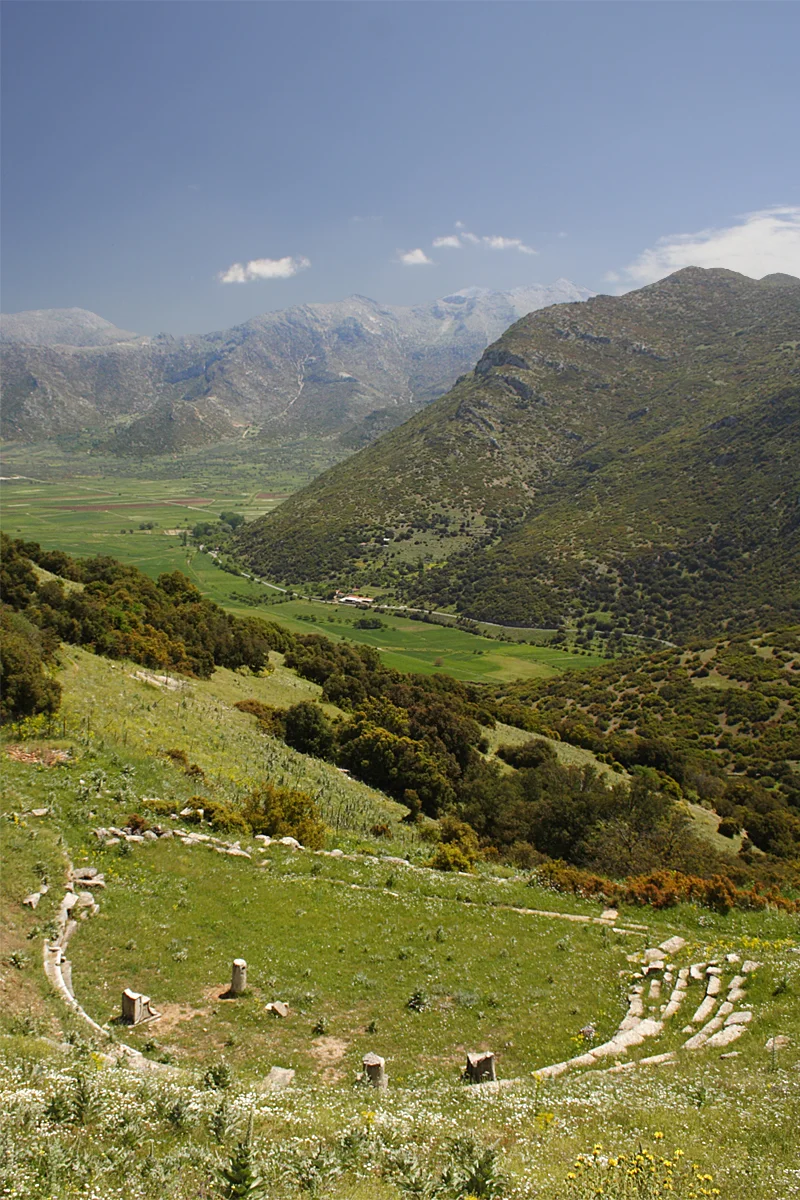
Orchomenus sits where geography made power inescapable. The acropolis rises nearly 900 metres above sea level on the summit of a western hill, commanding two separate mountain-locked plains. The plains themselves are extraordinary: closed karst basins where water has nowhere to run except downward through sinkholes the Greeks called katavothres — natural drain-holes in the limestone. In Pausanias's day, around the 2nd century AD, the waters of the southern plain funnelled through a narrow ravine into the northern plain, where they collected into a large lake. Today that lake is gone. But the basins remain, still seasonally difficult to drain, still channelled by an ancient canal that crosses the valley floor. What Pausanias described as a lake, moderns understand as a recurring karst flood. The city on the ridge watched it all from above, immune to the water below, master of every road that crossed the mountains into Pheneus, Stymphalus, and Mantineia.
Homer's Sheep-Rich City
Homer called Orchomenus polymelos — "abundant in sheep" — and the epithet stuck. Ovid called it ferax: fertile, productive. Apollonius of Rhodes used a word meaning wealthy. These writers were not simply flattering a backwater; by the 7th and 6th centuries BC, Orchomenus was genuinely one of the dominant cities of western Arcadia, alongside Tegea and Mantineia, and it minted its own currency. Its kings are said to have ruled nearly all Arcadia at the city's peak. In the Persian Wars, it sent 120 men to hold Thermopylae, and 600 more to fight at Plataea — numbers that speak to a city of real substance. Agapenor, the legendary commander whose troops included Orchomenian soldiers, led the contingent described in the Iliad's Catalogue of Ships. The city's origins, according to Pausanias, lay with a hero who was son of Lycaon, or perhaps with Elatus, son of Arcas himself. Either way, the mythology rooted the place deep in the Arcadian story.
Sieges, Garrisons, and the Price of a Good Position
The commanding hilltop that made Orchomenus valuable also made it a perpetual prize. In 418 BC, when Athenians and their Peloponnesian allies advanced on the city, its walls were already in disrepair; the Orchomenians submitted rather than fight and handed over the hostages the Spartans had deposited there. The Hellenistic period brought no relief. In 313 BC it changed hands between Cassander and Polyperchon. In 303 BC, Demetrius Poliorcetes besieged it; when the garrison commander Strombichus refused to surrender and reportedly insulted him from the walls, Demetrius brought up siege engines, breached the defenses, and took the city by storm. Strombichus was crucified, along with at least eighty others. Around two thousand captured mercenaries were absorbed into Demetrius's own forces. The city subsequently allied with the Aetolians, made terms with the Achaean League around 234 BC under a ruler named Nearchus, fell to Cleomenes III in 229 BC, and was retaken by Antigonus Doson in 223 BC, who installed a Macedonian garrison. Control seesawed for decades before Philip V handed the city back to the Achaeans under Roman pressure. Strabo, visiting later, claimed it had nearly vanished. Pausanias thought Strabo was exaggerating — and the monuments suggest he was right.
What the Excavations Found
The theatre is the most striking survivor: a 4th- to 3rd-century BC structure with a capacity of 4,000, set at 800 metres altitude, its seats angled to look out across the basin with the same view Pausanias admired. The agora, the city walls, and the temple of Artemis Mesopolitis have all been partially identified. Excavations also revealed a bouleuterion, a prehistoric tomb, and a bridge from the Archaic period. Approaching from the south, tumuli line the way — stone burial mounds Pausanias described in detail. Below the acropolis is the tomb of Aristocrates, that first stoned king, and beyond it the fountains called Teneiae, which Pausanias singled out as one of the most remarkable objects at Orchomenus. Close to the ancient city, he noted a wooden statue of Artemis enclosed within a great cedar tree; because of this, the goddess was called Cedreatis. The temple of Artemis Hymnia, whose violated priestess triggered a dynasty's downfall, stood on the northern slope of Mount Anchisia. Its probable site today is marked by a chapel of the Virgin Mary, east of the village of Levidi. The modern village of Orchomenos occupies the site of the ancient lower town, just as it has since antiquity.
A Name to Distinguish
Thucydides felt compelled to specify: this was the Arcadian Orchomenus. The Boeotian Orchomenus — a separate, unrelated city in central Greece — was older and more famous. The need for the qualifier says something about how ancient Greeks navigated a world without GPS, where the same name could attach to completely different places. The Arcadian city never ranked among the great powers of the Greek world, but it outlasted many of them. When William Smith, the 19th-century classicist, visited the acropolis, he found it in ruins, with only vestiges of the agora and town walls. But the theatre seats still held their shape against the mountain, the karst basins still absorbed the winter rains, and the pass roads north toward Pheneus and Stymphalus still cut through the mountains exactly where Pausanias had described them. Some places persist through sheer geography.
From the Air
Orchomenus (Arcadia) lies at approximately 37.725°N, 22.315°E in the central Peloponnese, within a mountain-ringed karst basin at roughly 600–900 metres elevation. The acropolis hill rises clearly above the surrounding plain and is visible from altitude as a distinct summit separating two enclosed valleys. The modern village of Orchomenos sits at the base. Nearest major airport: LGRX (Araxos/Patras), approximately 70 km to the northwest. Recommended viewing altitude: 3,000–5,000 feet to resolve the twin-basin karst geography and the acropolis ridge above the village. Visibility is generally excellent in dry summer months; haze can limit views in humid spring conditions.
Nearby Stories
- Peloponnese 5.1 km away
- Lepreum 6.4 km away
- Heraion of Perachora 6.6 km away
- Battle of Lalas 6.8 km away
- Aristarchos 2.3 m Telescope 11 km away
- Arkadiko Bridge 15 km away
- Battle of Chalandritsa 16 km away
- Franchthi Cave 25 km away