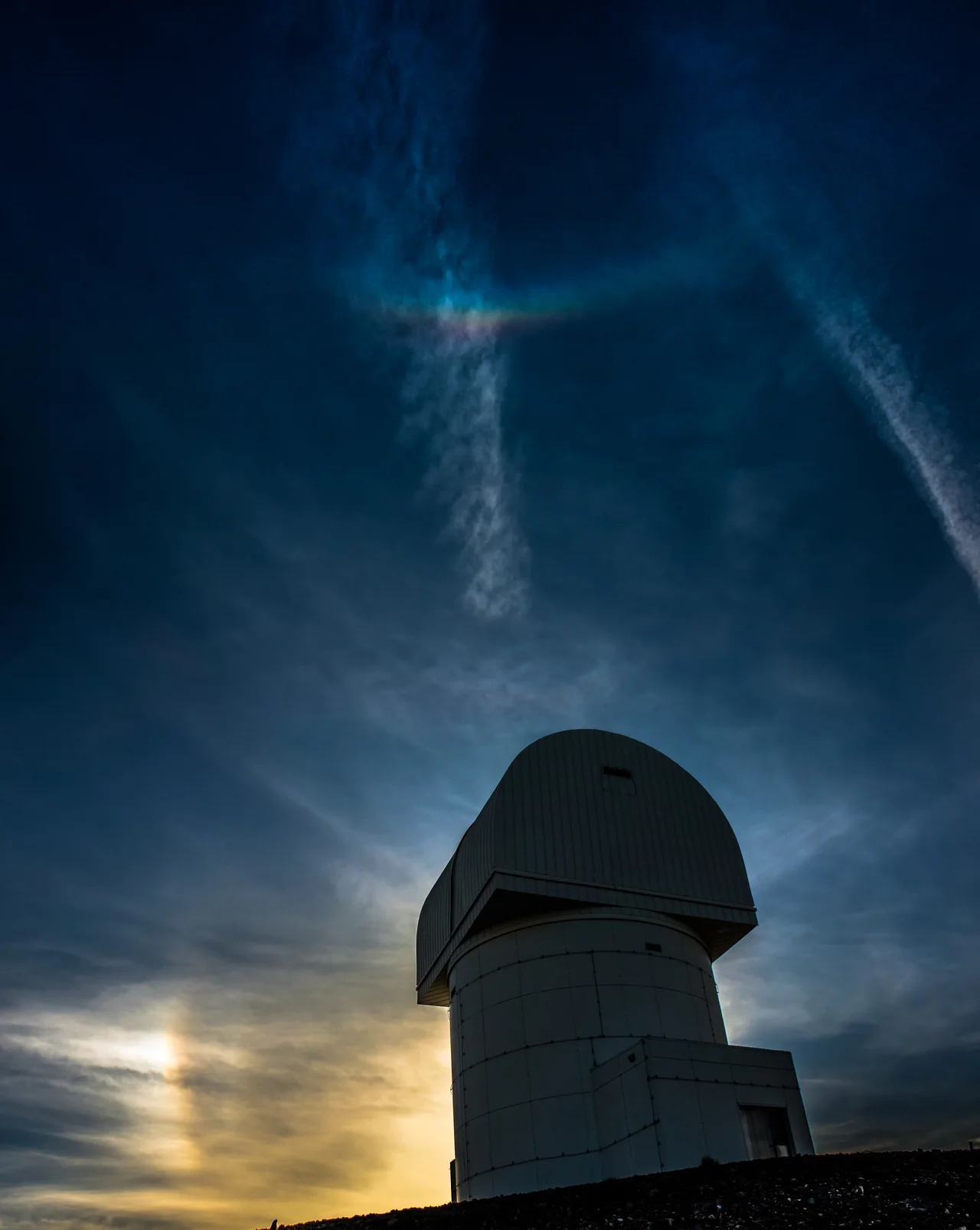

Aristarchos 2.3 m Telescope
On 7 July 2025, astronomers at the Chelmos Observatory on Mount Chelmos in the mountains of Achaea fired a laser into space and waited. The target was the Psyche spacecraft, already millions of kilometres from Earth and travelling toward the main asteroid belt. The signal arrived. Psyche responded. The Aristarchos Telescope, the largest in Greece, became one of only two European observatories to participate in NASA's Deep Space Optical Communications demonstration — a test of laser-based communication across interplanetary distances. It was a long way from the telescope's first light test in 2005. It was also, somehow, exactly what the instrument was built for.
A Mountain Built for Stargazing
Mount Chelmos rises to 2,355 metres in the mountains of the Peloponnese, south of the Gulf of Corinth and east of Kalavryta. The Chelmos Observatory sits near the summit, at an altitude and latitude that provide both dark skies and a high proportion of clear nights. The Aristarchos Telescope was built here by Carl Zeiss AG to a Ritchey-Chrétien design — the same optical configuration used in the Hubble Space Telescope — with a primary mirror 2.3 metres in diameter. It was funded by the European Commission and the Hellenic Ministry of Development as part of Greece's New Greek Telescope project and became fully operational in 2007. At that point it became the largest telescope in Greece and the largest in the Balkans. The instrument is housed in a tower 35 metres from the control building, a deliberate separation designed to prevent heat and vibration from human activity — computers, vehicles, bodies — from disturbing the telescope's performance.
Looking Outward: Exoplanets and Asteroid Families
The Aristarchos Telescope has spent years doing the patient, accumulative work of modern astronomy. In 2014–2015 it contributed photometric follow-up observations that helped confirm two exoplanets, WASP-113b and WASP-114b — transit detections announced in 2016 that added two more worlds to the growing catalogue of planets beyond our solar system. In 2022 it proved that a group of 55 asteroids believed to share a common origin do in fact form a genuine collisional family — the remnants, spread across their orbits, of a collision that occurred approximately four billion years ago. The telescope has also measured the distance to a planetary nebula, KjPn 8, the expanding shell of gas cast off by a dying star. These are not headline-grabbing discoveries but they are the real texture of science: careful observations that clarify the universe incrementally, one data point at a time.
Reaching Deep Space
Since 2020, the Aristarchos Telescope has taken on a second role: a ground station for experimental communications. In August 2020 it was selected as the first ground-based station for the ESA's ScyLight program, which supports research into optical, photonic, and quantum communication technologies. By July 2021 the equipment was installed and tested, achieving communication with the Alphasat satellite. Then came the NASA project. The Deep Space Optical Communications demonstration, carried out with the Psyche spacecraft in July 2025, required extraordinary precision: locking a laser receiver onto a spacecraft moving at speed across tens of millions of kilometres. The nearby Kryoneri Observatory fired the laser; Aristarchos received the spacecraft's response. These two Greek observatories were the only European participants in the experiment. For a telescope on a mountain in the Peloponnese, it was an extraordinary reach.
Named for a Forgotten Pioneer
The telescope is named for Aristarchus of Samos, the ancient Greek astronomer who, around 270 BC, proposed that the Earth revolves around the Sun — a heliocentric model that would not become scientific consensus for another eighteen centuries. Aristarchus was largely ignored in his own time; his contemporaries preferred Ptolemy's Earth-centred model. Naming the modern instrument after him is a quiet acknowledgment that correctness and recognition do not always arrive together. The telescope operates under the Institute for Astronomy, Astrophysics, Space Applications and Remote Sensing (IAASARS) of the National Observatory of Athens. It is designed for remote observation, meaning astronomers worldwide can request time on the instrument without traveling to the mountain — a practical openness that has helped the telescope contribute to international projects well beyond its size.
From the Air
The Chelmos Observatory and Aristarchos Telescope are located at approximately 37.986°N, 22.198°E on Mount Chelmos, at an elevation of around 2,340 metres. Flying over this region at 10,000–12,000 feet, you are roughly at eye level with the summit — the dome of the observatory may be visible as a small white structure near the peak on clear days. Mount Chelmos is the dominant high point in this section of the Peloponnese. To the north, the Gulf of Corinth and the coastal town of Diakopto are visible; to the south and west, the mountain drops toward Kalavryta. The nearest major airport is LGRX (Araxos), approximately 80 km to the northwest. Mountain weather can be severe: cloud and icing are common above 2,000 metres even in summer, and the terrain demands careful altitude planning.
Nearby Stories
- Rio–Antirrio Bridge 2.1 km away
- Heraion of Perachora 3.2 km away
- Battle of Chalandritsa 6.2 km away
- Orchomenus (Arcadia) 7.6 km away
- Galaxidi 8.1 km away
- Battle of Coronea (447 BC) 11 km away
- Battle of Lalas 11 km away
- Arkadiko Bridge 23 km away