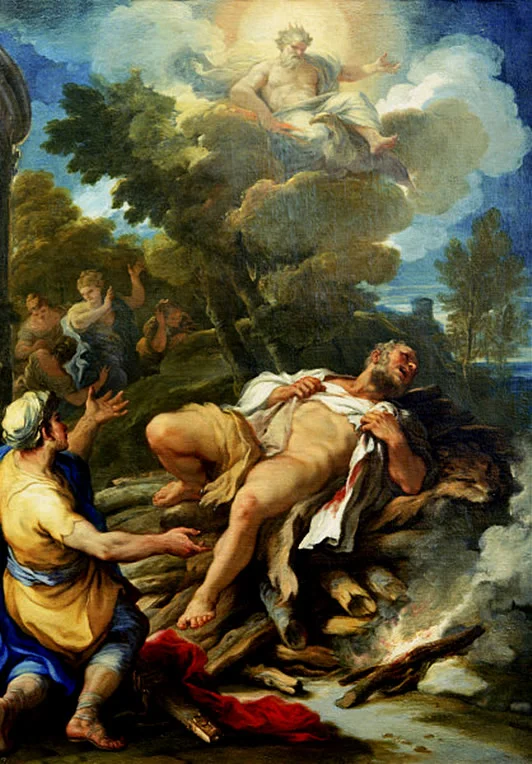

Pyre of Heracles
Sophocles set the scene precisely: the hero, unable to bear the agony burning through his body, commands his son to build a pyre on the summit of a mountain. Heracles climbs onto it himself. What happens next, in the myth, is apotheosis — the mortal burned away, the god revealed. The mountain Sophocles chose was Oeta, in central Greece. Archaeologists found it still remembered the story more than two thousand years later.
The Story That Began With a Cloak
The chain of events in Sophocles's Trachiniae starts with a centaur named Nessus. Heracles had killed him after Nessus attempted to abduct his wife Deianeira. Dying, Nessus gave Deianeira a poisoned cloak, claiming it was a love charm. Years later, fearing that Heracles had fallen for a princess named Iole, Deianeira sent him the cloak. The poison — described in ancient sources as the blood of the Lernaean Hydra, already on the arrow that felled Nessus — worked into Heracles's skin and began consuming him. The pain was beyond endurance. Heracles, who had overcome monsters, the underworld, and divine madness, could not overcome this. He ordered a pyre built on Mount Oeta and walked into the fire himself. In the myth, what rose from the flames was not smoke but a god.
Ruins on the Summit
The remains of a Doric temple from the 3rd century BCE stand near the summit of Mount Oeta, at approximately 38.74°N, 22.31°E, at elevation in the regional unit of Phocis. The nearby village carries the name Pyra — the Greek word for funeral pyre. Roman general Manius Acilius Glabrio visited the site in 191 BCE, suggesting that even in antiquity the location was known and revered. Greek archaeologists first excavated the area in 1919–1923, and resumed in 1988. What they found shaped the scholarly debate: pottery with Heracles's name inscribed on it, and figurines of the hero, turned up in the ash layers. The site was not merely commemorative. It had been used for ritual.
Ritual Before Story
The excavation findings gave momentum to a theory proposed by scholar Lewis Richard Farnell: that the myth of Heracles's self-immolation might itself have grown from an existing Eastern tradition — the death and rebirth of a deity through fire. If worshippers had been performing fire rituals at this spot for generations before Sophocles wrote his tragedy, the myth may be the story's explanation rather than its origin. Swedish philologist Martin Nilsson, examining the same evidence, concluded that the ritual was indeed the source of the myth. The pottery naming Heracles, the figurines, the site's continuous use — all pointed to a cult that predated the literary version of the story. Mount Oeta was not simply the setting Sophocles chose. It was the place where the ritual that inspired the story had actually been performed.
The Mountain in Context
Mount Oeta rises above the valley of central Greece to a height that places it among the visible landmarks of the region. Thermopylae — where the Spartans made their stand — is only a short distance to the northeast, at the point where the mountains press close to the sea. The ancient road from northern Greece into Attica passed through this narrowing, and Oeta dominated the landscape above it. For travelers in antiquity, the mountain was not just geography. It was the place where the greatest of mortal heroes had burned himself into divinity. The Doric ruins, weathered by twenty-three centuries of Greek winters, still occupy that summit.
From the Air
The Pyre of Heracles site lies at approximately 38.74°N, 22.31°E on the upper slopes of Mount Oeta in Phocis, central Greece. The mountain is a prominent feature visible from altitude, rising sharply above the coastal plain near Thermopylae and the Maliac Gulf. Recommended viewing altitude is 6,000–9,000 feet to appreciate the full relief of Oeta against the surrounding terrain. The nearest major airport is LGBL (Nea Anchialos National Airport, near Volos), approximately 60 km to the northeast. Athens Eleftherios Venizelos (LGAV) lies roughly 180 km to the south-southeast.
Nearby Stories
- Boeotia 6.7 km away
- Prousou Monastery 12 km away
- Crissa 13 km away
- Abae 14 km away
- Amaliapolis 16 km away
- Agrafa 18 km away
- Rio–Antirrio Bridge 20 km away
- The 1954 Sofades Earthquake 27 km away