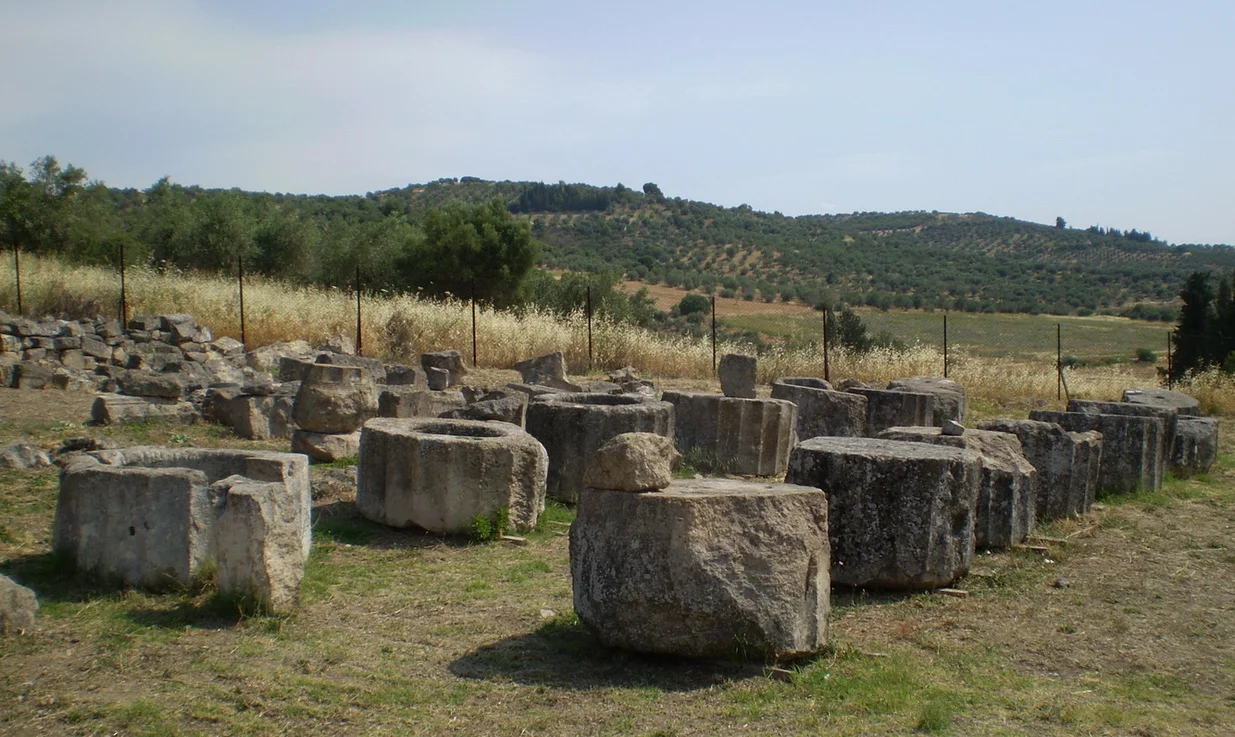

Abae
Sometime in the mid-sixth century BC, the richest king in the world sent messengers to every oracle he could find. Croesus of Lydia was planning a war against the Persian empire and wanted divine confirmation that he would win. He tested the oracles first, sending emissaries to ask each one what the king was doing on a specific day at a specific hour; the oracle of Apollo at Delphi answered correctly. So did the oracle of Apollo at Abae, a small town in the northeastern corner of Phocis. Abae was not Delphi — nothing was — but the fact that Croesus consulted it alongside the great oracles tells you something about the reputation it held across the Greek world. The sanctuary at Abae was famous, trusted, and rich with offerings. Then the Persians came.
A Sanctuary Before History
The myths surrounding Abae suggest great antiquity. The town was said to have been founded by Abas, son of Lynceus and Hypermnestra, and grandson of Danaus — a genealogy that places its origins deep in the heroic age. Whether or not the legend has any historical core, the archaeology supports it: excavations at Kalapodi, the modern village where the ancient sanctuary was rediscovered and identified, have confirmed continuous religious activity from the Early Bronze Age through the Roman period. The site at Kalapodi holds the distinction of being the first site in Greece where archaeology has confirmed a direct continuity between Mycenaean and Classical Greek religious practice — a thread running from roughly 1400 BC to the Roman Empire without interruption. That continuity helps explain why Abae's oracle was taken seriously: it was one of the oldest sanctuaries in Greece.
The Persian Burning
In 480 BCE, the army of Xerxes marched through Phocis. Herodotus describes the passage in his *Histories*: the Persians burned the towns and sanctuaries of the region as they moved south toward Athens. Abae was among them. The temple of Apollo, which had stood richly adorned with treasuries and votive offerings, was set ablaze. The Greeks who survived swore an oath not to rebuild the temples destroyed by the Persians, leaving the ruins visible as a permanent monument to the invasion's savagery — a kind of open wound in the landscape meant to be seen and remembered. The sanctuary at Abae was left in its burned state as an act of collective memory. This was a deliberate choice, and it endured for a long time.
Burned Again
The first burning was not the last. In 346 BCE, during the Third Sacred War — a conflict fought partly over control of Delphi and the resources of its sanctuary — Boeotian forces burned the temple at Abae a second time. The same site, the same god, the same pattern of destruction. Whether the Boeotians broke the earlier oath of non-reconstruction in the intervening years, or whether the sanctuary had been left substantially in ruins since 480, is unclear. What is clear is that by the time the traveler Pausanias visited in the second century CE, the original temple was still in a ruined state. Hadrian had ordered a smaller replacement temple built near the ruins of the old one; in it stood three ancient bronze statues of Apollo, Leto, and Artemis, dedicated by the people of Abae, perhaps saved from the fire.
The Rediscovery at Kalapodi
For centuries, the location of Abae was lost. Colonel William Leake, the British topographer who surveyed Greece in the early nineteenth century, proposed one identification; later scholars questioned it. The fortified hilltop Leake described — with its polygonal acropolis walls visible on a circular hill about 150 metres above the plain of Exarcho — is now believed more likely to be Hyampolis, a different Phocian town. The true sanctuary of Abae was identified only in the second half of the twentieth century, when excavations at Kalapodi revealed a site of extraordinary depth and continuity. The Kalapodi excavations, carried out by German and international teams, established the oracle's location definitively and produced finds from every period of occupation from the Mycenaean age onward. The oracle was also mentioned in Sophocles' *Oedipus Rex*, where the king sends to Delphi and Abae for answers — a detail that shows how naturally the two oracles were paired in the Greek imagination.
What the Oracle Was
Apollo at Abae was not Apollo in the abstract. The epithet Abaeus — Apollo of Abae — distinguished this manifestation of the god from his other shrines. Ancient sources describe Abae as a prosperous sanctuary before the Persian wars, its temple filled with treasuries, votive dedications, and artwork. The sanctity of the shrine conferred certain privileges on its people, which the Romans later confirmed. That the Persians chose to burn it, and that the Greeks preserved the ruin as a memorial, tells you something about what it meant: this was not a minor local cult but one of the recognized nodes in the network of Greek sacred places. That network — linking Delphi, Dodona, Olympia, Abae, and a dozen others — was the closest thing the fragmented Greek world had to shared institutions. The oracle at Abae was part of that fabric, consulted by kings, honored by athletes, and destroyed by empires, more than once.
From the Air
Abae is identified with the site near modern Kalapodi, at approximately 38.637°N, 22.896°E, in the foothills of Phocis in central Greece, about 120 kilometres northwest of Athens International (LGAV). Flying northwest from Athens, the terrain rises sharply from the Boeotian plain into the folded ridges of Phocis. The modern village of Kalapodi sits in a small valley between these ridges. The excavated sanctuary is not visually dramatic from altitude, but the landscape context is striking: an ancient sacred site tucked into mountain terrain where Bronze Age, Archaic, Classical, and Roman remains are all stratified in the same ground.
Nearby Stories
- Battle of Alamana 3.6 km away
- Free and Real 5.7 km away
- Agios Thomas Tanagras 5.7 km away
- Pythian Games 11 km away
- Thespiae 12 km away
- Euripus Strait 14 km away
- French Cruiser Châteaurenault (1898) 17 km away
- Skopelos 32 km away