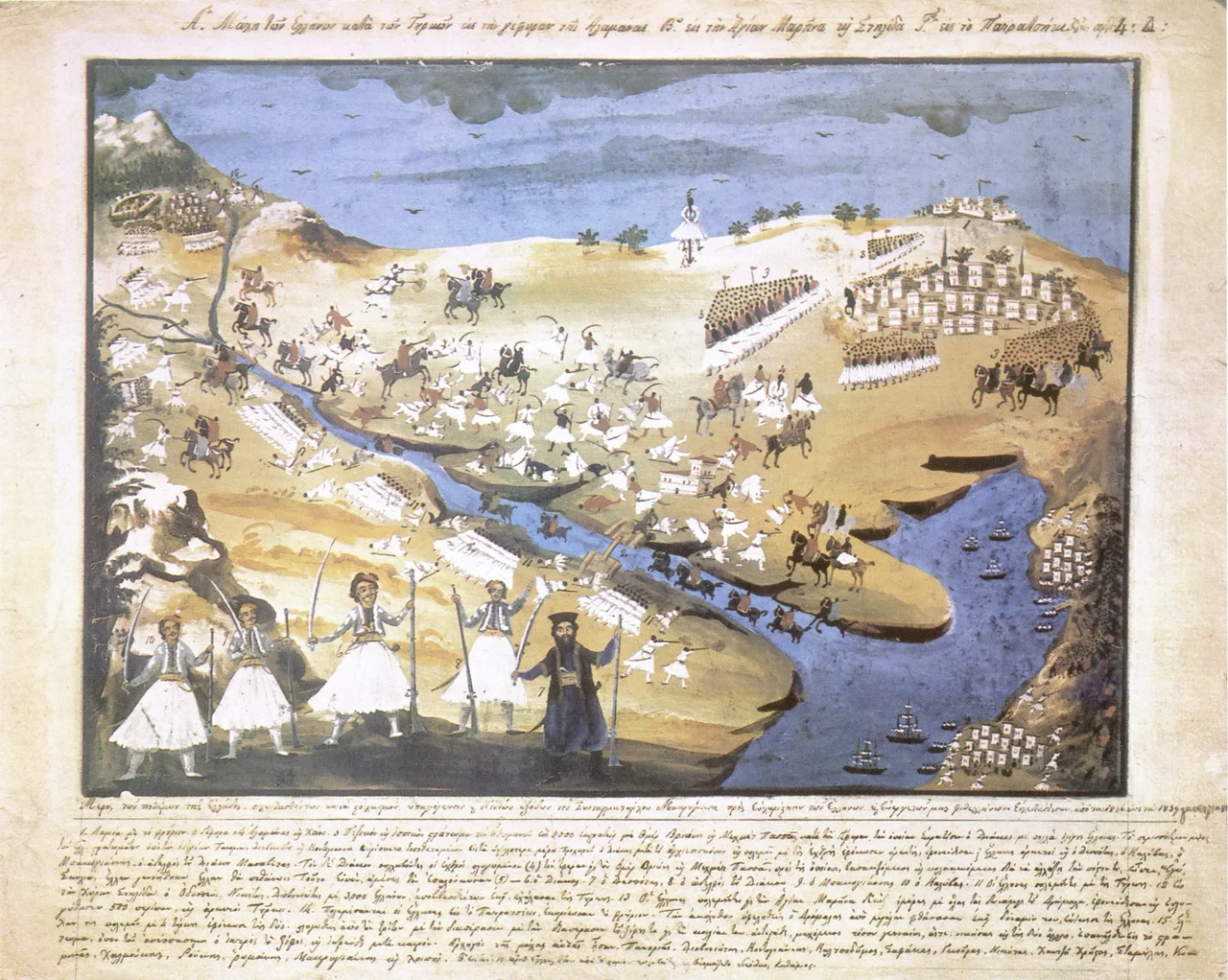

Battle of Alamana
Greece had been rising against Ottoman rule for only three weeks when the battle at the Alamana bridge began. What happened there on 22 April 1821 was a military defeat — outnumbered, the Greek position was eventually overrun, and its commander was taken prisoner. But the way Athanasios Diakos faced what came after his capture left a mark on the Greek national story that the battle's outcome never did.
Three Bridges, One Plan
After Greek fighters took Livadeia on 1 April 1821, the Ottoman commander Hursid Pasha dispatched two of his most capable commanders from Thessaly — Omer Vrioni and Köse Mehmed — at the head of 8,000 soldiers. Their orders were to crush the revolt in Roumeli and then proceed to the Peloponnese. Diakos and his forces, joined by fighters under Dimitrios Panourgias and Yiannis Dyovouniotis, moved to block the Ottoman advance near Thermopylae. They divided their 1,500 men across three defensive positions: Dyovouniotis at the Gorgopotamos bridge, Panourgias at the heights of Halkomata, and Diakos at the bridge over the Alamana stream, south of Lamia.
The plan required all three positions to hold. None of them did — but not for lack of trying.
The Bridge Held as Long as It Could
Setting out from their camp at Lianokladi, the Ottoman forces divided as they approached. The main column struck Diakos's position while the other engaged Dyovouniotis, who was quickly routed. Then Panourgias fell back when wounded. With the flanks gone, the Ottomans concentrated everything on the Alamana bridge. Vasilis Bousgos, fighting alongside Diakos, could see what was coming and pleaded with him to retreat. Diakos refused. He remained with 48 men and fought hand-to-hand for hours. When his sword broke and he was wounded, he was taken prisoner. The disproportion — 48 men against the concentrated force of an 8,000-strong army — makes the duration of that stand remarkable.
A Man Who Would Not Change His Answer
Brought before Omer Vrioni, Diakos received an offer: convert, enter Ottoman service, and survive. He refused. "I was born a Greek and I will die a Greek," he said. Vrioni ordered his execution by impalement.
The Ottomans commanded Diakos to carry the sharpened pole himself. He threw it down. As he was led away, those present heard him singing — a song about spring, about branches flowering and grass pushing up from the earth, and about the cruelty of dying at such a moment. The song became famous; the image it captured, of a man facing death with bitter irony rather than despair, became central to how Greeks remembered him.
Diakos died from his injuries. One local oral tradition holds that a Greek rebel ended his suffering the following day out of mercy, as he was found near death from the impalement. The exact details of his final hours are not certain; what is documented is that he did not survive and that he did not yield.
Defeat That Became Myth
Militarily, the Battle of Alamana was a Greek loss. The defensive positions collapsed, the Ottoman advance into Roumeli continued, and Diakos was dead. But his refusal of Vrioni's offer — and his composure in what followed — gave the revolution something that a tactical victory could not have provided. His death circulated through the uprising as a story of what the cause meant, and of what it demanded. He became one of the most recognizable martyrs of the Greek War of Independence.
The Alamana site lies near Lamia in Phthiotis, in the shadow of the same Thermopylae pass where the Spartans had made their own last stand twenty-three centuries before. The parallel was not lost on those who told Diakos's story.
From the Air
The Battle of Alamana was fought near the confluence of the Alamana stream and the Spercheios River, at approximately 38.85°N, 22.46°E, just south of Lamia in Phthiotis. The site sits in the wide alluvial valley of the Spercheios, with the mountains of central Greece rising on either side and the narrowing at Thermopylae visible to the east where the hills meet the sea. Recommended viewing altitude is 3,000–5,000 feet to take in the strategic geography — the valley floor, the mountain walls, and the coastal bottleneck that made this area decisive for anyone moving between northern and southern Greece. The nearest major airport is LGBL (Nea Anchialos National Airport, near Volos), approximately 50 km to the northeast. Athens Eleftherios Venizelos (LGAV) is approximately 170 km to the south.
Nearby Stories
- Karpenisi 2.6 km away
- Duchy of Neopatras 2.7 km away
- Kalapodi 5.1 km away
- Farsala 11 km away
- Lake Plastiras 12 km away
- Thermos (Aetolia) 17 km away
- Demetrias 17 km away
- Free and Real 21 km away