
Kalapodi
The oracle was here long before Delphi had its famous reputation. At a crossroads in the hills of central Greece, where the pass between Boeotia and the Gulf of Euboea narrows to a single strategic intersection, priests tended an altar that nobody ever let go dark. Archaeologists drilling down through the soil at Kalapodi have found temple upon temple stacked one atop the other — Bronze Age, Dark Age, Archaic, Classical, Hellenistic, Roman — an unbroken sequence of devotion stretching back more than three thousand years. No other known sanctuary in Greece can claim as long a continuous cult life.
The Crossroads at the Heart of Phocis
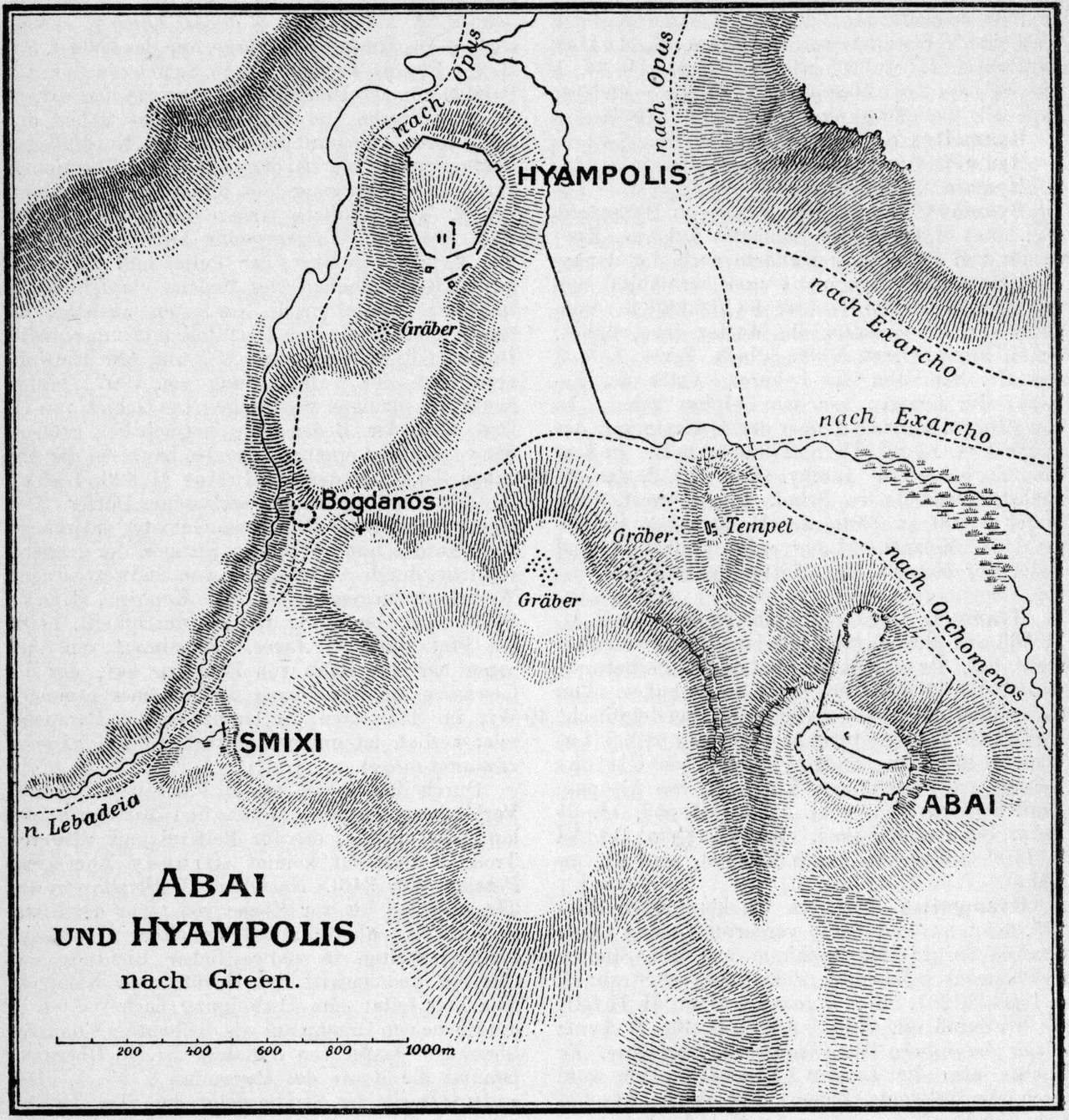
Kalapodi sits in rolling upland on the flank of a mountain pass, with Mount Parnassus visible to the southeast and two wildlife refuges flanking the hills on either side. The pass itself bifurcates just east of the village: one fork leads to the Valley of Kalapodi, the other to the Valley of Exarchos. In antiquity, these valleys formed the geographic and political heart of the city-state of Phocis. The state was born at nearby Hyampolis, under the auspices of Artemis, after a rebellion against Thessaly and other neighboring powers. Delphi, though technically Phocian, was controlled by the Amphictyonic League, a committee of outside states. The sanctuary at what would become Kalapodi was different: it answered to Phocis alone.
Traffic passed through these valleys from every direction — from the north, from the Boeotian plains to the south, from the Aegean coast to the east. An oracle positioned here could be consulted by travelers arriving from Athens, from Thessaly, from the islands. Delphi, blocked on the north by Parnassus, did not have the same geographic accessibility. The crossroads made this place.
Layer upon Layer: The Archaeological Riddle
When British archaeologists first examined the two hills flanking the valley in the early twentieth century, they labeled one 'the town of Abae' and the other 'Hyampolis,' and went home. Their report noted that the excavation 'was conducted in bad weather and proved disappointing.' It would take German archaeologists from the Deutsche Archäologische Institut, working from the 1970s onward under Rudolf Felsch, to reveal what actually lay beneath the soil: not one temple but many, stacked in numbered layers like geological strata. North Temple 1, North Temple 2, North Temple 3. South Temple 1, South Temple 2. Each phase built directly on the ruins of the last, the altar never moved, the worship never interrupted.
The German team concluded that the north temple was dedicated to Apollo, and the south to his twin Artemis. The site's founding cult appears to have been that of Artemis — she was the protector of the emerging Phocian state — but Apollo's presence grew more prominent as the centuries passed. A geophysical survey conducted by the University of Kiel between 2014 and 2017 found evidence of a substantial settlement surrounding the sanctuary, its different features built in different periods, not a single fortified city but a living community that supported the sacred complex over millennia.
The Oracle Riddle
The German archaeologist Wolf-Dietrich Niemeier, who directed excavations at the site from 2004 to 2013, called the central question 'Das Orakel-Rätsel' — the oracle riddle. The ancient sources mention two famous sites in this region: Hyampolis, the Phocian capital, and Abae, the seat of an Apollo oracle that Herodotus mentions in connection with the Persian Wars, and which was among the oracles consulted before the Battle of Plataea. But where exactly was Abae? Two valleys, two hills, competing evidence.
The clue that tipped the balance was epigraphic: inscriptions mentioning Apollo were found in the Valley of Kalapodi, while inscriptions mentioning Artemis turned up in the Valley of Exarchos. If Artemis's sanctuary belonged to Exarchos, and Abae — Apollo's oracle — was in Kalapodi, the geography made sense. Niemeier excavated the south temple looking for confirming evidence. Today the predominant scholarly view holds that Kalapodi was ancient Abae. The oracle that Croesus consulted, that Persian kings feared, that Greek city-states sought in moments of crisis — it was here, in this quiet pass in the hills of Phocis.
What the Excavations Revealed
The finds from Kalapodi span thousands of years of religious life. Ceramic sherds from the Middle Bronze Age suggest the site attracted ritual activity even before the first formal temple was built in the Late Bronze Age. Metal objects — votive offerings, weapons, ornaments — illuminate what worshippers brought as gifts through the Dark Age, when literacy largely vanished from Greece but the fire at this altar was apparently never extinguished. Felsch's team produced two volumes for the German Archaeological Institute's monograph series covering the ceramic and metal finds along with the site's stratigraphy, a compendium of thousands of artifacts catalogued by dozens of participating archaeologists.
The most striking finding, perhaps, is not any single object but the sequence itself. When the Dorian migrations disrupted Greek civilization around 1200 BC, sanctuaries across the Aegean went dark. Kalapodi did not. When Athens and Sparta fought each other into exhaustion in the Peloponnesian War, Kalapodi continued. When Rome absorbed Greece into its empire, Roman nobles added their offerings to the pile. The last attested phase of use dates to Imperial Roman times — roughly 1,500 years of continuous cult activity in a mountain pass that most people today have never heard of.
A Village Above Its Own Past
Modern Kalapodi is a small agricultural community of a few hundred people, with a church, a clinic, a police station, and schools. The archaeological site lies about a kilometer east of the village, and the land above it still looks much as it would have to ancient travelers: a valley pass, rolling upland, the distant snow-capped bulk of Parnassus on the horizon. Tourists are rare here. The site has no grand museum, no popular tourist infrastructure, no Acropolis lighting it up at night. What it has is depth — the kind of depth that comes from a place that has meant something to people for so long that the meaning is almost geological.
From the Air
Kalapodi lies at approximately 38.633°N, 22.883°E in the mountains of central Greece (Phocis), about 120 km northwest of Athens. Flying northwest from Athens International (LGAV), the site sits in a highland pass between the Boeotian plains and the Gulf of Euboea. Mount Parnassus (2,457 m) is the dominant visual landmark, visible to the southeast of the site. Viewing altitude of 3,000–5,000 feet gives a clear impression of the valley geography that made this crossroads strategically and spiritually vital. The terrain is rugged hill country, with the passes clearly legible from the air as the low gaps connecting the coastal plains to the interior.
Nearby Stories
- Battle of Alamana 3.6 km away
- Free and Real 5.7 km away
- Agios Thomas Tanagras 5.7 km away
- Pythian Games 11 km away
- Thespiae 12 km away
- Euripus Strait 14 km away
- French Cruiser Châteaurenault (1898) 17 km away
- Skopelos 32 km away