
Thespiae
The Spartans get three hundred. Thespiae gets seven hundred. That disproportion has always seemed worth noting. When the Persian army of Xerxes I arrived at the pass of Thermopylae in 480 BC, the 300 Spartans under Leonidas have entered legend — the movies have been made, the memorials erected. But alongside them stood 700 hoplites from Thespiae, a Boeotian city at the foot of Mount Helicon, who also chose to remain on the final day rather than retreat. They also died. Thespiae had made its decision, and it paid the same price.
City of Divine Inspiration
The name Thespiae derives from the Greek word thespis, meaning 'divine inspiration' — the same root that gives English the word 'thespian,' linking the theatrical tradition to the city's mythological identity. Thespiae sat at the foot of Mount Helicon in Boeotia, the region northwest of Attica dominated politically by Thebes. The Boeotian plain had been settled since the Bronze Age, and Thespiae formed part of the patchwork of city-states that made up the Boeotian League, a federation under Theban leadership that began around 520 BC. Thespiae's geographic position — controlling sea routes through the harbor of Siphai, positioned between the competing powers of Athens and Sparta — gave the city a degree of strategic leverage unusual for a place of its modest size.
Thermopylae and Its Aftermath
When Persia invaded in 480 BC, most Boeotian cities sided with the invaders — 'medized,' as the Greeks called it, submitting to Persia in exchange for survival. Thebes medized. Thespiae and Plataea alone among the Boeotian states chose to ally with Greece. The Thespians sent their 700 hoplites to Thermopylae under the commander Demophilus. They remained to fight on the final day not because they were trapped but because they chose to stay. After the pass fell, Xerxes's army burned Thespiae to the ground as punishment for this defiance. The surviving Thespians, their city in ruins, furnished 1,800 men for the confederate Greek army that fought at Plataea the following year. They fought from ashes. Greece eventually honored the Thespians with a monument at Thermopylae, a recognition that arrived centuries after the fact but arrived nonetheless.
Praxiteles, Lysippos, and the God of Love
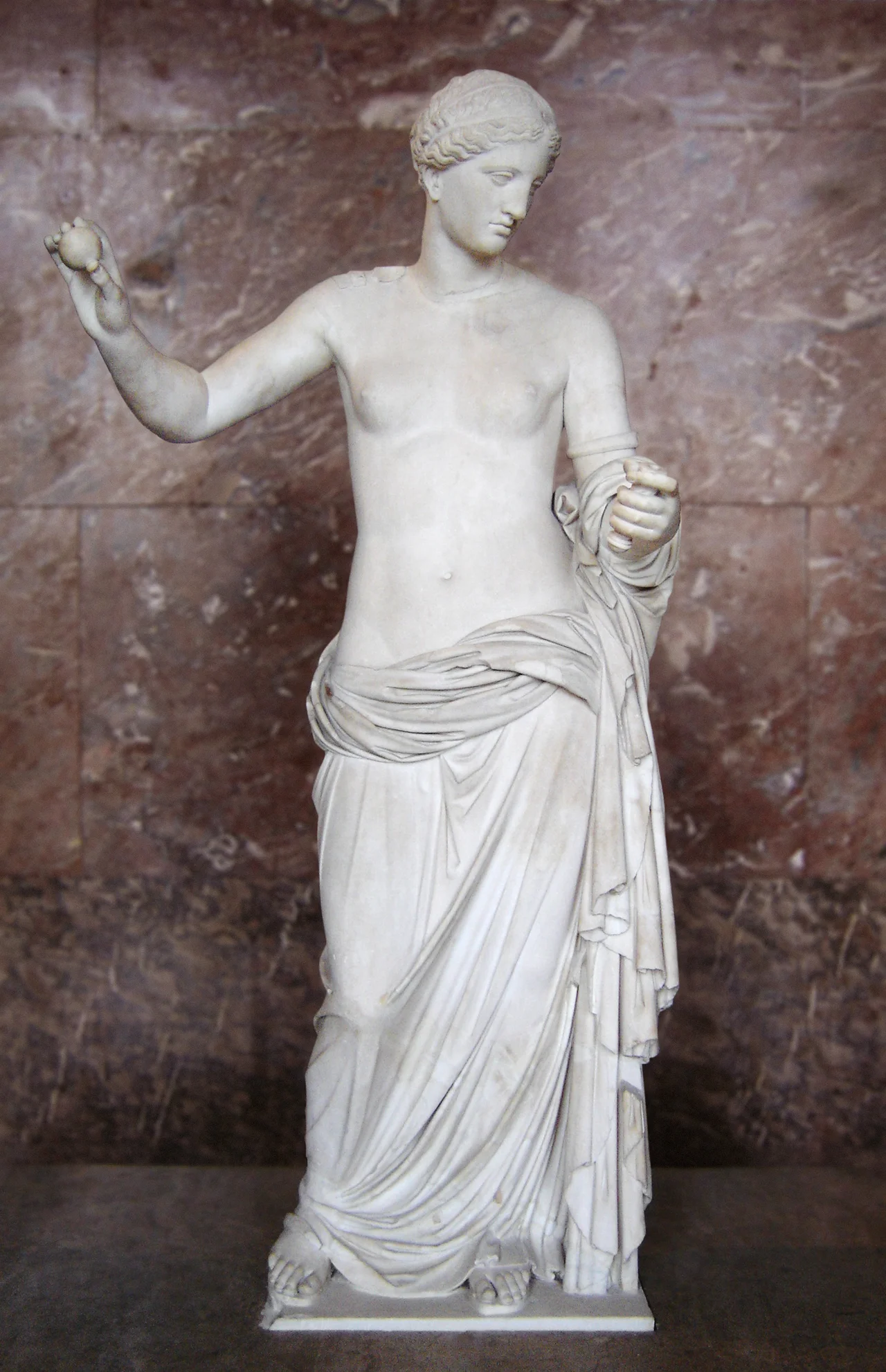
According to Pausanias, the deity most worshipped at Thespiae was Eros. This was not an accident of geography but a genuine civic devotion — the god of desire, in a city whose name meant divine inspiration. Praxiteles, one of the greatest sculptors of the 4th century BC, carved an Eros from Parian marble for Thespiae. The statue became one of the most celebrated works in the ancient world, copied, moved, and eventually carried off to Rome. Lysippos, the court sculptor of Alexander the Great who also worked at Sicyon across the Gulf, crafted a separate Eros in bronze. Praxiteles also made an Aphrodite for Thespiae — the Aphrodite of Thespiae, which scholars believe is represented in the Venus of Arles now in the Louvre. Two of antiquity's most accomplished sculptors both worked for this Boeotian city's cult of love.
Phryne and the Walls of Thebes
The most famous person born at Thespiae in the 4th century BC was Phryne, a hetaira — a courtesan of the educated, high-status kind that moved in intellectual and artistic circles in classical Athens. Phryne became the most celebrated hetaira of her generation, known across the Greek world, and she served as the model for Praxiteles's Aphrodite of Cnidos, the first full female nude in Greek sculpture. When she was prosecuted for impiety in Athens, the orator Hypereides defended her. The case became legendary. She won. Perhaps the most striking anecdote about her comes from Athenaeus: when Thebes was destroyed by Alexander the Great in 335 BC, Phryne offered to finance the rebuilding of the Theban walls on one condition — that the inscription read: Destroyed by Alexander, Restored by Phryne the courtesan. The Thebans declined. The offer itself, equal parts generosity and audacity, tells you something about the woman Thespiae produced.
The Long Arc of Survival
Thespiae's history after Thermopylae was one of repeated devastation and survival. Thebes dismantled the city's walls in 423 BC on the charge that the Thespians were pro-Athenian. The city was razed again by Thebes after the Battle of Leuctra in 371 BC. Each time, the Thespians rebuilt or were restored. They joined Alexander the Great in destroying Thebes in 335 BC — payback, perhaps, for generations of Theban bullying. Later, as a free city within the Roman Empire recognized by Pliny, Thespiae hosted Roman merchants and traders until the refoundation of Corinth in 44 BC drew commercial life elsewhere. The Erotidia, a festival celebrating Eros held every five years, continued through these upheavals. Boys danced at the Temple of the Muses on Mount Helicon. The city that worshipped love and sent its sons to die at Thermopylae endured through the Roman period, carrying its peculiar identity — principled, stubborn, devoted to beauty — into a world that no longer remembered what it had chosen, or what it had cost.
From the Air
Ancient Thespiae is located at approximately 38.294°N, 23.155°E at the foot of Mount Helicon in Boeotia, northwest of Athens. From altitude, the site lies on the Boeotian plain between the distinctive mass of Mount Helicon to the west and the Theban plateau to the northeast. The modern village of Thespies marks the approximate location. Approach from the south at 5,000–8,000 feet for views of both the Boeotian plain and the slopes of Helicon rising behind the site. The nearest major airport is Athens International (LGAV), approximately 60 km to the southeast.
Nearby Stories
- Battle of Salamis 2.2 km away
- Ancient Greece 2.4 km away
- Agios Thomas, Boeotia 4.6 km away
- Corinth Canal 5.4 km away
- Achaia (Roman province) 9.8 km away
- Phocis (Ancient Region) 11 km away
- Corinth Rail Disaster 13 km away
- Euboea 39 km away