
Agios Thomas, Boeotia
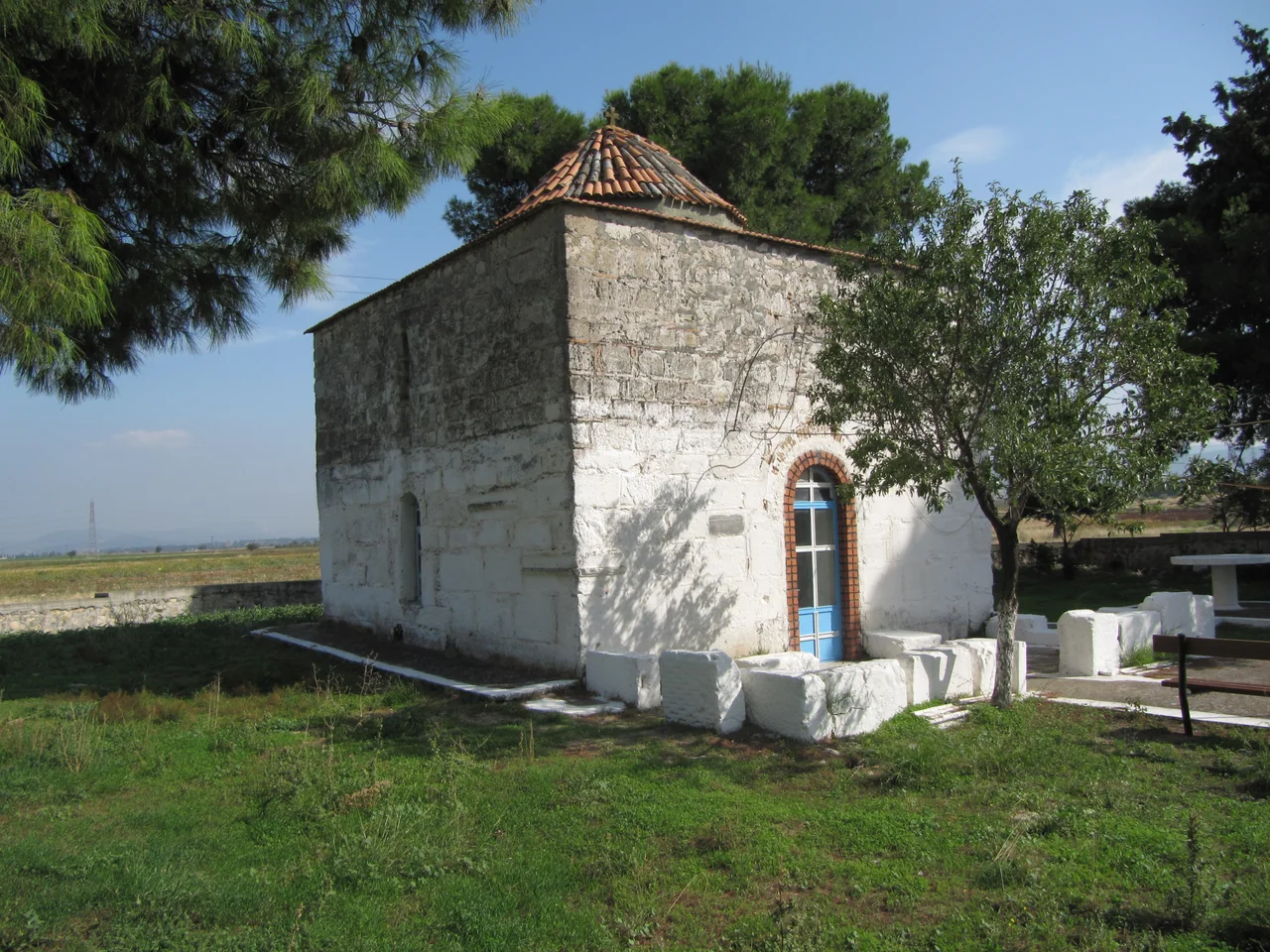
A single Byzantine church still stands alone in the fields, a kilometre from the ruins of ancient Tanagra. It is the last witness to a village that vanished six centuries ago, when plague and war emptied the lowlands of Boeotia and scattered its people into the hills. Walk the plowed ground around that 12th-century chapel and the surface still glitters with broken pottery - the everyday debris of farmers who lived, prayed, and died here between the 11th and 14th centuries. Modern Agios Thomas grew up nearby, but its roots run all the way down into that older, abandoned world.
The Vanished Village
Archaeologists from Leiden and Ljubljana, surveying the fields around Tanagra in 2003, pieced the story together from ceramics scattered across the soil. When the Eastern Roman Empire reclaimed the Greek countryside from Slavic settlement by the 8th century, rural life flourished again. Across Boeotia, small villages sprang up every few kilometres, their pottery dating their birth to the 10th and 11th centuries. One settled barely a kilometre from ancient Tanagra, drawn to the same advantageous ground that had supported the classical town. Its church, Middle Byzantine and built in the 12th century, still stands beside the Asopos River. Then, in the 14th century, the whole network collapsed at once - the Bubonic Plague returned, and the wars between Franks, Byzantines, and Turks swept the population away. Those who survived fled to the uplands or were carried off into slavery. The fields fell silent.
Liatani, the Name That Wouldn't Settle
For nearly a century the lowlands stayed empty. Ottoman tax records from 1466 show eastern Boeotia almost deserted, its great plains around Tanagra all but vacant. To repopulate the land, the Frankish dukes and then the Ottoman rulers invited Albanian settlers, directing them to plant new villages beside the abandoned old ones. Out of this resettlement came the village the records call Liatani - a name whose origin no one can quite fix. One account ties it to an Arvanitic phrase; another to the Liapedes communities of the Ottoman era; an old villager interviewed in 1967 swore the real name was Mavromati, after the sea of olive trees, and indeed the British colonel William Martin Leake recorded that name when he passed through in 1806. Modern Agios Thomas formed only in the early 19th century, as families came down out of the mountains between Boeotia and Attica after the War of Greek Independence.
Fighters on the Road to Athens
Liatani sat astride the road armies used to reach Athens, and in the revolution of 1821 it could not stay out of the way. That July, the Ottoman pasha Omer Vryonis marched through with thousands of men to relieve the Turks besieged on the Acropolis, where they had run out of food. The villagers fought on the side of Captain Athanasios Skourtaniotis, the guerrilla leader from nearby Dervenochoria. Two local officers earned lasting honor: Ioannis Kiokes, who fought at the battle of Arachova under Georgios Karaiskakis and was decorated for his service - including his help during plague on the island of Poros - and Ioannis Koubitsas, remembered for wisdom and courage, who died years later in a clash between rebels and government troops. In 1827, Vassos Mavrovouniotis defeated an Ottoman column at Liatani itself, delaying the resupply of Athens.
Earthquake, Explosion, and a Solemn Title
The village kept its older name until 1929, when Liatani officially became Agios Thomas, after Saint Thomas, its patron. The 20th century brought hardship in waves. A powerful earthquake in October 1914 leveled most of the houses, and villagers accused local officials of handing out relief unfairly. In 1963, an explosion at the ELVIEMEK plant killed four young people from the village - Evangelia, Catherine, Theofani, and Constantinna, all between sixteen and twenty-one - a loss the community still records by name. The story carries a heavier shadow still: in 2020, by Presidential Decree, Agios Thomas was officially designated a martyr village, a Greek honor reserved for communities that suffered atrocity, most often during the Second World War occupation. The decree binds the present village to a memory of sacrifice it does not let go.
Olives, Roots, and the Asopos
For all its layered history, daily life in Agios Thomas has long turned on the land. Farming and livestock sustained the village from its founding, alongside the blacksmiths, grocers, and tradespeople any rural community needs. Olive oil remains the prized product, pressed from groves that cover the surrounding slopes, along with root crops like potatoes and carrots; in recent years growers have experimented with cotton, tobacco, and pomegranates. When the Asopos basin industrialized in the 1960s, many of the young left the fields for factory work nearby. The village itself, set in the community of Tanagra municipality across nearly forty square kilometres, keeps its primary school, its clinic, its care center for the elderly, and at its heart the church of the Nativity of Mary - the quiet center of a place that has been emptied, refilled, renamed, and rebuilt more times than most towns ever are.
From the Air
Agios Thomas sits at 38.267°N, 23.583°E in the hills of eastern Boeotia, within Tanagra municipality, about 45 km north of Athens near the Attica border. From the air it appears as a compact village amid extensive olive groves on rolling terrain, with the Asopos River valley and the ruins of ancient Tanagra a short distance to the southeast. Recommended viewing altitude 2,500-4,500 ft AGL; the broad plain around Schimatari and Oinofyta aids orientation. Nearest major airport is Athens International (LGAV), roughly 50 km southeast. The area lies near the Athens-Thessaloniki corridor (E65/A1); expect en-route traffic overhead. Clear conditions are common in summer, with haze possible over the industrial Asopos basin.
Nearby Stories
- Acropolis Museum 0.2 km away
- Battle of Leuctra 4.9 km away
- Sousaki Volcano 11 km away
- Ancient Greece 18 km away
- Great Sand Beach 23 km away
- Euboea 24 km away
- HMHS Britannic 30 km away
- Skyros 48 km away