.jpg)
Battle of Leuctra
Diodorus says a comet was seen before the battle, and that some who looked back on what happened at Leuctra believed it had been foretold. Whether the omen was real or invented after the fact, the events of 6 July 371 BC certainly looked, to anyone alive at the time, like the natural order of things being rewritten. For nearly a century the Spartan phalanx had been the most respected weapon in Greece. By sunset on a summer afternoon in Boeotia, that reputation lay among the dead on a plain outside an unremarkable village called Leuctra.
How They Got There
The path to the battle ran through a quarrel over signatures. According to Xenophon, the Thebans signed a treaty as 'the Thebans' but asked the next day to change their signature to 'the Boeotians', claiming leadership of the wider Boeotian league. The Spartan king Agesilaus II would not allow it. Sparta saw an opportunity to discipline a city that had grown ambitious. The other king, Cleombrotus I, marched his army from Phocis - not by the obvious pass, where the Thebans expected him, but over the hills via Thisbae, taking the small fortress of Creusis along with twelve Theban warships before the news of his presence had even arrived. By the time the Boeotians realized what was happening, a Spartan army was on the plain in front of Leuctra waiting for battle.
The Argument Among the Generals
There were six Boeotarchs - the federal generals - present, and they were split. Three were against giving battle. They were outnumbered, perhaps 7,000 hoplites against 10,000 Spartan and allied infantry plus 1,000 cavalry, and several of their allies could not be relied upon. Three were for fighting, with Epaminondas among the most insistent. The deadlock broke only when a seventh Boeotarch arrived from outside the council and added his vote to those who wanted battle. It was the kind of thin, contingent decision on which the history of nations sometimes turns.
The Echelon and the Sacred Band
What Epaminondas did next was a piece of military thinking that historians still teach. Greek armies traditionally placed their best men on the right wing and met an opposing right with their own weaker left. Epaminondas inverted this. He stacked his Theban infantry on the left fifty ranks deep - against a Spartan right that was twelve deep - and held back the rest of his line in echelon, refusing to engage until the decisive blow had landed. At the head of his column, almost certainly, was the Sacred Band of Thebes, an elite unit of three hundred trained to fight in pairs. The Theban cavalry drove the Spartan horse off the field first; then the deep Theban column smashed into the Spartan right where King Cleombrotus stood.
The Death of a King
Cleombrotus was killed in the press, along with about four hundred Spartiate citizens - full Spartan citizens whose numbers, by 371 BC, had already shrunk to perhaps twelve hundred. The remaining Peloponnesian allies, watching their right wing collapse, declined to fight on. Some sources record that the allied troops were half-hearted in any case - subjects of Sparta more than partners - and they retired from the field, leaving the Boeotians in possession of it. Diodorus says the Spartan dead were believed by some to have been foretold by the comet earlier in the year. Plutarch and others record the disbelief at home: a Spartan army had been broken in open battle, an event that for older men was almost a contradiction in terms.
What Leuctra Took Away
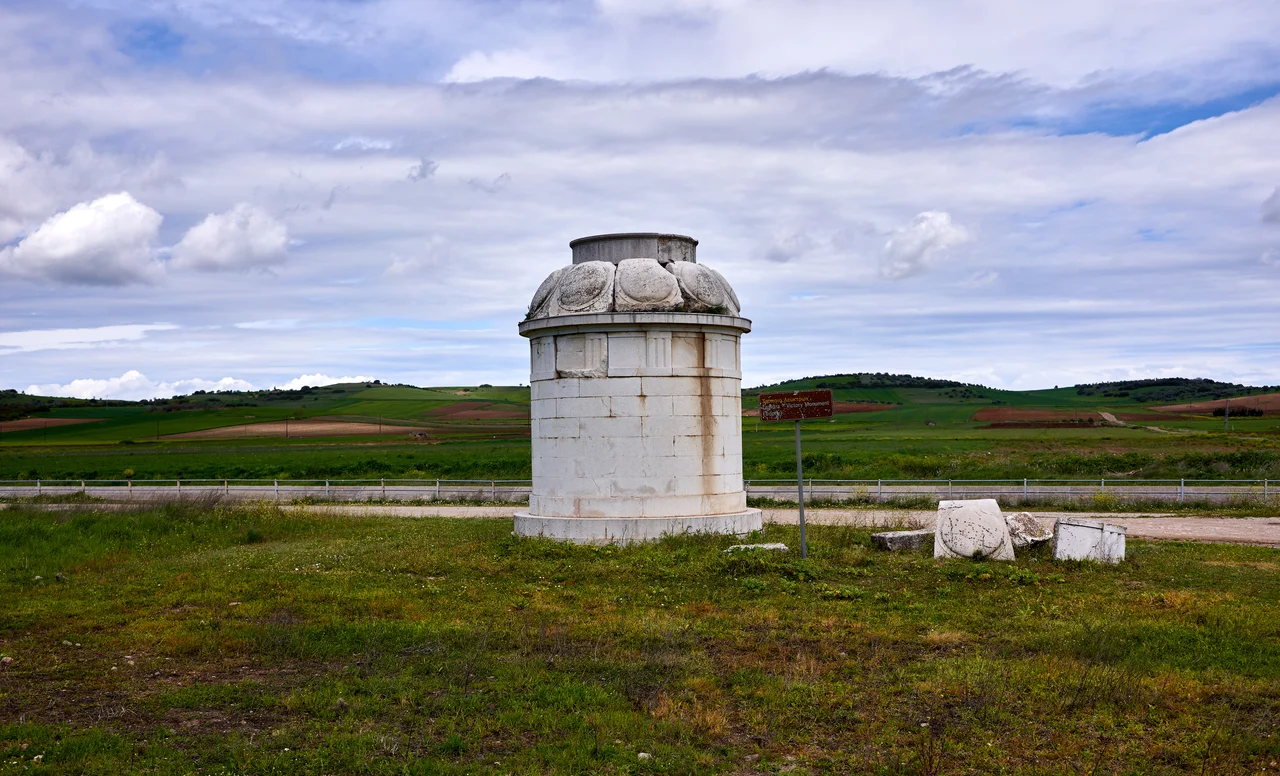
What followed was the unraveling. Within a few years Epaminondas had marched into the Peloponnese, freed Messenia from Spartan control after three centuries of helot subjugation, and helped found the city of Megalopolis to keep Sparta penned in. The Spartiate population, already declining, never recovered. The men who died at Leuctra were not faceless statistics; they included citizens who had grown up in the agoge, brothers and fathers from a small society that could not absorb such losses. Their corpses remained on the plain while the herald asked permission to recover them, and that herald's request - sent to Thebans, not received from them - itself signified what had happened. The Sparta that resumed its place in Greek politics afterward was a smaller, more cautious city. The plain at Leuctra is mostly farmland today, with a reconstructed victory monument near the road, but the question it asked of every later Greek general - what if the strong wing strikes the strong wing - never quite went away.
From the Air
Battlefield at 38.27N, 23.17E, on a small plain in Boeotia about 11 km southwest of Thebes (modern Thiva) and roughly 60 km northwest of Athens. Athens International Airport (LGAV) lies to the southeast; Tanagra (LGTG) is the closest military airfield. From cruise the plain sits just east of the foothills of Mount Helicon, with the Gulf of Corinth visible beyond. Best viewing 6,000-10,000 ft on a clear day, when the corridor between Boeotia and the gulf - the route Cleombrotus used - is easy to trace.
Nearby Stories
- Battle of Salamis 2.2 km away
- Ancient Greece 2.4 km away
- Agios Thomas, Boeotia 4.6 km away
- Corinth Canal 5.4 km away
- Achaia (Roman province) 9.8 km away
- Phocis (Ancient Region) 11 km away
- Corinth Rail Disaster 13 km away
- Euboea 39 km away