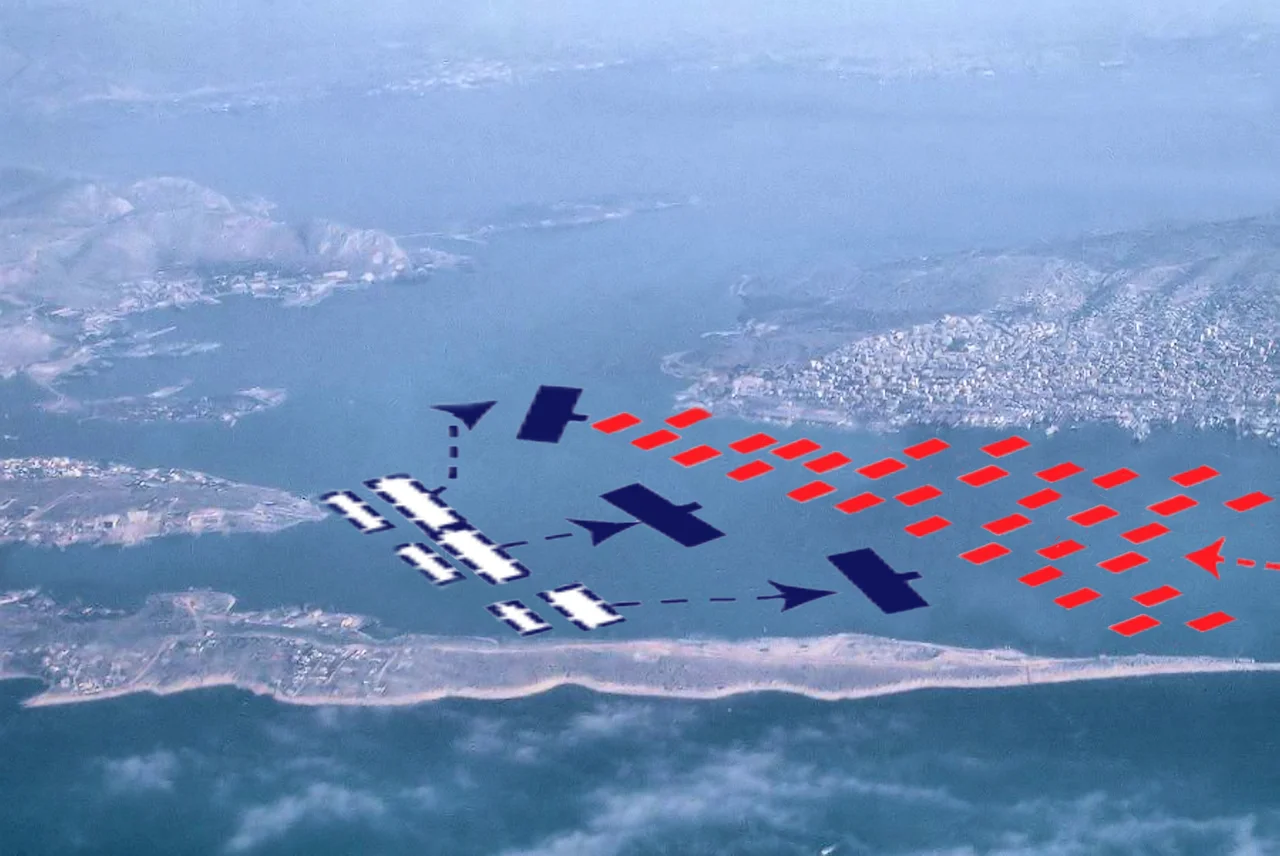
![Photo: Map: The Department of History, United States Military Academy [1] Photograph: Jona Lendering | Public domain](https://commons.wikimedia.org/wiki/File:Battle_of_Salamis_battle_order.jpg)
Battle of Salamis
There is a young man fighting in the Greek line whose name we know. He is a hoplite from the deme of Eleusis, in his early forties, and his brother died at Marathon a decade ago. Eight years from this autumn morning, he will write a play about what he is seeing. His name is Aeschylus. The Persians, first staged in Athens in 472 BC and the oldest surviving European drama, is the only one of his that takes its story not from myth but from a battle he survived. Salamis is unusual among ancient battles because we have testimony from a man who held a spear in it.
The Golden Throne
Xerxes did not intend to fight from a ship. From the slopes of Mount Aigaleo, on the Attic shore looking south across the narrow strait, he had servants carry up a golden throne and writing materials. Scribes stood ready to record the names of his bravest captains. The king of kings would watch the battle as a teacher watches an examination. He had reason to be confident. His army had marched through Thermopylae, sacked Athens, and burned the Acropolis. His fleet, drawn from Phoenicia, Egypt, Ionia, and Cyprus, outnumbered the Greek coalition perhaps two to one. What he did not know was that the man commanding the Athenian ships had spent the night feeding him a lie.
Themistocles' Trap
The Greek captains had spent days arguing. The Peloponnesians wanted to fall back to the Isthmus of Corinth and fight where their armies could support the fleet. Themistocles, the Athenian, insisted on Salamis - the narrow waters between the island and the Attic mainland, where Persian numbers would not fit. Losing the argument by debate, he won it by deception. He sent a slave named Sicinnus to Xerxes with a message: the Greeks were planning to flee in the night, and if the Persian king moved fast he could trap them. Xerxes believed it. He ordered his Egyptian squadrons to seal the western exit, and sent his main fleet into the strait at dawn. The Greeks were waiting.
The Strait That Drowned an Empire
What happened in the channel that morning is described by Aeschylus in lines that read like a man watching from a low deck. The Persian ships came on in disordered ranks, jamming each other in the narrow water, oars fouling. The Greek triremes, lighter and better-trained for ramming in close quarters, came from the shadows of the island shore. Phoenician ships were rammed amidships and sank with their crews. Greek ships hauled their own losses ashore and put fresh hands aboard. By midday the Persian formation had collapsed. By evening, Xerxes - watching from his throne as commanders who lost their ships swam to the Attic shore and were beheaded in front of him - understood that he had lost. Persian losses ran to perhaps 200 ships; Greek losses, around forty.
The Anchorage Beneath the Water
On 17 March 2017, Greek archaeologists announced they had located the partially submerged anchorage where the Greek fleet had moored before the battle - on the Salamis shore at the Ambelaki-Kynosaurus site, almost exactly where Herodotus places it. Stone harbor works lie just below the modern waterline, twenty-five centuries after the trireme crews drew them up onto a beach. The discovery was unusual not for what it changed but for what it confirmed: the geography of the most consequential naval battle in Western history is still readable in the rock. Stand on the Kynosoura peninsula at dusk today and the strait looks exactly as it did to the men who pulled their oars through it in 480 BC.
What Survived
Xerxes withdrew, fearing the Greeks would sail north and burn the bridges over the Hellespont, leaving him stranded in Europe. He took the bulk of his army home. The Persian general Mardonius stayed in Greece with the elite infantry, and was killed the following year at Plataea. The Persian fleet, what was left of it, was destroyed at Mycale on roughly the same day. Within thirty years, Persia had lost the Aegean coast it had held for a generation. Aeschylus lived to see it. He wrote his Persians not as a victory parade but as a tragedy of a great king brought low - the chorus is Persian, the grief is Persian, the play asks Athenian audiences to feel for the mothers waiting in Susa for sons who would not return. It is the earliest surviving European literature, and it begins with empathy for the enemy.
From the Air
37.95N, 23.57E. The Salamis Strait lies just west of Athens, between Salamis Island and the Attic mainland. From 4,000-6,000 ft, look for the narrow blue channel running roughly north-south for about 5 km between two coasts; Mount Aigaleo rises on the eastern (mainland) side, where Xerxes set up his throne. Athens International Airport (LGAV) is 35 km east; Athens-Hellinikon (closed) was at the southern Attic coast. Piraeus, modern Greece's main port, sits at the southern end of the strait. The town of Salamis on the island faces the channel; the Kynosoura peninsula juts northeast into the water and marks the likely Greek anchorage. Visibility in the Saronic Gulf is typically excellent except in summer afternoon haze.
Nearby Stories
- Parnitha 3.4 km away
- Kea (island) 7.3 km away
- Sanctuary of Apollo Maleatas 11 km away
- Sousaki Volcano 12 km away
- Battle of Leuctra 14 km away
- Great Sand Beach 18 km away
- Agios Georgios (island) 23 km away
- Skyros 84 km away