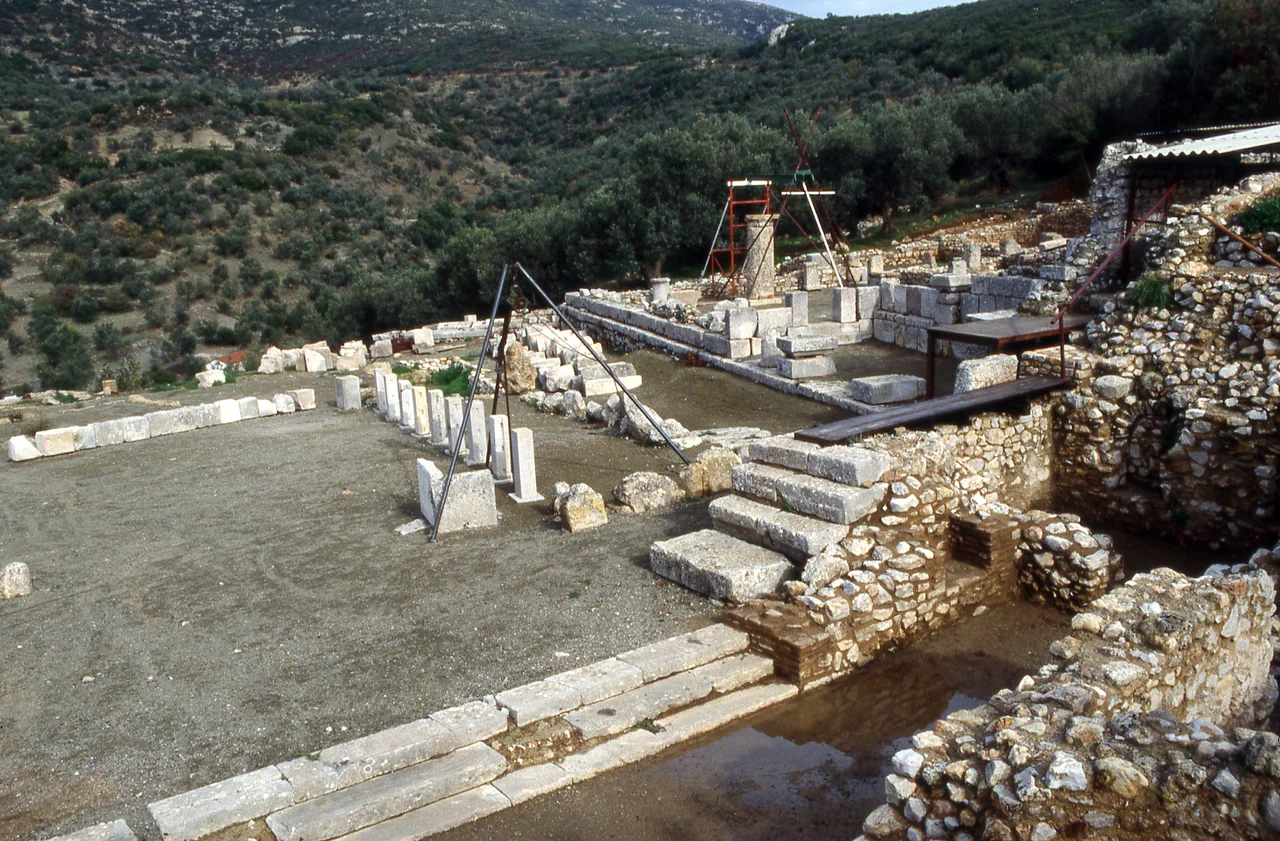

Sanctuary of Apollo Maleatas
The healing that made Epidaurus famous did not begin at the great sanctuary in the valley. It began up here, on the summit of Mount Kynortion, where people had been leaving offerings at an open-air altar long before Asclepius had a temple of his own. The Sanctuary of Apollo Maleatas is the older and less-visited of the two sacred sites above ancient Epidaurus — the one that Pausanias, writing in the 2nd century AD, said was ancient even then. It sits on a low hilltop east of the Asclepieion, and the mythology of the whole healing complex is threaded through it: this was believed to be the very hill where the infant Asclepius was exposed after birth, nursed by a goat, and discovered. Apollo and Asclepius begin here together.
Fire and Ash Before the Temples
At the peak of Mount Kynortion there was once a small Early Helladic settlement, occupied in the third millennium BC. The settlers left, and later generations chose not to build over the site. Instead, sometime at the beginning of the Late Bronze Age — roughly the same era when the Kazarma tholos tomb was in use nearby — worshippers began using an open-air altar on the hilltop. Animals were sacrificed and their remains burned; votive objects were pressed into the ash. Among the offerings recovered: bronze double axes, bronze swords, and clay figurines of animals. These deposits show cult activity continuing into the Geometric period, centuries before any temple stood here. The place accumulated meaning slowly, through accumulation of offerings and ash rather than through any single founding moment.
What Pausanias Saw
By the 4th century BC, a proper sanctuary had taken shape: a small Doric temple of Apollo, an altar, a stoa, a shrine of the Muses, and living quarters for the sanctuary staff. These were the structures visible when the site flourished. Then came the first century BC, a period of sustained catastrophe for the entire region. Sulla looted the main Asclepieion in 87 BC; pirates sacked it before 67 BC; the sanctuary of Apollo Maleatas was destroyed entirely. It lay abandoned for more than a century. When the Roman senator Sextus Julius Major Antoninus Pythodorus — an aristocrat from Nysa in Asia Minor — undertook a major renovation campaign in the 160s and 170s AD, he restored the hilltop shrine along with the sanctuary below. He added a propylon, a nymphaeum, and a vast underground cistern. Pausanias, who visited in the second half of the 2nd century, recorded the result in his Description of Greece: "The sanctuary itself is ancient, but everything about it, including the cistern in which the rain-water is collected, is a gift of Antoninus to the Epidaurians."
The Last of the Pagan Shrines
The sanctuary could not have remained active past the 4th or 5th century AD. The Christian emperors issued successive edicts shutting down pagan cult sites, and the temples at Epidaurus — including this hilltop shrine — fell silent along with the rest. The structures themselves were gradually dismantled or collapsed, their stones reused or simply absorbed back into the hillside. What remained when archaeologists arrived centuries later were foundations, fragments, the underground cistern, and the accumulated debris of centuries of offering. Panagiotis Kavvadias began excavating at Epidaurus in 1881, but gave the Apollo Maleatas site only cursory attention during his long career there. It was John Papadimitriou who conducted the first systematic excavation of the hilltop sanctuary, between 1948 and 1951, revealing the stratigraphy that links Early Helladic settlement to Bronze Age cult to classical temple to Roman renovation to final closure.
The Hilltop Above the Famous Place
Visiting the Sanctuary of Apollo Maleatas today means climbing past the crowds that fill the Asclepieion below. The theatre at Epidaurus draws tens of thousands of visitors each summer — its acoustics are justly celebrated, and modern performances still fill the ancient stone seats. The healing sanctuary in the valley is well-signed and well-excavated. The hilltop shrine above it is quieter. The remains are spare: foundations, a cistern, the bones of a stoa. But the view from Kynortion takes in the whole sacred landscape at once — the valley where the sick once came to sleep and dream, the grove that once surrounded the temple of Asclepius, the road that led here from the Saronic Gulf. It is easier to understand the geography of the healing cult from up here than from anywhere within it.
From the Air
The Sanctuary of Apollo Maleatas sits at approximately 37.599°N, 23.086°E atop Mount Kynortion, east of the Asclepieion at Epidaurus. From the air at 4,000 feet, the hilltop is clearly distinct from the valley sanctuary below. The ancient theatre of Epidaurus — one of the best-preserved in Greece — is visible to the northwest as a characteristic semicircle cut into the hillside. The nearest major airport is LGAV (Athens International Eleftherios Venizelos), roughly 100 kilometres to the northeast. The Argolic Gulf lies approximately 10 kilometres to the southeast. Flying over this area on a clear day, the layered archaeology of Epidaurus becomes visible as a landscape rather than a single site: hilltop shrine, valley sanctuary, ancient theatre, and the roads connecting them.
Nearby Stories
- German Submarine U-133 (1941) 5.1 km away
- Battle of the Trench (1821) 5.4 km away
- Battle of Settepozzi 6.7 km away
- Stymphalus (Arcadia) 8.2 km away
- Kechries 11 km away
- Battle of Sellasia 13 km away
- Saronic Gulf 19 km away
- SS Heraklion 68 km away