
Battle of Sellasia
Cleomenes III had tried to remake Sparta from the inside out. He cancelled debts, redistributed land, freed helots who could pay for their freedom, and rebuilt the Spartan army in the Macedonian phalanx style — not out of admiration for Macedon, but in order to fight it more effectively. In the summer of 222 BC, those reforms ran into a force of 29,200 soldiers on two hills called Olympus and Euas at Sellasia, just north of the Laconian border. The battle that followed ended Sparta's last serious bid for primacy in the Greek world, and the cost was staggering: according to Plutarch, of 6,000 Spartiates who fought that day, only 200 survived.
A Revolution in Arms
Cleomenes came to power in Sparta around 235 BC and almost immediately began dismantling the aristocratic order that had calcified around the old Spartan constitution. He cancelled the debts of Spartan citizens, redistributed land to expand the citizen body, and even sold freedom to helots — the enslaved population of Laconia — in exchange for money he desperately needed to pay his mercenaries. These were not incremental reforms. They were an attempt to rebuild a society. His military successes against the Achaean League between 229 and 226 BC seemed to validate the gamble: Sparta won at the Battle of Mount Lycaeum and at Ladoceia, and for a brief period was the dominant power in the Peloponnese. The Achaean League's response was to invite the very power Cleomenes feared into the peninsula. Aratus of Sicyon, the League's leading figure, opened negotiations with King Antigonus III Doson of Macedon, offering to surrender the formidable citadel of Acrocorinth in exchange for military intervention. The Achaeans who opposed the deal lost the argument.
The Hemming-In
Antigonus marched south with 20,000 infantry and 1,300 cavalry — routing through the island of Euboea because the hostile Aetolian League blocked the direct land route. Cleomenes had fortified the Isthmus of Corinth against him; those fortifications held briefly, then collapsed when Argos revolted against its Spartan garrison. By 222 BC, Antigonus had reconstituted something resembling Philip II's old Hellenic League, incorporating most Greek city-states, and had hemmed Cleomenes back into Laconia itself. Ptolemy III of Egypt, who had been subsidizing Cleomenes, switched his backing to Sparta's enemies. Without Egyptian money, Cleomenes couldn't pay his mercenaries. The desperate attack on Megalopolis — which Cleomenes sacked and razed after the city refused to join his alliance — was as much an act of financial desperation as military strategy. It shocked the Achaean League but changed nothing strategically. As historian F.W. Walbank assessed, it was "an impressive demonstration, but it had no effect other than to make it even more clear that Cleomenes had to be defeated in a pitched battle."
Two Hills, Two Phalanxes
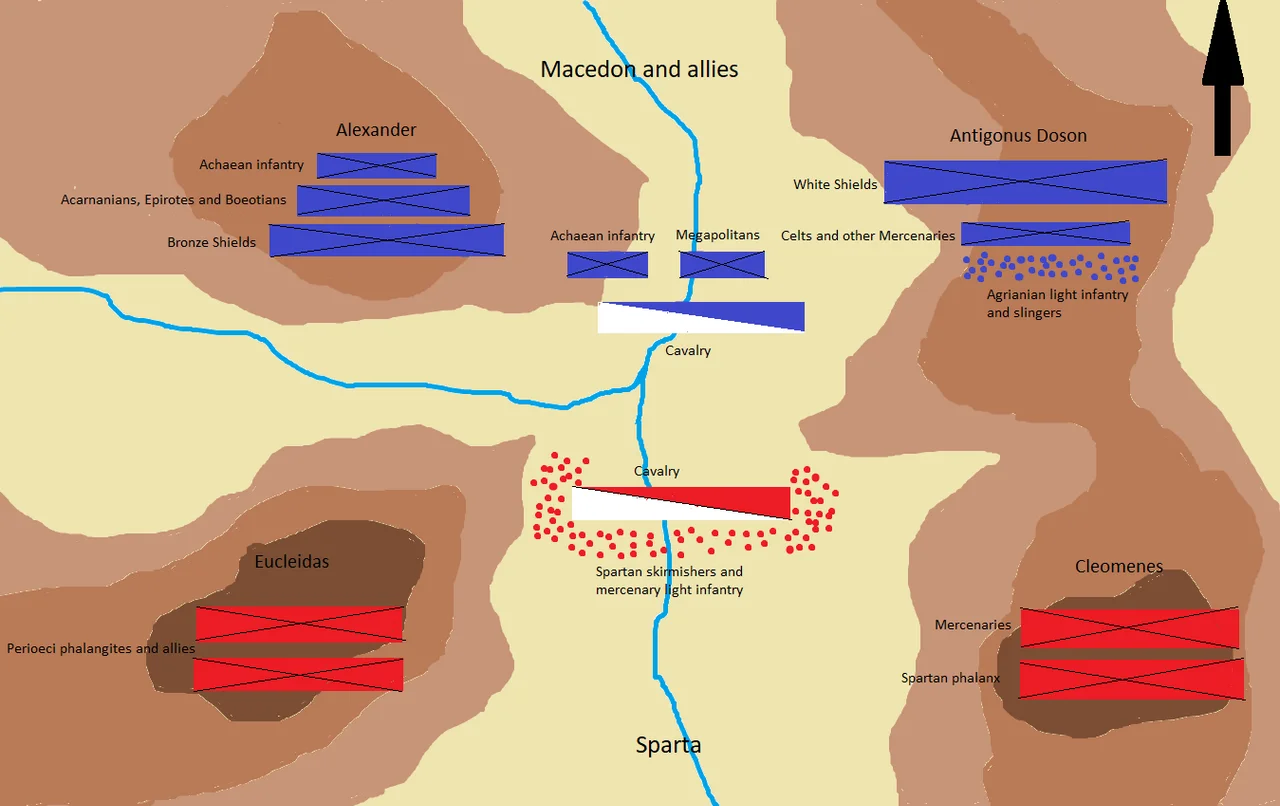
Sellasia is a pass on the northern frontier of Laconia where the Oenous River runs between two hills, Olympus and Euas. Cleomenes positioned his forces across both high points: his brother Eucleidas held Euas with the perioeci troops and allied contingents, while Cleomenes himself held Olympus with the Spartan citizen soldiers and mercenaries. Cavalry and additional mercenaries occupied the flat ground between the hills. It was a strong defensive position, and for a time Antigonus hesitated to assault it. Polybius describes the combined Macedonian-Achaean-allied force as 29,200 men, against Cleomenes's 20,650. When the attack came, the allied right wing advanced on Euas but was caught in a dangerous flanking attack. The situation was rescued by a young Arcadian cavalryman named Philopoemen, who charged on his own initiative without orders — a decision that saved the allied light infantry from destruction. Antigonus praised him afterward and reproved his own commander for not having acted. On Olympus, the two phalanxes ground against each other longer. Then the allied reinforcements from Euas swung around and hit the Spartans in the flank.
The Reckoning
Eucleidas died on Euas. The Spartan phalanx on Olympus, flanked and outnumbered, fought until it could no longer stand. Plutarch's figure — 200 survivors from 6,000 Spartiates — is almost certainly an approximation, but the scale of the catastrophe is not in dispute. These were men with families, histories, and a belief that they were fighting for something larger than a king's survival. Cleomenes himself left the field with a handful of companions, sailed from the harbor of Gytheion, and went into exile in Alexandria. He had sent his mother and children there earlier, in anticipation of this outcome. Three years later, he died in Egypt. Antigonus entered Sparta — the first non-Spartan commander to occupy the city — and reorganized its government. The land reforms Cleomenes had made were reversed. The helots he had freed did not return to bondage, but the broader redistribution that had briefly reordered Laconian society was undone. The revolution was over.
A Pass Between Mountains
Sellasia sits at approximately 37.167°N, 22.417°E, in the narrow valley north of Sparta where the Oenus River (the modern Kelefina) cuts through the hills. The site is not dramatically marked today — a pass with agricultural land, the hills still visible on either side, the river still running below. From altitude, the narrowing of the Eurotas basin here is clear: the valley pinches as the mountains crowd in from both sides, which is exactly why Cleomenes chose it as his last defensive line. The nearest airport is LGKL (Kalamata International), roughly 60 kilometers to the west. Approaching from the north along the Eurotas corridor at low altitude, the pass at Sellasia is a visible constriction in the landscape before the valley opens toward Sparta.
From the Air
Sellasia is at approximately 37.167°N, 22.417°E, in the Oenus River valley north of Sparta at the Laconian frontier. The pass is visible as a narrowing of the Eurotas basin when approaching from the north at 2,000–4,000 feet. Nearest airport: LGKL (Kalamata International), approximately 60 km west-southwest. The hills of Olympus and Euas on either side of the pass are the key geographic features. Morning visibility in the valley is often excellent; afternoon haze can reduce range.
Nearby Stories
- Leonidio 1.4 km away
- Araklovon Castle 5.3 km away
- Battle of Valtetsi 5.3 km away
- Kardamyli 8.7 km away
- Pylos 8.9 km away
- Barony of Gritzena 9.7 km away
- Metamorfosi, Laconia 13 km away
- Arkadiko Bridge 19 km away