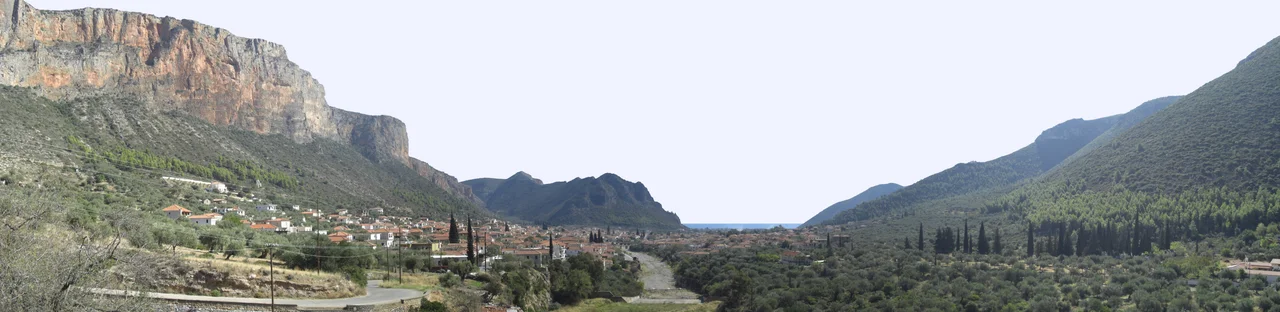

Leonidio
Greek comedy writer Dimitrios Psathas once quipped: carnival in Patras, and Easters in Leonidio. He knew what he was recommending. Every spring, the sky above Leonidio fills with fire — aerostata, handmade paper hot-air balloons, rising on Orthodox Easter night in a tradition unique to this town. But even without the balloons, Leonidio earns the journey. It sits at the foot of sheer ochre cliffs where the Dafnon River carves its way out of the Parnon mountain, a small town of 3,826 people pinched between stone walls so dramatic they look painted. From above, the reddish rock face practically glows at golden hour, and three old windmills stand sentinel over the rooftops below.
The Last Voice of Doric Greek
In Leonidio, the locals have a name for their town that no Greek-language dictionary will recognize: Agie Lidi. That is what Tsakonian speakers call this place — and Tsakonian is not simply a regional dialect. It is the only surviving descendant of Doric Greek, the ancient tongue of Sparta, distinct enough from modern standard Greek that linguists classify it as a separate language. Most of the Greek world speaks a lineage that descends from the Attic and Koine dialects; Tsakonian traces itself directly to a different and older branch. Leonidio is the capital of the Tsakonia region, and the language is still spoken in some of the surrounding villages. Signs in the town appear in both Tsakonian and standard Greek. Walking down a street and encountering a bilingual sign is a small but genuine encounter with continuity — a thread of spoken language stretching back more than two millennia.
The Eggplant That Made It to Brussels
Leonidio's most celebrated export is not a word or a ruin but a vegetable. The Tsakoniki eggplant — smaller, rounder, and more intensely flavored than its common counterpart — has been cultivated in the fertile plain around Leonidio for generations and is now protected by the European Union as a product of designated origin. The plain is the economic heart of the town: framed by those sheer cliffs on either side, irrigated by the Dafnon, it produces citrus fruit, pears, tomatoes, and olives in addition to the famous aubergine. Every August, the port village of Plaka hosts the Tsakonian Eggplant Festival, drawing chefs from across Europe. Plaka sits 4 kilometers from the town center, a cluster of tavernas and bars right at the water's edge on the Myrtoan Sea. The beach 4 kilometers further along the shore is well-regarded, and a small fishing fleet still works out of the harbor between summer crowds.
Cliffs, Sinkholes, and Ancient Harbors
Before Leonidio existed, this stretch of the eastern Peloponnese coast was known for the ancient city of Prasiae, an important Spartan harbor until the Athenians destroyed it during the Peloponnesian War. That old strategic logic — a sheltered coastal plain backed by mountains — still defines the place. Leonidio town itself is a protected architectural site: regulations governing new construction within its limits are strict, and the result is an unusually intact streetscape. The geology around the municipality rewards the curious: the Peleta Sinkhole and the Propantes pothole, a vertical cave, are among the more unusual formations carved by water through the Parnon limestone. And for those who prefer their dramatic rock faces vertical rather than horizontal, Leonidio has in recent years built a strong reputation in the international rock-climbing community, with crags that draw climbers from across Europe.
Easter Night, Fire in the Sky
Of all the things that set Leonidio apart, the Easter balloon tradition may be the most visually arresting. On Orthodox Easter night — a date that sometimes falls weeks after the Western celebration — residents launch aerostata: large paper hot-air balloons, lit from within by open flame, rising silently over the gorge and the cliffs. The custom is local to Leonidio in this form, and Psathas was not the last person to recommend making the trip specifically for it. The balloons drift upward past the orange walls of stone, catch the night wind, and eventually disappear into the mountains. It is not a spectacle manufactured for tourists; it is simply what Leonidio does on Easter night, as it has for generations. The rest of the year the town is lively in summer and quieter in the off-season, agricultural and coastal in its rhythms, more interested in producing eggplants and citrus than in performing for visitors.
From the Air
Leonidio sits at approximately 37.17°N, 22.85°E on the eastern coast of the Peloponnese, where the Dafnon River valley meets the Myrtoan Sea. From the air, the town is unmistakable: a compact settlement of warm-colored rooftops pressed against sheer reddish-ochre cliffs, with the flat agricultural plain stretching south to the port of Plaka. Approach from the east over water for the best view of the gorge entrance. Recommended viewing altitude is 3,000–5,000 feet to appreciate the full sweep of cliff face above the town. The nearest major airport is LGKL (Kalamata International), approximately 90 km to the southwest. Visibility is best in spring and autumn; summer haze can reduce contrast on the cliff faces.
Nearby Stories
- Tegea 6.8 km away
- Battle of Sellasia 7.5 km away
- Saladi Beach 8.9 km away
- Siege of Kastania 12 km away
- Metamorfosi, Laconia 16 km away
- Saronic Gulf 29 km away
- Agios Georgios (island) 47 km away
- SS Heraklion 52 km away