.jpg)
Tegea
When Spartan kings fell from grace, they fled to Tegea. Leotychides fled there. Pausanias, son of Pleistoanax, fled there. The seer Hegesistratus fled there. The Temple of Athena Alea in Tegea held the right of asylum — a sanctuary so recognized that even Sparta, the most powerful military state in Greece, respected it. That says something about Tegea's standing. It was not a city that bent easily.
Nine Villages Become One City
Tegea sits in the southeastern corner of the Arcadian plateau, 10 kilometers southeast of what is now Tripoli, its territory bounded by mountains — Parthenium to the east, toward Argolis; the highlands of Laconia to the south. In the Archaic period, nine separate townships that occupied this territory banded together through the process the Greeks called synoecism, the merging of communities into a unified polis. The names of those nine original settlements were preserved by the geographer Pausanias centuries later: Gareatae, Phylaceis, Caryatae, Corytheis, Potachidae, Oeatae, Manthyreis, Echeuetheis, and — added in the reign of king Apheidas — Apheidantes. The citizens were organized into four tribes. From the beginning, Tegea was a layered place, conscious of its own composite origins.
Homer knew Tegea. The Iliad's Catalogue of Ships lists it among the cities whose troops sailed for Troy under Agapenor. Its legendary king Echemus was said to have killed Hyllus, son of Heracles, in single combat — a story that gave Tegea a heroic claim to have held back the Heraclid return to the Peloponnese.
The Sanctuary That Sheltered Enemies of Sparta
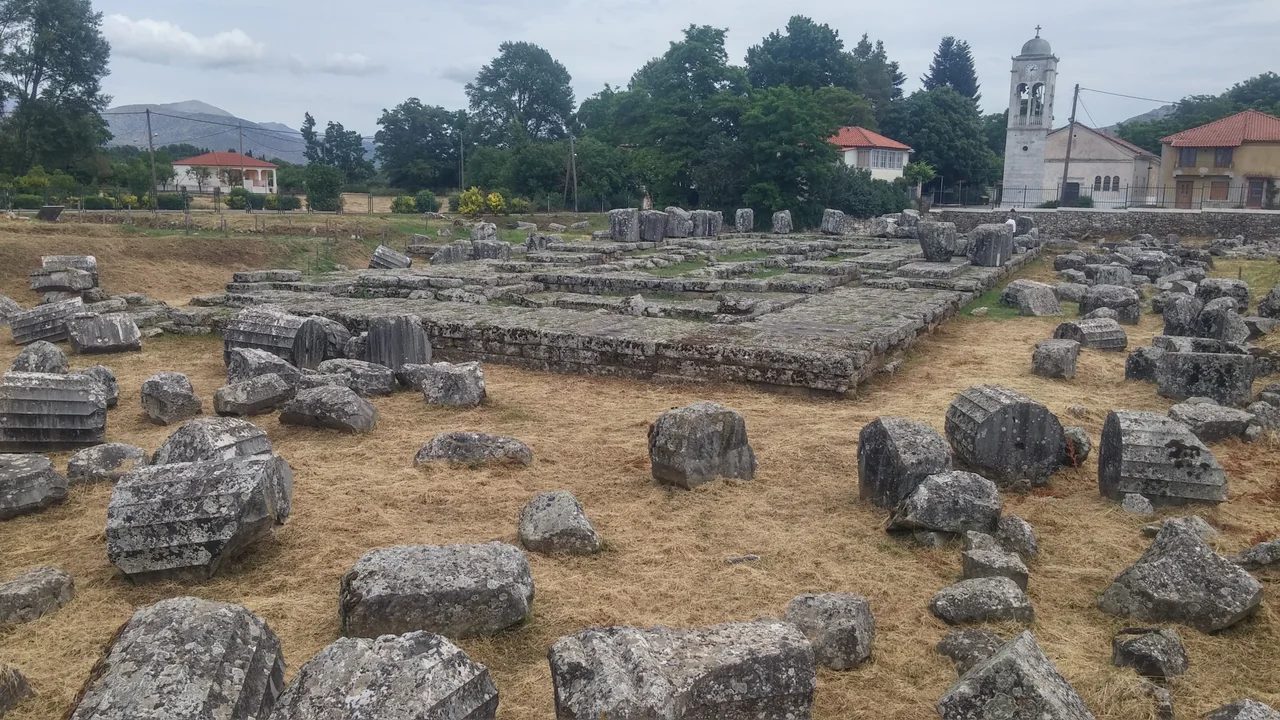
The Temple of Athena Alea was Tegea's greatest institution. The *temenos* — the sacred precinct — was founded by the hero Aleus, whose name the modern village Alea carries still. Votive offerings accumulated there over centuries: bronze horses and deer from the Geometric and Archaic periods, sealstones, fibulae. The temple was one of the most respected sanctuaries in the Peloponnese, and its right of asylum was genuinely observed.
The temple burned in 394 BC — the same year as the Battle of Corinth, in which Tegea fought on the Spartan side. It was magnificently rebuilt, to designs by Scopas of Paros, one of the great sculptors of the 4th century BC. The new temple's pediment featured reliefs of the Calydonian boar hunt. Scopas's building became one of the celebrated works of late classical architecture, described by Pausanias in detail when he visited. Today the site is in the modern village of Alea, and a museum there holds some of the sculptural fragments that survive.
Sparta's Stubborn Neighbor
Tegea and Sparta had a long, complicated relationship. The Tegeatae resisted Spartan expansion for generations — at one point, the Spartan king Charillus invaded Tegeatis, was defeated, and was captured along with all his surviving men. Centuries of intermittent conflict followed, ending around 560 BC when Sparta, having obtained what an oracle said were the bones of Orestes, defeated Tegea and compelled it to acknowledge Spartan supremacy. Tegea was then drawn into the Peloponnesian League — perhaps among its earliest members.
But acknowledgment of supremacy was not the same as submission. Tegea retained its own institutions and military. In the Persian Wars, it fought as the second military power of the Peloponnese, holding the place of honor on the left wing of the allied army. Five hundred Tegeatans fought at Thermopylae alongside the Spartans. Three thousand fought at Plataea. After Leuctra broke Spartan power in 371 BC, Tegea expelled the Spartan party from within its walls and joined the Arcadian League. It then fought against Sparta — alongside Epaminondas — at the great Second Battle of Mantinea in 362 BC.
Poets, Mythical Kings, and a Politician from Kerasitsa
Tegea produced people worth noting across two and a half millennia. Aristarchus of Tegea wrote tragedies in the 5th century BC. Anyte of Tegea, a poet of the 3rd century BC, wrote some of the finest epigrams in the Greek Anthology — her work on animals and children and death has a tenderness unusual in ancient verse. From Tegea's mythological tradition came Telephus, Cepheus the Argonaut, and the warrior-king Echemus.
In modern times, the village of Kerasitsa — within the Tegea municipality — was the birthplace in 1912 of Gregoris Lambrakis, the politician and peace activist whose assassination in 1963 inspired Costa-Gavras's film Z. The village sits in the same municipality that once held the sanctuary of Athena Alea. Two and a half thousand years of Arcadian history, compressed into a stretch of plateau south of Tripoli.
What Outlasted Everything Else
When the geographer Strabo was writing in the 1st century BC, he noted that Tegea was the only Arcadian town that remained continuously inhabited. Its neighbors had emptied, declined, or been deliberately destroyed. Tegea persisted. In the Roman period it retained civic life. The Goths sacked it in AD 395–396, but the city survived. Roman poets used 'Tegean' as a synonym for Arcadian — it appeared as an epithet for Pan, for Callisto, for Atalanta, for the goddess Carmenta, for Mercury. To be Tegean was to be of Arcadia itself.
In the Middle Ages the city acquired a new name, Amyklion, shortened to Nikli by the 10th century. It became a bishop's seat, then a Frankish barony after the Crusaders took the Peloponnese, then a Byzantine recovery. The ancient walls dissolved back into the earth. The sanctuary of Athena Alea became a field. The village of Alea — called Piali before 1915 — sits on the site today, and the Archaeological Museum of Tegea preserves the Scopaic sculptures and the dedications of ten centuries of worshippers who brought their horses and deer in bronze to the goddess on the hill.
From the Air
Tegea lies at approximately 37.46°N, 22.43°E on the southern portion of the Arcadian plateau, about 10 kilometers southeast of Tripoli. The site of ancient Tegea is within the modern village of Alea. The plateau is flat and easily surveyed from altitude; the Parnon range rises to the southeast and Mount Parthenium to the east-northeast marks the border with Argolis. Nearest major airport: LGKL (Kalamata International), approximately 80 km to the southwest. Approaching from the west at 6,000 feet, the full sweep of the Arcadian basin is visible — from Mantinea in the north to Tegea in the south, the ancient cities of the plain laid out in the landscape below.
Nearby Stories
- Araklovon Castle 4.8 km away
- Pellana 6.6 km away
- Arkadiko Bridge 10 km away
- Siege of Corinth (1463) 11 km away
- Leonidio 11 km away
- Kyparissia 11 km away
- Pheneus 14 km away
- Santameri Castle 29 km away