
Siege of Corinth (1463)
Sixty men changed the course of a war on a dark night in September 1463. They came out of a fortress that was about to fall, charged a Venetian army that vastly outnumbered them, and triggered a panic that lost the entire Peloponnese for Venice. The fortress commander was Elvanoglu Sinan Bey. The Venetian general, Bertoldo d'Este, had every advantage of numbers, equipment, and momentum, and was on the verge of bringing down the walls with artillery when Sinan made his calculation: he would gamble that the Venetians would mistake a sortie for a relief army, and they would break before they understood what was happening. He was right.
Venice Makes Its Move
In May 1463, Venice opened its campaign for the Morea, the Peloponnese held by the Ottomans since 1460. The Senate financed an army on a scale it rarely matched: thousands of warriors under the Italian condottiere Bertoldo d'Este, embarked on a fleet of 32 galleys plus auxiliaries commanded by Alvise Loredan. The objective was strategic and ambitious. If Venice could break through the Hexamilion wall across the Isthmus, the Ottomans would be cut off from their southern conquests and the entire peninsula could be liberated. On August 12, the Venetians took the fortress of Argos, a real and morale-lifting victory. On September 3, they began the siege of Corinth. Bertoldo's artillery hammered the walls from the start. Within days, breaches were imminent.
The Night Sortie
Inside the fortress, Sinan Bey watched the walls cracking and concluded that he could not survive a conventional assault. He calculated that an attack from inside, in the dark, when the Venetians were thinking about other things, might still tip the balance. On a moonless night he led 60 men out of a postern and charged the besieging camp. The Venetian troops, exhausted and unprepared for an attack from a position they thought they had under siege, could not understand what was happening. Word spread that the assailants were the vanguard of the relief army under Grand Vizier Mahmud Pasha, who was known to be moving through the peninsula. Confusion turned into panic. Discipline broke. Bertoldo d'Este received fatal wounds during the chaos and died on October 20.
The Real Relief Army
While the Venetians were still trying to recover from Sinan Bey's sortie, the actual relief force arrived. Sultan Mehmed II had sent reinforcements under Turahanoglu Omer Bey to support Sinan. When that force linked up, the besiegers' position became untenable. Mahmud Pasha's main army, marching south from Thessaly, then broke through the Hexamilion, the wall the Venetians had hoped to defend. He recaptured Argos and pushed deep into the Morea before winter. Alvise Loredan, who had been waiting in the Isthmus Strait with the fleet, found himself with no army to support and no foothold to cover. The Venetian achievement of August had vanished by mid-October.
Cascading Loss
Mahmud Pasha did not stop at Corinth. He marched on the Greek towns that had welcomed the Venetians and reduced them one by one, almost all submitting without further fighting. The Ottoman army entered Leontari without a battle. Turahanoglu Omer Bey raided Venetian-held coastal Methoni and Koroni, taking both, and forced the Albanian highlanders of the central Peloponnese to submit. Had winter not arrived to break the campaign, more would have fallen. By spring, the Ottoman position in the Morea was stronger than it had been before Venice attacked. The first Ottoman-Venetian War (1463-1479) would drag on for sixteen more years and largely confirm what the night raid at Corinth had decided in a few hours.
What the Walls Remember
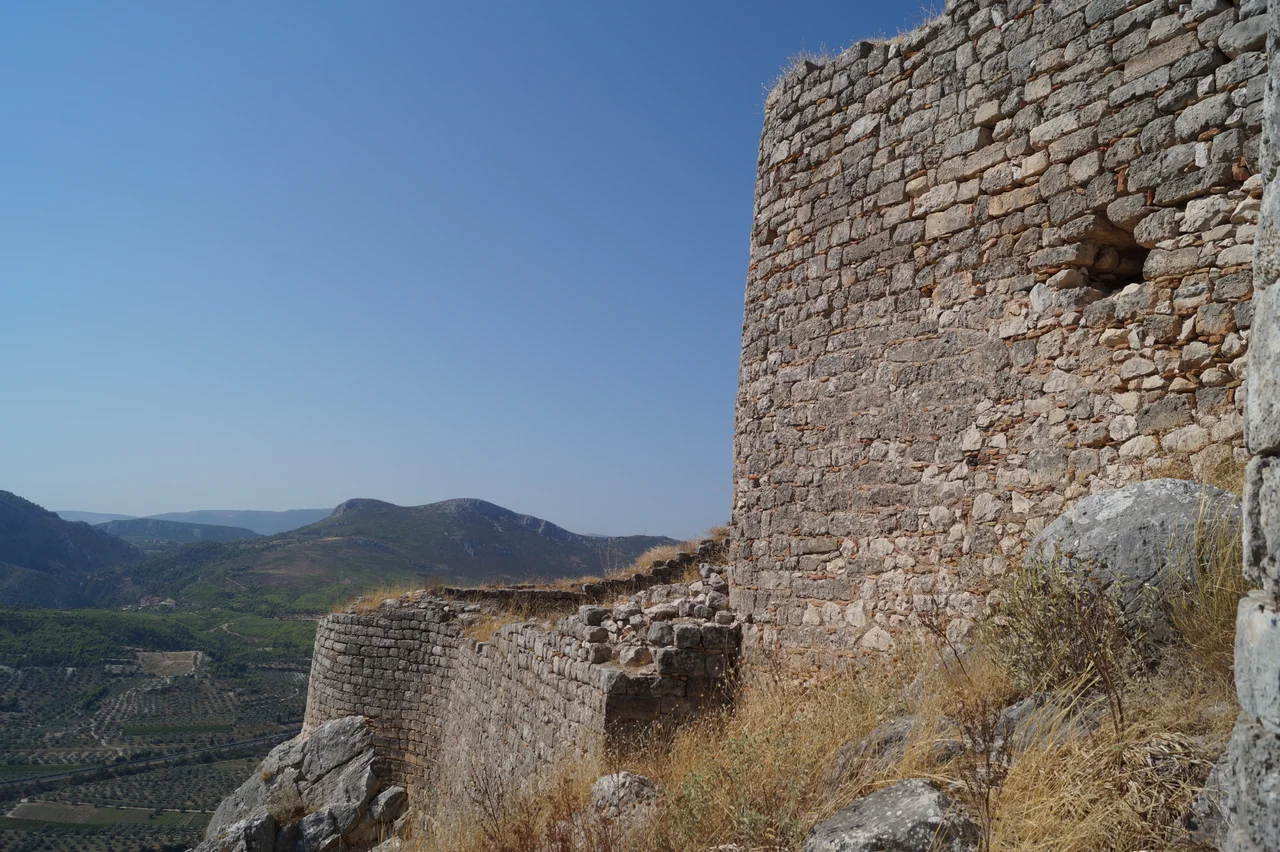
The Acrocorinth fortress, perched on the limestone monolith above modern Corinth, has been fought over since the Mycenaean age. Greeks, Romans, Byzantines, Franks, Catalans, Florentines, Knights of Saint John, Venetians, Ottomans, and the army of independent Greece all held it at one point or another. The walls Sinan Bey defended are still recognizable on the upper bailey, mixed with Frankish and Byzantine masonry below. The Venetians would briefly hold the place again from 1687 to 1715, when Francesco Morosini's campaigns reached the Morea. Then the Ottomans took it back. Today the site is one of the great archaeological complexes of the Peloponnese, and somewhere in the maze of stones is the postern Sinan Bey came out of in the dark with 60 men.
From the Air
Acrocorinth sits at 37.89°N, 22.87°E, rising 575 meters above the modern town of Corinth on the Peloponnese. The fortress occupies a dramatic limestone outcrop visible for miles, with the Isthmus of Corinth to the north and the Saronic Gulf to the east. Athens International (ICAO: LGAV) is the closest major airport, about 80 km east-northeast. Best viewed from 5,000-7,000 ft. The Hexamilion wall remnants and the Corinth Canal, cut in 1893, are visible nearby.
Nearby Stories
- Stymfalia 3 km away
- Sanctuary of Asclepius, Epidaurus 4.6 km away
- German Submarine U-133 (1941) 5.9 km away
- Battle of the Trench (1821) 6.7 km away
- 1981 Gulf of Corinth Earthquakes 12 km away
- Aigeira 13 km away
- Agios Thomas, Boeotia 14 km away
- Agios Georgios (island) 36 km away