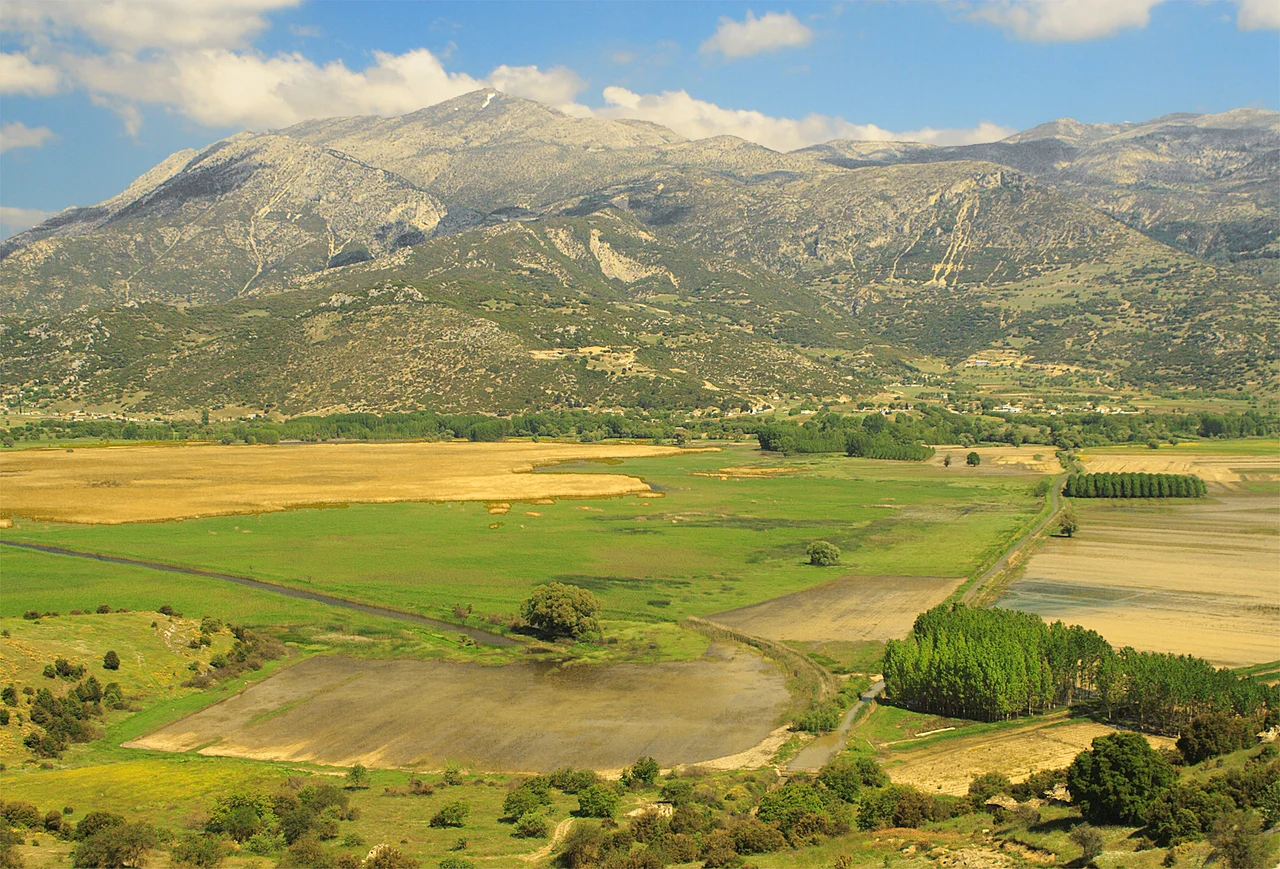

Stymfalia
The sixth labour of Heracles brought him to a reed-fringed mountain lake where a flock of man-eating birds had driven the local population from their land. The Stymphalian Birds — bronze-beaked, bronze-clawed, dropping metallic feathers like arrows — had made the marshes impassable. Heracles drove them off, according to the myth, with a bronze rattle given to him by Athena. The birds rose in a panicked mass and he shot them from the sky. The lake they once haunted still sits in its mountain valley at 600 metres elevation in what is now Corinthia, still edged with reeds, still overlooked by Mount Kyllene rising to around 2,400 metres to the northwest. The birds are gone. The lake remains.
The Lake and Its Valley
Lake Stymphalia occupies a broad mountain valley in the borderlands between ancient Arcadia and Corinthia, a region now administered as part of the municipality of Sikyona. The municipal unit covers 205 square kilometres; its population as of 2021 was 1,898 — a thin scattering across a landscape of limestone ridges and upland meadows. The largest village is Kaisari, but the principal ancient remains cluster just south of the modern hamlet of Stymfalia, home to around 150 people. Hadrian, who visited Greece in the 2nd century AD and took his role as Hellenic benefactor seriously, built an aqueduct to carry water from the lake northward toward Corinth — an engineering work whose traces are still visible at the site called Siouri. The aqueduct is one of the more concrete reminders that Stymphalos mattered to Rome, not merely to myth.
A Goddess in Three Phases
Before the myth of Heracles eclipsed everything else at Stymphalos, the site was holy to Hera — not the Olympian queen in her familiar form, but Hera in something older and stranger. She was venerated here in three phases: as maiden, as matron, and as widow. It is a complete life cycle, and the triple form suggests a cult of considerable antiquity, perhaps pre-Olympian, surviving into historical times as a layer beneath the more familiar mythology. Pindar, in his sixth Olympian Ode, celebrated an Olympic mule-cart victor named Hagesias and urged the choir to venerate the virginal Hera of Stymphalos — a detail that points to the maiden aspect of the cult as still active in the 5th century BC. Artemis was the principal divinity of the ancient town and her temple was still in use in Roman times. An inscription of the early 2nd century BC refers to the sanctuary as that of Brauronian Artemis — an Athenian cult transplanted to Arcadia, which speaks to the reach of Athenian cultural influence even in remote upland valleys.
The Runner Who Won Everything
Pausanias recorded a statue at Stymphalos of a man named Dromeus — a long-distance runner who won at all the Panhellenic Games in the mid-5th century BC. The name Dromeus means "runner" in Greek, which raises the question of whether it was a given name or a later honorific, but the achievement was real enough to merit a monument. Stymphalos was not a major city — little else of it appears in the ancient literary record — and the statue of Dromeus is one of the few moments when an individual from this remote valley steps into the broader Greek world. He ran, and won, and the city commemorated him in stone. The stone is gone, but Pausanias's record of it survives.
What the Archaeologists Found
Anastasios Orlandos excavated parts of the site for the Archaeological Society of Athens between 1924 and 1930. Since 1982, excavations on the north shore of Lake Stymphalia have continued under Hector Williams for the University of British Columbia. What they have uncovered is a town refounded in the 4th century BC on a rational grid: six-metre-wide north-south streets every thirty metres, major east-west avenues at intervals exceeding a hundred metres. The city was planned, not organic. Houses, a theatre, a palaestra, a fountain house, and several temples have all been identified. In the sanctuary, an inscription fragment reading POLIAD — suggesting "of Athena Polias" — was found by Orlandos in 1925 but subsequently lost. A graffito on a pottery shard refers to Eilythyia, goddess of childbirth. Large quantities of copper and bronze jewellery suggest the sanctuary drew female worshippers in particular; a partially preserved statue of a child and several dozen loom weights in an annex support the reading of a shrine associated with childbirth and weaving. The sanctuary was probably destroyed by the Romans in 146 BC, but Roman pottery lamps and four small early Christian cemeteries nearby suggest the site was revisited for centuries. The cemeteries are what remains of a medieval Cistercian monastery called Zaraka.
Layer Upon Layer
Stymphalos is one of those places where every era left something behind. Bronze-age mythology fixed the lake in the Greek imagination as the site of a hero's labour. An archaic triple goddess cult shaped the religious life of the early city. A 4th-century BC refounding imposed rational urban planning on ancient ground. Roman engineers ran an aqueduct across the valley. Early Christians buried their dead beside a sanctuary the Romans had smashed. Cistercian monks built a monastery on top of the cemeteries. Canadian archaeologists have been carefully pulling the layers apart since 1982. The hamlet of Stymfalia sits beside the lake today, 150 people on the edge of a reed bed that has been haunted, in one form or another, since before the Greeks had gods.
From the Air
Lake Stymphalia lies at approximately 37.871°N, 22.468°E in a mountain valley at roughly 600 metres elevation, on the Corinthia-Arcadia border in the northern Peloponnese. The lake is clearly visible from altitude as a distinctive water body set among limestone ridges, with the massive bulk of Mount Kyllene (c. 2,374 m) to the northwest. Nearest major airport: LGRX (Araxos/Patras), approximately 90 km to the west-northwest. Recommended viewing altitude: 6,000–10,000 feet to see the full valley context and the lake's reed-fringed edges. Hadrian's aqueduct channel is traceable on the north side of the valley from low altitude. Visibility is generally good in summer; morning mist can form over the lake in cooler months.
Nearby Stories
- Siege of Corinth (1463) 2.1 km away
- Aigeira 2.7 km away
- Oblou Monastery 3.7 km away
- Isova 4.9 km away
- Mantinea 5.2 km away
- Arkadiko Bridge 8 km away
- 1981 Gulf of Corinth Earthquakes 11 km away
- Battle of Lalas 20 km away