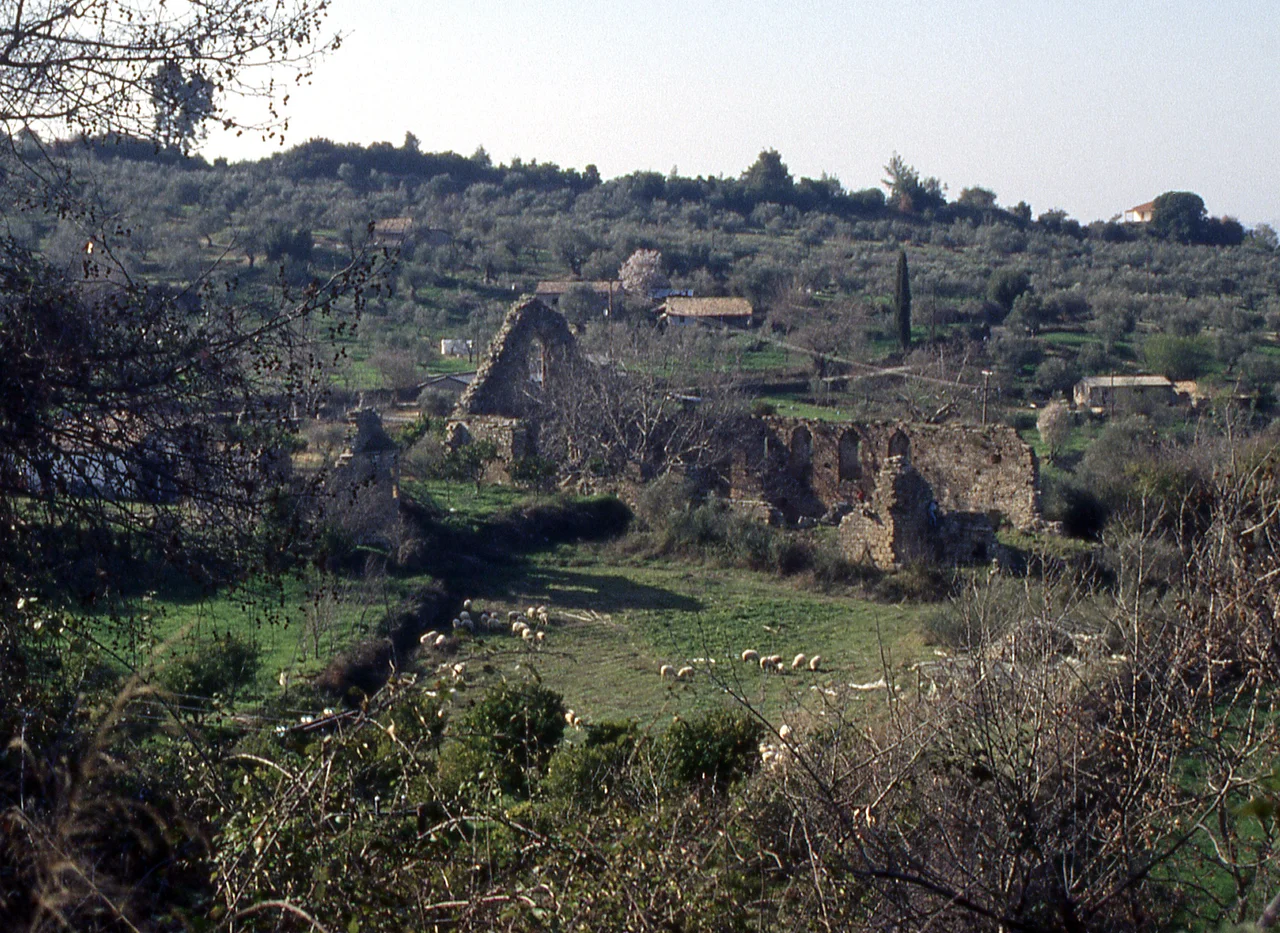

Isova
The north wall still stands nearly intact. You can trace the lancet windows, each 1.8 meters high, their stones cut with the precision of western craftsmen who had no business being in the Peloponnese at all — except that a crusade had brought them there. Notre Dame at Isova is a Gothic church in the classical French tradition, built in the first half of the 13th century, a thousand kilometers from the nearest cathedral that could have trained the hands that shaped it. The arch profiles, the corbels, the proportions of nave to chancel — all of it belongs entirely to western Europe. What happened to it belongs entirely to the violent political history of a peninsula where Byzantine Greeks, Frankish nobles, and Ottoman forces spent three centuries fighting over the same contested ground.
The Crusade That Came to Greece
The Fourth Crusade of 1202-1204 did not reach the Holy Land. It sacked Constantinople instead, and in the chaos that followed, Frankish knights fanned out across the former Byzantine territories and carved out principalities for themselves. The Peloponnese — which the Franks called the Morea — became the Principality of Achaea, ruled first by William of Champlitte and then by the Villehardouin dynasty. The Cistercian order, which had been closely involved in promoting the crusading movement, followed the knights. In Byzantine territories conquered by the Crusaders, the Cistercians founded at least a dozen abbeys. Two are known from the Peloponnese itself. One can be identified with certainty: the monastery of Zaraka at Stymphalia, in the archdiocese of Corinth. For the other, in the archdiocese of Patras, the monastery at Isova appears to be the only viable candidate. Isova was founded sometime between 1205 and 1263 — likely in the earlier part of that window, while Frankish control was still being consolidated and resources for ecclesiastical construction were flowing.
Notre Dame of the Peloponnese
The abbey church of Notre Dame at Isova was a single large rectangular hall, about 38.5 meters long and 12.5 meters wide on the interior. A chancel projected an additional 8 meters at the eastern end, finishing in an octagonal apse buttressed by six external supports — a form common in French Gothic architecture, deeply unusual in Greece. There was no narthex, no transept: the building was austere and direct, in the Cistercian manner. The wooden roof spanned the entire width without internal supports, its pitch preserved in the triangular profile of the surviving west gable. The lancet windows in the north wall — single lights topped by pointed arches — are among the best-preserved Gothic windows in Greece. In plan and in every constructional detail, the church shows no Byzantine influence whatsoever. It was a piece of northern France set down in the Peloponnese. Scholars have suggested it was not merely designed by western architects but actually built by western craftsmen, possibly the monks themselves.
The Fire of 1263
The Chronicle of the Morea, a 14th-century history of Frankish Greece written in several languages including Greek, French, and Aragonese, records the end of Notre Dame at Isova. In 1263, shortly before the battle of Prinitza, a band of Turkish mercenaries fighting alongside Greek forces set fire to the church. The context was the Byzantine reconquest of the Peloponnese: the empire of Nicaea had recaptured Constantinople in 1261 and was now pressing to reclaim the Morea from its Frankish lords. The burning of Isova was one episode in this wider war. The church was not restored. The Cistercian community — if it still existed in 1263 — did not return to rebuild on the original scale. What had been the finest Gothic building in the Peloponnese was left as a ruin, its roof gone, its stones open to wind and rain.
Saint Nicolas: Gothic and Byzantine
A generation or more after Notre Dame burned, a second, much smaller church was built about 20 meters south of the ruins. Dedicated to Saint Nicolas — Ayios Nikolaos in Greek — it was constructed for Catholic worship, as the absence of an iconostasis makes clear, but in a style that blended Gothic and Byzantine features. The square plan, triple apses, and construction techniques suggest Byzantine influence; the pointed arches, the tripartite nave arrangement, and several architectural details are Gothic. At least one fragment from the ruined Notre Dame was incorporated into the new building's walls, a physical sign of the older church's destruction and the new one's dependence on its predecessor's stone. The date of Saint Nicolas is uncertain — sometime between the late 13th and 15th centuries — and the religious community it served was likewise diminished from what Isova had once been. The two churches stand together now, their walls at different heights, their histories written in different architectural languages.
Gothic in a Byzantine World
Isova exists in a particular category of historical object: physical evidence of a world that was briefly possible and then wasn't. The Principality of Achaea lasted from 1205 until 1432, when the last Frankish prince surrendered his territories to the Byzantines of Mystras. During that time, the Franks built churches, castles, and monasteries across the Peloponnese, importing western architectural forms into a landscape that had no previous tradition of them. Most of those buildings were abandoned, repurposed, or demolished as Byzantine and then Ottoman power returned. Isova's Notre Dame survives partly because it was too far gone to repurpose — the fire of 1263 left nothing intact enough to serve another function — and partly because its location near the modern village of Trypiti kept it from being systematically quarried for stone. What the north wall's intact lancet windows communicate, seven and a half centuries after the building burned, is that the craftsmen who raised them were serious. They built for permanence. The fire came anyway.
From the Air
Isova's ruins lie at approximately 37.57°N, 21.78°E, in the low hills of the Elis regional unit near the modern village of Trypiti, west of the Mount Minthi massif. The site sits in a landscape of olive groves and low limestone hills about 15 kilometers inland from the Ionian coast. The Alfeios River crosses the plain to the north. From altitude, the broader Elis coastal plain is flat and green, with the broken hill country beginning sharply to the east — Isova lies just at the point where the lowlands meet the first hills. The nearest major airport is LGRX (Araxos Airport), approximately 70 km to the northwest. Flying at 4,000 feet on a clear afternoon, the landscape around Isova looks agricultural and peaceful — which makes the story of what happened here in 1263 all the more striking.
Nearby Stories
- Aroanios 4.6 km away
- Kyparissia 4.7 km away
- Strofades 7.6 km away
- Arcadia (region) 9.1 km away
- Longanikos 9.5 km away
- HMS Perseus (N36) 21 km away
- Astras 23 km away
- St. Mark's Roman Catholic Church 34 km away