
Arcadia (region)
The phrase 'Et in Arcadia ego' — even in Arcadia, there am I — has been painted onto canvases and carved into monuments for four centuries, usually beside a skull. Death, the sentence means, is present even in paradise. But the Arcadia the painters imagined bore little resemblance to the actual place: a landlocked highland mass at the center of the Peloponnese, ringed by mountain ridges, drained by the Alpheios river, and described by ancient geographers as mostly mountainous except for the plains around Tegea and Megalopolis. The real Arcadia was not idyllic. It was strategic, contested, and fiercely independent — which may be why the poets preferred to imagine it.
Mountains All the Way Down
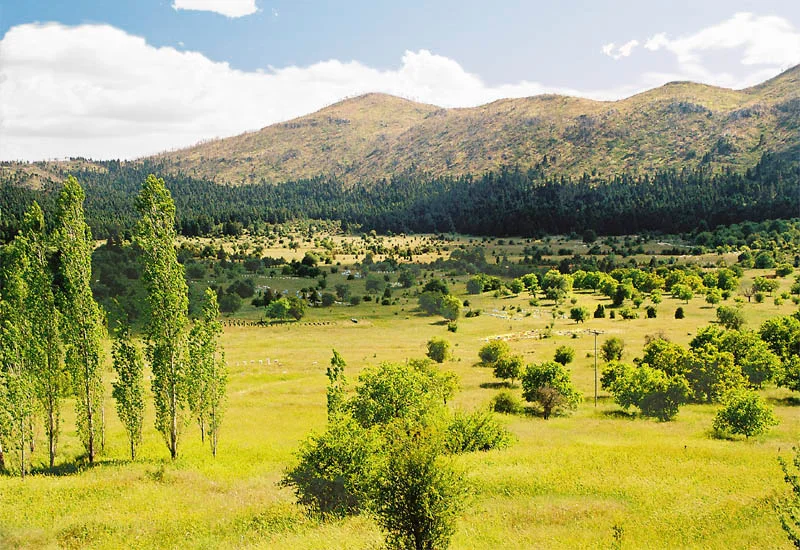
Geographically, ancient Arcadia occupied the highlands at the center of the Peloponnese. Every border was a ridge. To the north, the high ground running from Mount Erymanthos to Mount Cyllene separated Arcadia from Achaea. To the east, the ridge line bent around toward Mount Oligyrtus and then south to Mount Parthenius, marking the borders with Argolis and Corinthia. The Parnon and Taygetos ranges formed the southern edges, where the foothills dropped toward Laconia and Messenia. Arcadia held all the headwaters of the Alpheios river but none of those of the Eurotas. Most of the region was upland terrain — thin soils, limestone karst, forested ravines — with two exceptions: the plains around Tegea and Megalopolis, which became the region's power centers precisely because flat land was so rare. The strongest Arcadian cities were always the ones that controlled a fertile valley.
The Last People Before the Greeks
Ancient authors described the Arcadians as among the oldest inhabitants of Greece — part of or related to the Pelasgians, the pre-Greek aboriginal population that Herodotus and others wrote about with a mixture of fascination and uncertainty. The Arcadians themselves seem to have cultivated this antiquity. Their mythology was deep and strange: Lycaon, a king who had fifty sons and was turned into a wolf; Callisto, his daughter, transformed into a bear and placed in the sky as Ursa Major; Arcas, the mythological king from whom the region took its name. Pan, the goat-footed god of wild places and shepherd music, was Arcadian. So was Hermes. These were old gods, rooted in landscape rather than city. Arcadia appears in Homer's Iliad — the Catalogue of Ships lists Arcadian troops who sailed to Troy aboard ships that Agamemnon provided, because Arcadia had no coastline and therefore no fleet of its own.
Independence, Alliance, Subjugation
Politically, Arcadia spent antiquity balancing between neighbors who were larger and more aggressive. In the seventh century BC, the Arcadians formed a loose confederation — the League of the Arcadians — and successfully resisted Spartan expansion. They sent forces to Thermopylae and Plataea during the Persian Wars. But the pressures of the Peloponnesian War eventually pulled them into an alliance with Sparta and Corinth. The decisive shift came in the 370s BC, when the Theban general Epaminondas, seeking to diminish Spartan power, reinforced the Arcadian federation and founded Megalopolis as its new capital in 370 BC. For a generation Arcadia had more weight than it had held before. Then came the Macedonians, and the Arcadians joined what would become the Achaean League — the last major Greek federal institution before Rome absorbed the peninsula entirely in 146 BC.
The Secrets of Despoina
Religion in Arcadia had its own character. The primary deity worshipped here, alongside Demeter, was a goddess called Despoina — a title, not a name. The word means 'the mistress,' and her real name was revealed only to those initiated in the Arcadian mysteries. This was not the civic religion of Athens or the Olympian hierarchy familiar from Homer. It was older, more chthonic, tied to the landscape and its agricultural rhythms rather than to epic narrative. The sanctuary at Lycosura, dedicated to Despoina and Demeter, was one of the region's major religious sites. Pausanias, the second-century AD travel writer, described it as perhaps the holiest site in all of Arcadia — a place where the veil between the human and divine felt genuinely thin.
The Pastoral Dream
Somewhere in the classical period, Arcadia's reputation shifted. The actual mountains and contested plains gave way, in literature, to a golden landscape of shepherds, nymphs, and perpetual mild weather. Virgil's Eclogues, written in the first century BC, placed idealized shepherds in an 'Arcadia' that was never meant to be taken literally. Renaissance poets and painters took the metaphor and ran with it — Jacopo Sannazaro's 1504 prose-poem Arcadia was enormously influential, and the tradition culminated in paintings like Poussin's Et in Arcadia Ego, where even death seems aestheticized against the green hills. The actual Arcadians — fighters of the League, subjects of Spartan pressure, farmers on thin highland soil — would perhaps have found this version of themselves unrecognizable. But the dream was powerful enough to outlast everything else they left behind.
From the Air
Arcadia occupies the central highland plateau of the Peloponnese, centered roughly around 37.6°N, 22.2°E. The modern regional capital is Tripoli, easily visible from the air as the largest settlement on the plateau. From altitude, the terrain reads clearly: the flat plain around Tripoli (ancient Tegea is just southeast) surrounded on all sides by mountain ridges rising above 1,500 meters. The nearest major airport for the region is Kalamata International (LGKL) to the southwest, with Athens International (LGAV) serving as the primary gateway some 200 kilometers to the northeast. Flying in from Athens, the Saronic Gulf gives way to the Argolid plain and then the abrupt rise of the Arcadian highlands — the topographic logic of the ancient borders becomes immediately legible.
Nearby Stories
- Araklovon Castle 4.8 km away
- Pellana 6.6 km away
- Arkadiko Bridge 10 km away
- Siege of Corinth (1463) 11 km away
- Leonidio 11 km away
- Kyparissia 11 km away
- Pheneus 14 km away
- Santameri Castle 29 km away