
Kyparissia
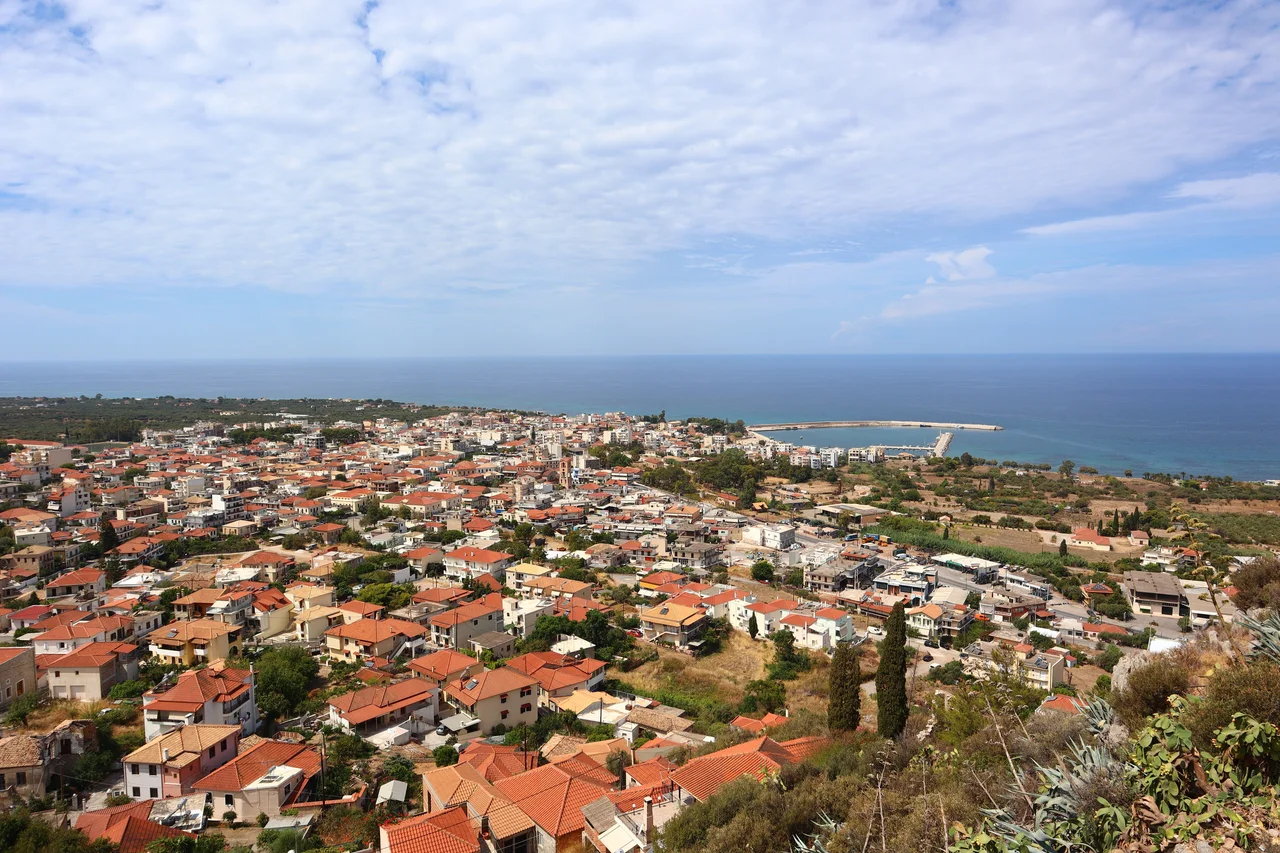
Homer mentioned Cyparissia in the Iliad — which means this small coastal town in western Messenia has been on the map, in one form or another, for at least three thousand years. That is longer than most cities get. The ancient acropolis stood on the same narrow rocky summit where a Frankish-Byzantine castle stands today, east of the modern town centre, looking out over the Gulf of Kyparissia and the Ionian Sea beyond. Below it, the town of around 5,000 people goes about its business: a cargo port, an agricultural plain, a disused railway terminus, and a shoreline where endangered loggerhead sea turtles still come to nest. The castle on the hill is the through-line — the point around which every era of this town's history has organised itself.
Temples, Harbours, and a Name That Keeps Changing
Ancient Cyparissia impressed classical writers with its setting: a town on a spur of the coastal mountains, steep and defensible, looking west across the sea. The geographer Pausanias found temples to Apollo and Athena within its walls when he visited. The town coined its own money well into the Roman era, under the emperor Severus. There was a harbour — or at least an artificial mole, traces of which could still be seen on the shoreline in the nineteenth century. The geographer Strabo puzzled over whether Cyparissia properly belonged to Triphylia or to Messenia; the question was never definitively resolved. What the ancient sources agree on is that this was a place of some consequence, useful as a port serving Messene — the capital Epaminondas rebuilt — when no better anchorage existed along this stretch of coast north of Pylos.
Arcadia by the Sea
In the Middle Ages, the town acquired a new name: Arcadia. The medieval Franks of the Principality of Achaea borrowed the name from the pastoral interior of the Peloponnese and applied it to this coastal settlement — an oddity that ancient geographers would have found baffling. Under that name, it became the seat of the Barony of Arcadia, one of the Principality's feudal domains. The Frankish castle on the hill was built during this period, replacing or supplementing whatever Byzantine defences had stood there before. For nearly two centuries, the barons of Arcadia ruled this stretch of coast from that hilltop. When the Byzantine Despotate of the Morea steadily absorbed the Frankish principality through the fifteenth century, Arcadia was the last to fall — in 1432, making it the final Frankish foothold in the Peloponnese outside Venetian possessions. In 1460, the Ottomans took it too.
Fire, Ruin, and the Name Restored
For nearly four centuries under Ottoman rule — interrupted by roughly thirty years of Venetian control — the town continued to bear the Frankish name Arcadia. It was not until the Greek War of Independence brought devastation that the name changed again. In 1825, Ibrahim Pasha, leading Egyptian forces supporting the Ottomans against the Greek insurgency, destroyed the town. When it was rebuilt afterward, the inhabitants chose to restore its ancient name: Cyparissia, now rendered in Greek as Kyparissia. The Frankish name was shed along with the ruins. Some traces of ancient walls remained visible around the castle; fragments of columns lay near the church of Saint George on the hillside. On the southern edge of town, a spring sacred to Dionysus — noted by Pausanias — still flowed from the rock into the sea.
A Coast Where Turtles Nest
Modern Kyparissia sits at the seat of the municipality of Trifylia, the governing unit created by the 2011 local government reforms that reorganised Greek municipalities. The town itself numbers around 5,000 people. The port handles mainly cargo. The railway that once connected it to Kalo Nero, on the Pyrgos-to-Kalamata line, no longer operates. But the Gulf of Kyparissia — the broad bay of the Ionian Sea that the town faces — remains one of the most important loggerhead sea turtle nesting grounds in the Mediterranean. The sandy beaches that stretch north and south of the harbour have served that purpose long before anyone was counting turtle nests. The poet Kostis Palamas, born in Patras in 1859, went on to write the lyrics to the Olympic Hymn. The castle on the hill overlooking his birthplace had been standing, in one form or another, since the ancient acropolis was built. It will probably still be standing when the turtles have finished with this century's nesting season.
From the Air
Kyparissia lies at 37.25°N, 21.67°E on the western Messenian coast, on the Gulf of Kyparissia. From the air at 3,000–5,000 feet, the Frankish castle on its prominent hill is clearly visible just east of the town centre, with the long sandy gulf beaches stretching to north and south. The town and its port are recognisable against the backdrop of the coastal mountains. The nearest major airport is LGKL (Kalamata International), approximately 46 km to the southeast. The nesting beaches of the loggerhead sea turtle extend along the shoreline visible below — low, sandy, and protected.
Nearby Stories
- Zacharo 5.6 km away
- Battle of Zonchio 5.8 km away
- Kardamyli 8 km away
- Longanikos 11 km away
- Strofades 11 km away
- Valtetsi (village) 13 km away
- St. Mark's Roman Catholic Church 42 km away
- Valletta 599 km away