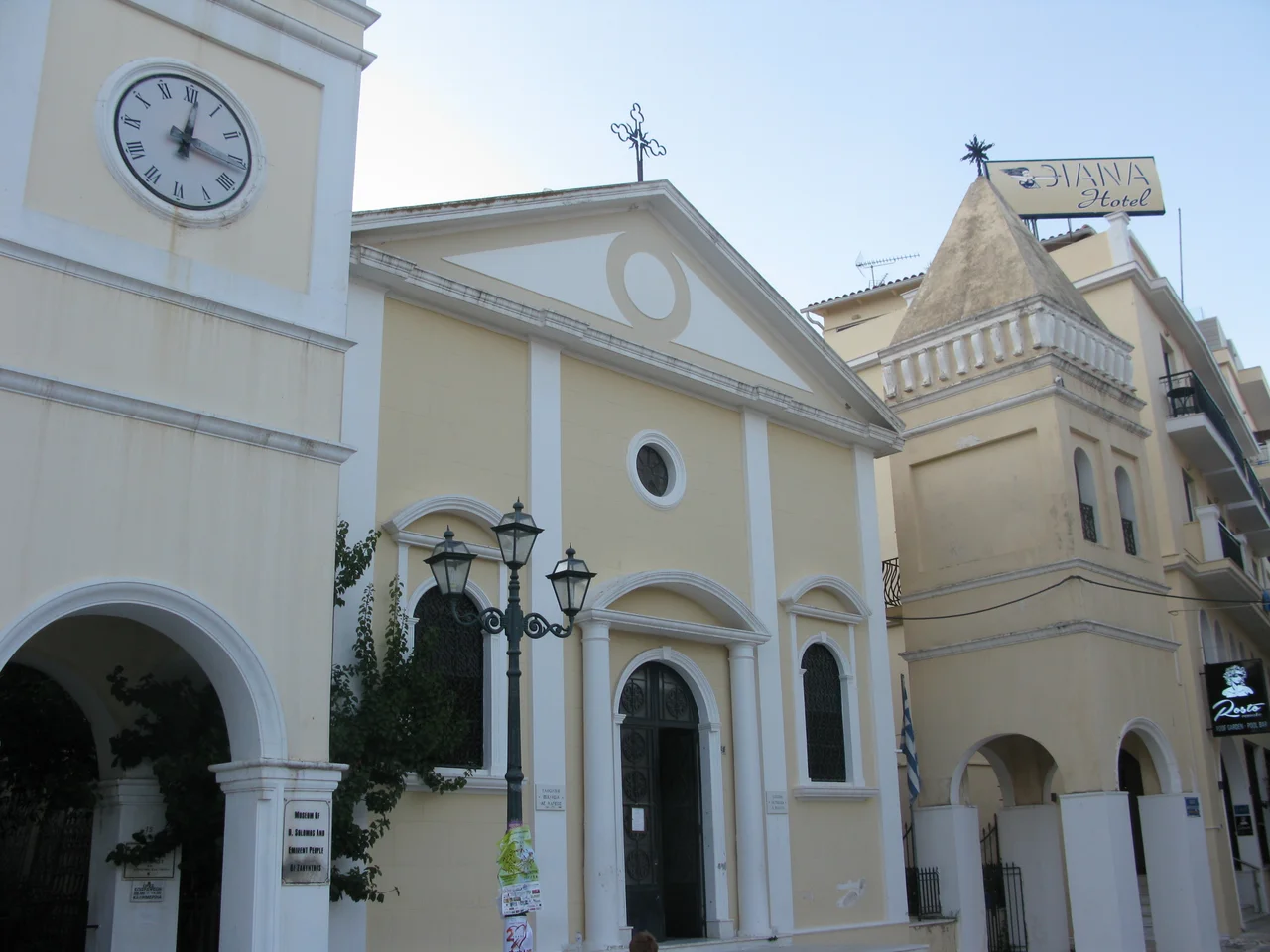

St. Mark's Roman Catholic Church
St. Mark's Square in Zakynthos town is not, despite the name, in Venice. But the connection is not accidental. Zakynthos spent four centuries under Venetian rule, and the Catholic community that Venetian settlers established here did not vanish when the Republic of Venice did. They built a church on their square — dedicated, naturally, to their patron saint — and over the centuries it became what those who saw it called a jewel of the island. Then, on August 12, 1953, the earthquake and the fire that followed took it. The church that stands on St. Mark's Square today is the second version: rebuilt in the 1960s to look as much like the first as memory and photographs could manage, holding a handful of things that the fire could not consume.
Five Centuries on the Square
The original Saint Mark's Roman Catholic Church was constructed in 1518, in the first decades of Zakynthos's absorption into the Venetian Republic. Zakynthos had passed permanently to Venice in 1482; by 1518 the Venetian presence was well established, and the Catholic community had both the need and the resources for a proper church.
The building was not static. Major rebuilding took place in 1747, and again in 1894. Each renovation reflected the community's continued presence and investment. By the time the 20th century arrived, the church housed a large pipe organ, valuable relics, artistic candlesticks, fine priestly vestments, and statues of the saints. Near the church stood a building that contained a library and a photo gallery — a small cultural center for the Catholic community of the island. All of it was considered, as one description put it, a jewel of the island.
The Night of August 12, 1953
The 1953 Ionian islands earthquake struck with a surface wave magnitude of 7.2. The maximum intensity on Zakynthos was rated Extreme. Buildings across the southern islands collapsed. On Zakynthos, fires broke out in the rubble and burned through what the shaking had not already destroyed.
Saint Mark's Church did not survive. The library and the photo gallery beside it were lost to the fire. The pipe organ, the relics, the vestments, the candlesticks — almost everything inside was gone. The earthquake levelled or severely damaged virtually every structure in Zakynthos town. The island, when the fires were out, had to decide what to rebuild and how.
Of all the statues inside the church, two survived: the statue of Saint Mark himself, and a statue of Saint Paraskevi. How they came through the fire and structural collapse is not recorded in the sources. They were there afterward, intact, waiting.
Rebuilt in Its Own Image
In the 1960s, construction began on a new Saint Mark's. The goal was fidelity to the original exterior appearance — to rebuild the church that had stood there rather than replace it with something new. The exterior preserved much of what had characterized the Venetian-era church. The marble slabs from the old building, salvaged from the ruins, were laid as flooring in the new one.
The surviving statues of Saint Mark and Saint Paraskevi were installed in the rebuilt church. Two large candlesticks flanking Saint Mark's pedestal, the Holy Cross, and a small marble baptismal font — all carried over from the original — gave the new interior a continuity with what had been lost. In 1994, a further renovation updated the floor, the altar, the pulpit, the statue pedestal, the monstrance base, the lighting, and the furniture. The church that stands today is the result of all those accumulated decisions: rebuilt, renovated, and still serving the Catholic community of Zakynthos.
A Minority Faith on a Greek Island
Zakynthos is overwhelmingly Greek Orthodox — as are the other Ionian Islands. But the Venetian centuries left a residue. Catholic communities, descended from Venetian settlers and later arrivals, maintained their own churches and their own religious traditions through the subsequent centuries of British rule, Greek unification, and the upheavals of the 20th century. Saint Mark's is the only Catholic church on Zakynthos bearing that name, and it stands as a material marker of that layered history: a Venetian patron saint, on a Venetian square, in a Greek town, rebuilt after a Greek earthquake, still in use.
The church is small by the standards of what once stood here, and quieter than the Orthodox churches nearby. But it occupies its square with the same composed presence it has maintained, in one form or another, since 1518 — longer than the Venetian Republic itself lasted after that first stone was laid.
From the Air
Saint Mark's Roman Catholic Church is located at approximately 37.79°N, 20.90°E in the center of Zakynthos town on the island's eastern coast. LGZA (Zakynthos 'Dionysios Solomos' Airport) is approximately 6 kilometers to the southwest, making this one of the closest story sites to the airport in this cluster. Approaching LGZA from the east, the Zakynthos town waterfront and its main square are visible below on descent. The church itself is too small to identify from cruise altitude, but the distinctive grid of the rebuilt town — reconstructed after 1953 in a more regular street pattern than the medieval original — is clear from above, a subtle aerial record of the earthquake's total destruction and the island's methodical rebuilding.
Nearby Stories
- Battle of Prinitza 6.2 km away
- Santameri Castle 12 km away
- Strofades 22 km away
- County Palatine of Cephalonia and Zakynthos 23 km away
- Chavriata 24 km away
- Lepreum 25 km away
- Hellenic Trench 36 km away
- Valletta 551 km away