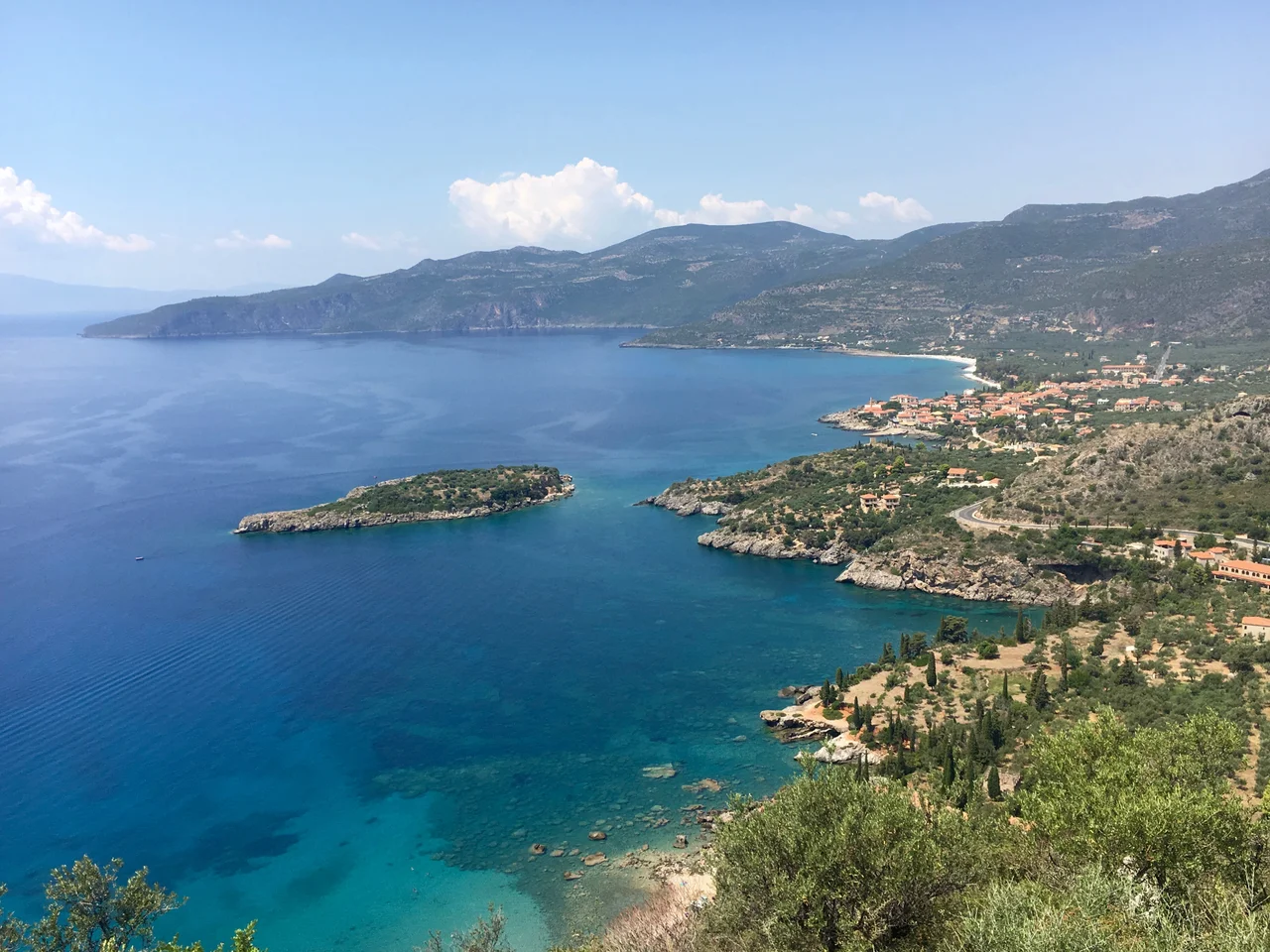

Kardamyli
Homer put this village in the Iliad. In Book 9, when Agamemnon is trying to lure the sulking Achilles back into the Trojan War, he offers him seven cities as a bride price for his return — and Kardamyli is one of them. The village has kept its ancient name through every empire that followed: Byzantine, Venetian, Ottoman, modern Greek. That continuity is not an accident. In the Mani, names and bloodlines persist because the terrain makes persistence possible and outside authority difficult.
Stone and Tower
Kardamyli sits at the foot of the Taygetus mountains where they meet the Messenian Gulf, on a coast built partly over a prehistoric lava flow still visible as igneous rock formations reaching into the sea. The old town — Pano Kardamyli, or Upper Kardamyli — rises above the harbor in the layered style typical of the Mani: thick-walled tower houses built by scions of the Nikliani clans, the medieval aristocracy of the peninsula, set among buildings from the Venetian period that blend traditional Greek construction with Italian detail. The Church of Saint Spyridon, inside the fortified compound of the Mourtzinoi-Troupakis clan, was built in the eighteenth century using material salvaged from ancient and Byzantine structures. The medieval castle and its outworks still stand. Nearby, hikers trace mountain paths into the Taygetus, some climbing all the way to the summit of Profitis Ilias — Prophet Elias, the local name for the peak. The Viros Gorge, twenty kilometers long, begins close to the village; dry in summer, it floods dramatically in winter when snowmelt and mountain rain pour down together.
A Town With Long Memory
Many residents of Kardamyli can trace lineage to the great clans of the area — the Mourtzinos and Troupakis families among them — or to the line of the Byzantine Emperor Constantine Palaiologos, one of whose descendants, Dimitri Palaiologos, settled in the region centuries ago. His descendants typically carry the surname Dimitreas, meaning "son of Dimitri." This kind of genealogical memory is characteristic of the Mani, where isolation preserved social structures that elsewhere dissolved. The ancient tombs believed to belong to the Dioskouri — Castor and Pollux, the Gemini twins of Greek myth — are said to lie near a hiking trail above the old town. A ruined soap factory, its smokestack still visible on the skyline, marks the town's more recent industrial past. The old customs house at Saint John's harbor, now privately converted, recalls a time when Kardamyli was a working port as well as a fortified hillside settlement.
The Writer Who Stayed
Patrick Leigh Fermor arrived in the Mani in the 1960s and eventually built a house in the village of Kalamitsi, just outside Kardamyli, with his wife Joan. He had earned a connection to Greece the hard way: during World War II he fought with the Greek Resistance, living in the mountains of Crete and taking part in the abduction of a German general. Greece made him an honorary citizen of Kardamyli for that service. He stayed for the rest of his long life, writing at a desk in the garden above the sea, finishing books about travel and memory and a vanishing Europe. In 1989, the ashes of another writer, Bruce Chatwin, were scattered near a Byzantine chapel above the village — Chatwin had been one of Fermor's admirers and a frequent visitor. The writers chose this place for a reason the Iliad might have recognized: it rewards the kind of attention that sees through the present into something older.
Climate and Coast
Kardamyli's weather is Mediterranean in the fullest sense — long, dry summers with temperatures that commonly reach 32 to 35 degrees Celsius, winter rains that can be heavy, and almost no snow in the town itself, though the Profitis Ilias peak typically holds its snowcap until early June. The Meltemi wind that cools much of Greece in summer is largely blocked by the Taygetus, leaving the sea below unusually calm, often glassy in the mornings before the afternoon sea breeze arrives. In recent decades the climate has shifted noticeably, with summers more humid and tropical plants — mango, avocado, lychee — appearing in local gardens alongside the olives and jasmine that have always been here. The coast changes slowly, but it changes.
From the Air
Kardamyli sits at 36.887°N, 22.232°E on the coast of the Messenian Gulf, with the Taygetus mountains rising steeply to the east. Kalamata International Airport (LGKL) lies approximately 28 km to the north-northwest; approaching from there, the transition from the broad Kalamata plain to the narrowing coastal strip of the Mani is visible. At 3,000 to 5,000 feet, the tower-house silhouette of the old town is discernible against the hillside above the harbor. The Viros Gorge opens to the northeast of the village, a dramatic slash in the mountain face that is particularly visible in winter when the gorge floor is flooded.
Nearby Stories
- Barony of Gritzena 0.3 km away
- Metamorfosi, Laconia 6.2 km away
- Methoni, Messenia 8 km away
- Leonidio 8.4 km away
- Kladas 9.6 km away
- Battle of Cape Spada 124 km away
- Siege of Chania (1645) 192 km away
- El-Kouf National Park 428 km away