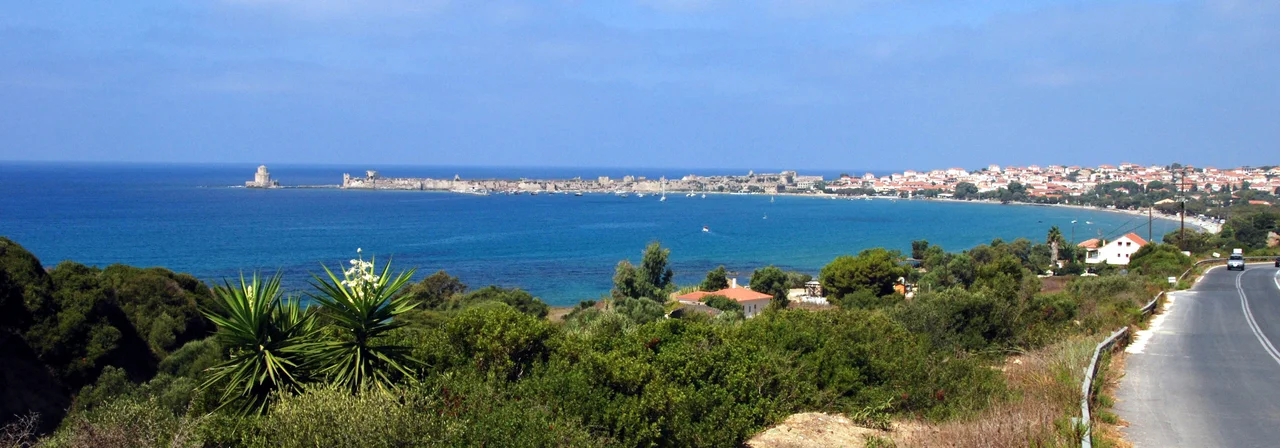

Methoni, Messenia
In the Iliad, Agamemnon offers the city of Pedasus to the furious Achilles as one of seven well-peopled cities worth his forgiveness. Pedasus is Methoni — or at least the town that would become Methoni — and if the offer seems extravagant, a glance at the geography explains it. The village sits on a promontory at the southwestern tip of the Peloponnese, sheltered by a cluster of islands that calms the harbor, positioned at a crossroads between the Adriatic and the eastern Mediterranean that made it strategically irresistible to every maritime power in European history. Today it has a population measured in hundreds rather than thousands, its beaches draw summer visitors, and the great fortress that dominates the headland is free to explore. The weight of everything that happened here is not always visible. But it is there.
Agamemnon's Bequest
Methoni's antiquity is not merely claimed — it is documented across millennia. Homer mentioned it. Pausanias, the second-century geographer, knew it as Mothone, named either after the daughter of the hero Oeneus or after the protective rock that shelters the harbor. He recorded a temple to Athena Anemotis there. A Roman historian, Ammianus Marcellinus, noted that the catastrophic earthquake of AD 365 hurled ships nearly two miles from the shore, citing specifically a Laconian vessel stranded near the town of Methone — evidence that the harbor's importance long predated the Venetians. The town gained independence from Spartan control along with the rest of Messenia in 369 BC. It was a bishopric during the Byzantine centuries, retaining what the sources describe as a remarkable harbor that kept it among the most important cities in the Peloponnese. The Oinoussai Islands — Sapientza, Schiza, and Santa Marina — form a natural breakwater to the west and south, protecting the anchorage from the turbulent open sea.
The Venetian Zenith
The Republic of Venice had watched Methoni with interest since the twelfth century, understanding that whoever controlled this harbor controlled the staging point between Italy and the eastern trade routes. In 1125 they sent a fleet to clear pirates based here who had seized Venetian merchants. It was not until the chaos following the Fourth Crusade that Venice actually acquired the town — in 1206 or 1207, their fleet arriving in the wake of the Crusader conquest of the Peloponnese. In the Treaty of Sapienza of 1209, rival claims were settled, and Methoni, which the Venetians called Modon, began its long rise. Under Venetian rule the town became a hub for trade with Egypt and the Levant. Pilgrims heading to the Holy Land stopped here, leaving accounts of its bustling port. By the fourteenth century, its population was mixed: Greeks, Jews, Albanians, and Latins living alongside one another. The Muslim geographer al-Idrisi had already noted it as a fortified town with a citadel in the mid-twelfth century, before Venice arrived.
Conquerors and Converts
What the Venetians built, others eventually took. On 9 August 1500, Sultan Bayezid II arrived in person to supervise the siege, which lasted 28 days. When Methoni fell, its population was either killed or enslaved. The Venetians returned in 1686 under Francesco Morosini during the Morean War; a census taken shortly afterward found only 236 inhabitants, a measure of how thoroughly the region had been emptied. The second period of Venetian rule ended in 1715, when the Grand Vizier Damad Ali Pasha invaded. As his troops besieged the town, the situation turned brutal: the Grand Vizier ordered the killing of all Christians inside, and many residents converted to Islam on the spot to save their lives. The fortress changed hands again in 1828, when French forces of the Morea Expedition arrived. They stayed until 1833, then handed the keys to the newly established Kingdom of Greece. By that point, the town had been besieged, sacked, repopulated, depopulated, and resettled so many times that its survival as any kind of community seems remarkable.
The Writer in the Tower
Methoni attracted visitors who later wrote about it, some willingly and some not. After the Battle of Lepanto in October 1571, Miguel de Cervantes — who had fought in that battle and lost the use of his left hand — is said by local tradition to have been taken to Methoni and spent time in a Turkish tower within the fortress walls. Historians note that Cervantes was not captured until 1575, four years after Lepanto, and was held in Algiers; but the local account holds that he might have conceived a few pages of Don Quixote there. François-René de Chateaubriand arrived in considerably better circumstances on 10 August 1806, disembarking to begin a grand tour across Greece and the Middle East, later published as the Itinéraire de Paris à Jérusalem. And the painting Young Knight in a Landscape by Vittore Carpaccio may — under one scholarly interpretation — depict Marco Gabriel, the Venetian rector who governed Methoni during the Ottoman siege of 1500. He was the only Venetian survivor. The Ottomans took him to Constantinople, where he was beheaded on 4 November 1501. His family may have commissioned the portrait as a memorial.
The Village at the End of the Road
Methoni today is the southern terminus of Greek National Road 9, which runs from Patras through Kyparissia before arriving here. The road, in that sense, ends at the sea. The village itself — part of the municipality of Pylos-Nestor since Greece's 2011 administrative reform — is modest in scale but rich in what surrounds it: the beaches of Tapia, Kokkinia, and Kritika draw visitors in summer, and the castle dominates the headland with the same physical authority it has held for centuries. The islands offshore still shelter the harbor. The stones of the castle still carry Venetian lion carvings on their faces. And in the evenings, when the light comes across the water from the west, the fortress on its cape looks exactly like something Agamemnon might have wanted to offer as a gift — if you were important enough, and if the anger was large enough to require it.
From the Air
Methoni sits at approximately 36.8217°N, 21.7069°E on the far southwestern tip of the Peloponnese peninsula. From the air, the town is identifiable by its promontory location and the large medieval castle jutting into the sea, with the small island group of Oinoussai (Sapientza, Schiza, Santa Marina) visible offshore to the west and south. Recommended viewing altitude: 3,000–5,000 feet offers the full panoramic context of the bay, the castle headland, and the island shelter. The nearest major airport is LGKL (Kalamata International Airport), approximately 55 km to the northeast. The area lies at the junction of the Ionian and Mediterranean seas; visibility is generally excellent in clear weather.
Nearby Stories
- Kardamyli 10 km away
- 1886 Peloponnese Earthquake 11 km away
- Vergadeika 18 km away
- Strofades 20 km away
- 2018 Ionian Sea Earthquake 91 km away
- Battle of Cape Spada 171 km away
- Siege of Chania (1645) 245 km away
- Valletta 595 km away