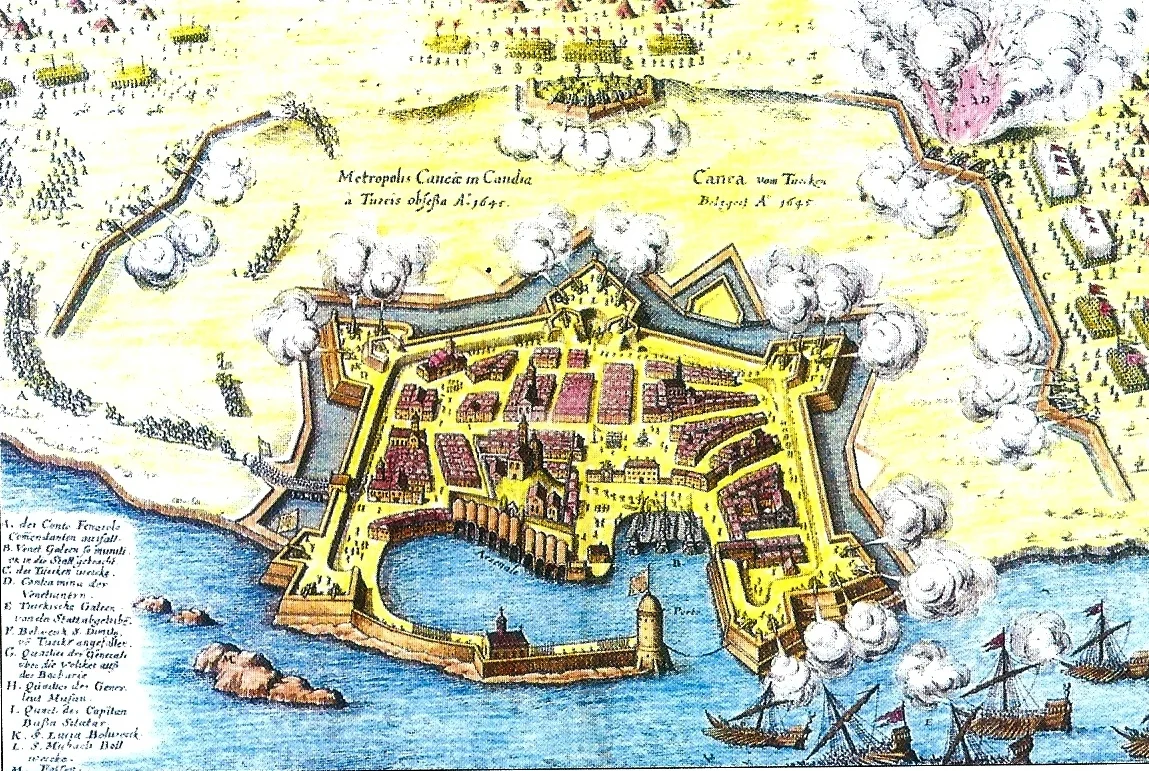

Siege of Chania (1645)
Silahdar Yusuf Pasha sailed from Istanbul on April 30, 1645, at the head of 416 ships and roughly 50,000 men, including 7,000 janissaries. He stopped at the Venetian island of Tinos for water and provisions, then put in at Navarino for three weeks, picking up Tripolitan and Tunisian fleets along the way. Venice watched the assembly with growing alarm and concluded, almost certainly correctly, that the target had to be Malta. It was not Malta. Yusuf revealed the true destination to his commanders only after the fleet had sailed again, and on June 23 the Ottoman armada appeared in the bay of Chania on the northwest coast of Crete. The war that opened that morning would last 24 years.
The Lighthouse Keeper Who Blew Himself Up
The first action took place at Agioi Theodoroi, a small island guarding the approach to Chania. Defending it was the Venetian commander Blasio Zulian, with 30 men and a few poor cannons. They held off the first ships and managed to sink two of them. When it became obvious the position was lost, Zulian set off the powder magazine, blowing up himself, his men, and the fortress in one ferocious flash. The Ottomans took what was left of the rock and pressed on. The act has been remembered ever since in Cretan accounts of the siege as the kind of resistance that defined the Venetian-held century: outnumbered, doomed, defiant to the last detonation.
Around the Walls
The Ottomans landed on June 27, encamping on the hillsides above the city and seizing the harbor. They put 7,000 janissaries ashore, plus 14,000 Sipahi cavalry, 3,000 sappers, and thousands of Timariot horse. The Venetian garrison numbered around 12,000, but it was an inadequately trained militia drawn hastily from the surrounding population. Cannon batteries went up at Constantine Hill, where the Rumelia Beylerbeyi Hasan Pasha and the Sanjakbeys of Krusevac, Vlore, and Ilbasan took up positions with seven batteries and the janissaries of Murad Aga. Heavy fighting on July 9 saw the Ottoman commander Hassan Agha killed leading an assault that nonetheless routed Venetian defenders and killed more than fifty. On July 17, Venetian soldiers driven into the sea were killed or captured.
Surrender on the Fifty-sixth Day
The defenders held for 56 days. On August 22, the Venetian command surrendered. The terms were generous by the conventions of the era: the garrison was allowed to march out unharmed for Souda, four days later the Ottomans entered, and the city itself was spared the worst of a sack. Twelve galleys in the arsenal fell into Ottoman hands. The Church of Saint Nicholas and two other churches were converted to mosques. Yusuf Pasha left a garrison of 8,000 men. The news reached Istanbul to three days of cannon-fire celebrations. It reached Zakynthos on August 30, just as a relief fleet of Tuscan, Spanish, Papal, and Maltese ships was preparing to sail. They sailed too late.
The Relief That Came When It Could Not Help
Niccolo Ludovisi, the papal captain-general, commanded the Christian relief fleet. By the time he reached the area, Chania was already Ottoman. Modern historians have argued that a vigorous attack on the newly-installed garrison might still have saved Crete from the long catastrophe that followed; instead, Ludovisi ordered a retreat to Souda. The Christian forces did mount an attack on Chania on October 1, but it failed. The opportunity was gone. The Cretan War would now grind on through the siege of Rethymno, the long agony of Candia (modern Heraklion) which the Ottomans besieged for 21 years from 1648 to 1669, and a sequence of naval actions that left Venice exhausted and the Mediterranean balance permanently changed.
What the Surrender Bought
For the residents of Chania, what mattered was who they would now answer to. Many Greek Orthodox Cretans had long resented Venetian rule and the Latin Church, and the Ottoman administration brought a kind of religious accommodation absent under Venice. Many converted to Islam in the decades that followed, and the city's population mixed Greek Orthodox, Muslim Cretan, and Sephardi Jewish communities through the next two and a half centuries. The city walls Yusuf Pasha breached are still there, lining the harbor where the Venetian lighthouse marks the old entrance. The minaret of the Kucuk Hasan Mosque, built shortly after the conquest, rises beside it. The mosque is now an exhibition hall. The lighthouse, rebuilt by Egyptians in the nineteenth century when Crete briefly belonged to Mehmet Ali, still works. Walking the harbor today, you cross every layer of the fight.
From the Air
Chania sits at 35.52°N, 24.02°E on the northwestern coast of Crete. The Venetian harbor with its distinctive curved breakwater and lighthouse marks the historic city core. Chania International Airport "Daskalogiannis" (ICAO: LGSA) is 14 km east on the Akrotiri peninsula, sharing facilities with the Souda naval base. Best viewed from 3,000-5,000 ft, looking at the old city walls and harbor. The Agioi Theodoroi islets, where Blasio Zulian made his stand, lie about 12 km west of the city.
Nearby Stories
- Arkadi Monastery 3.1 km away
- Emirate of Crete 41 km away
- Minoan Palaces 74 km away
- Siege of Melos 96 km away
- The Eruption of Thera: The Volcano That May Have Destroyed Atlantis 97 km away
- Monemvasia Mosque 102 km away
- Monemvasia 129 km away
- Battle of Derna (1805) 298 km away