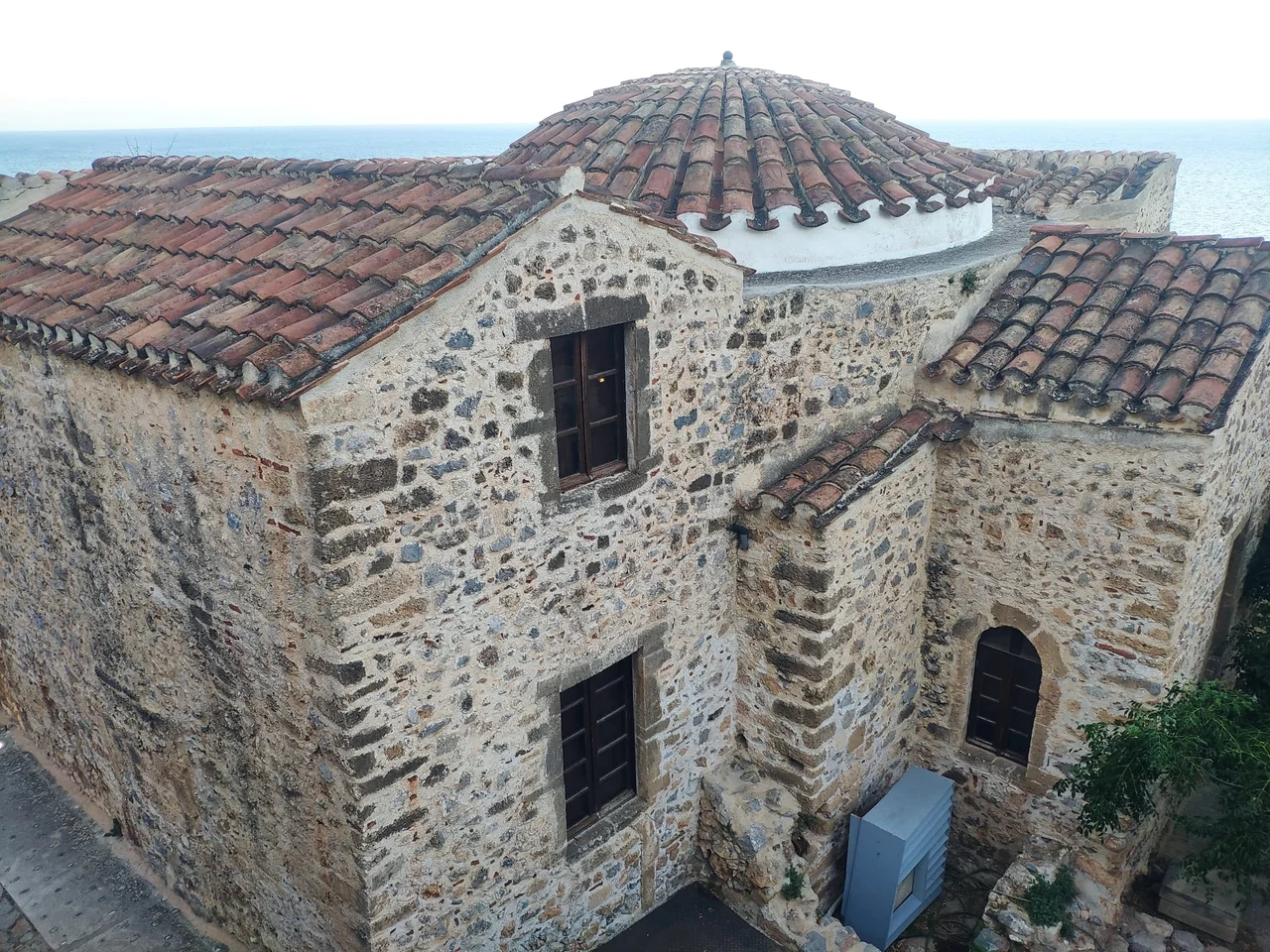

Monemvasia Mosque
It sits directly across the square from the Metropolitan Church of Christos Elkomenos, the two buildings facing each other like competing arguments about what this town belongs to. The mosque was built in 1540, within months of the Ottoman conquest of Monemvasia, on the south side of the central square of the lower town. The church beside it is Byzantine. The square between them is medieval. The accumulation is very Monemvasia: a place where time does not erase its previous occupants so much as layer them, one civilization on another, each leaving something in the stone.
The Ottoman Conquest and the Building That Followed
Monemvasia had been under Venetian control when the Ottomans arrived in November 1540. The Republic of Venice, which had held the town since 1464, surrendered it to Ottoman forces, and within a short time the new rulers erected a mosque south of the central square of the lower town. The location was deliberate — it placed the symbol of the new faith directly opposite the most prominent Christian church in the settlement.
Local tradition holds that the mosque was built on the site of a sixteenth-century Venetian church dedicated to Saint Peter, who had served as bishop of Monemvasia in the eighth century. Archaeological examination has not confirmed this: no clear structural evidence of a prior church has been found in the lower portions of the building. The historian Charis Kalliga has proposed that an unfinished Venetian loggia — an open-sided colonnaded hall — is a more likely predecessor on the site. The question remains open, which is perhaps appropriate for a building that has been so thoroughly remade by successive occupants.
Five Centuries of Changing Use
The building's biography since 1540 tracks the political history of Monemvasia with unusual fidelity. During the second period of Venetian rule, from 1690 to 1715, the former mosque was converted into a hospice, possibly on the initiative of Capuchin monks, or possibly into a church dedicated to Saint Anthony of Padua. When the Ottomans returned in 1715, it reverted to Muslim worship and remained a mosque until Greek independence in 1821.
The British diplomat Thomas Wyse attested that after independence the building served as a prison — a use that says something about how post-independence Greece dealt with the physical remains of Ottoman occupation. By the early twentieth century, when the architect and historian Ramsay Traquair visited, the place had become a café. It is hard to imagine a more complete set of repurposings: mosque, hospice or church, mosque again, prison, café. The building itself, having survived all of this, was restored and opened in 1999 as the home of Monemvasia's archaeological collection.
What the Building Still Shows
The architecture is difficult to read clearly, which is understandable given five centuries of successive reconstruction. What survives is a square prayer hall with an interior side of 6.5 metres, a rectangular extension to the west, and a two-storey room on the north side that now serves as a reception area. The mihrab — the prayer niche indicating the direction of Mecca — has not been preserved. Neither has the porch. The dome, originally 8.5 metres tall, rests on four squinches, the curved masonry inserts that transition a circular dome to a square base. The minaret that once stood at the southwest corner was subsequently destroyed.
The building is compact and, in its current form, quiet. The dome imposes a sense of vertical space disproportionate to the floor plan. Standing inside it now, surrounded by marble fragments of a twelfth-century church and ceramics from the early Christian period through the Ottoman era, the visitors find themselves in a museum that is also itself an exhibit — a building whose biography encompasses almost every political identity Monemvasia has ever held.
What the Museum Holds
The archaeological collection housed in the former mosque spans roughly fifteen centuries. Marble remains from a twelfth-century church share space with sculpted architectural elements from the church of Hagia Sophia — the Byzantine church that still stands in Monemvasia's ruined upper town. Ceramics and everyday objects from the early Christian period through the Ottoman occupation fill the display cases. The 5th Ephorate of Byzantine Antiquities, which oversees archaeological work in the region, maintains offices in the building as well.
The collection is small by the standards of major Greek museums, but it is unusually coherent — almost everything in it came from this rock, this town, these centuries of occupation. It is a local record rather than a general survey, and the building that houses it has the same quality: specific, layered, particular to this place.
From the Air
The Monemvasia Mosque stands in the lower town of Monemvasia, on the rock that juts into the Myrtoan Sea at 36.687°N, 23.055°E. From the air, the lower town's dense medieval roofscape is visible below the cliffs of the upper town. The tombolo causeway connecting the rock to the mainland is clearly legible. The two buildings facing each other across the central square — the mosque and the Byzantine church — are too close together to distinguish from altitude, but the square itself is one of the few open spaces in the lower town's compressed urban fabric.
From the Air
The Monemvasia Mosque is located in the lower town of Monemvasia at 36.687°N, 23.055°E, on the rock connected to the eastern Peloponnese coast by a 400-metre tombolo. Nearest major airport: LGKL (Kalamata International), approximately 90 km northwest. Recommend 2,000–3,500 ft to appreciate the rock's dramatic geography and the lower town's layout. The causeway connecting the rock to the mainland is a distinctive navigational feature.
Nearby Stories
- Agios Vasileios — Mycenaean Palace of Laconia 7.5 km away
- Alepotrypa Cave 11 km away
- The Slamat Disaster 17 km away
- SS Heraklion 57 km away
- Agios Georgios (island) 71 km away
- Battle of Cape Spada 79 km away
- Siege of Chania (1645) 132 km away
- Temple of Zeus, Cyrene 401 km away